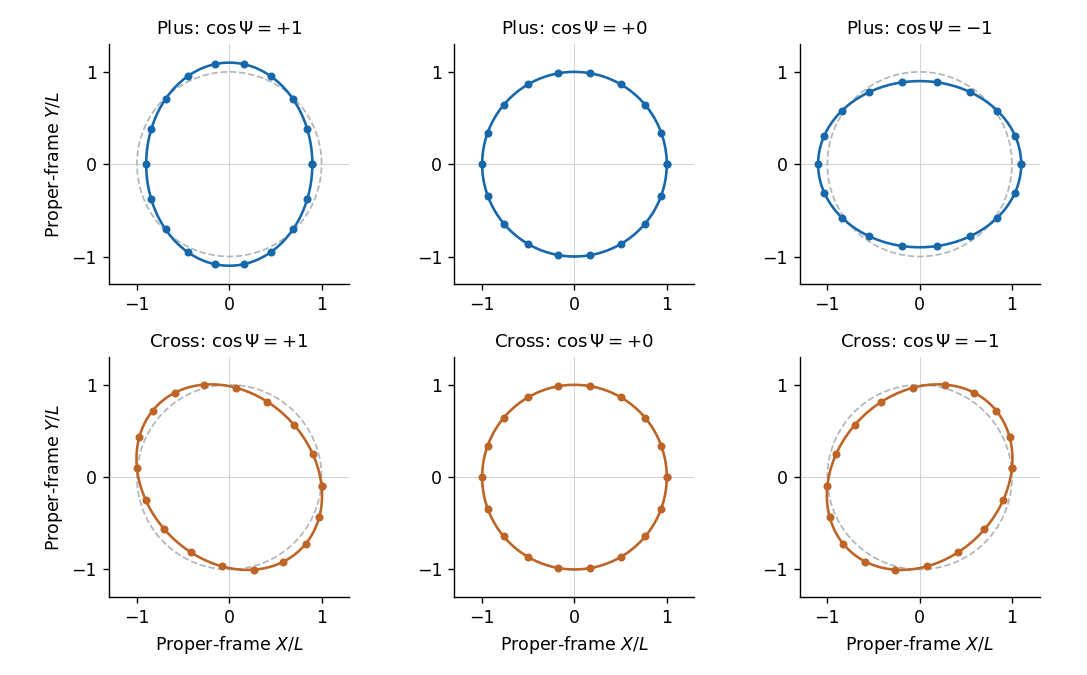
For the supplied plus polarization, the perturbation is traceless, so . At a fixed longitudinal coordinate , put . With the convention chosen above, the transverse spatial metric measuring positive squared lengths isThe initial coordinate separation is and remains constant in transverse-traceless gauge: implies , so initially stationary particles stay at fixed spatial coordinates. Their measured proper length is insteadThe first expression is understood within the linearized metric; only its first-order expansion is controlled. Separation along the two transverse axes varies oppositely; at degrees there is no first-order length modulation. This is the angular response of a gravitational-wave separation, despite constant coordinate separation.
If the background is instead chosen as while keeping the same numerical spatial amplitude, the displayed length modulation has the opposite sign. The question does not state a signature here; the convention above agrees with its earlier explicitly specified Minkowski metric. The physical alternating stretch-compress pattern is unchanged by consistently redefining the signed amplitude.

Articles by others on the same topic
There are currently no matching articles.