Use angular size under a collinear relativistic boost. For a small distant source, the two angular diameters have ratio , where is the relative rapidity. Thus , and the relative velocity satisfiesThe speed is therefore . The observers are momentarily coincident, so this is relativistic aberration, rather than a difference in their distance from the planet. The observer moving faster towards the planet measures the smaller angular diameter under the source-direction aberration convention.
The metric tensor and its inverse are diagonal: , , , on a patch where . Only is nonzero. The Christoffel symbol formula therefore giveswith all other components zero. Using the stated Riemann curvature tensor convention,so . This is the curvature of a two-dimensional warped metric; its Gaussian curvature is .
For a grazing null geodesic, take the impact parameter as . The leading Schwarzschild light deflection isWith the gravitational constant and speed of light ,Here , so the weak-field approximation is appropriate. A ray passing at a larger impact parameter has a correspondingly smaller deflection.
A fundamental observer follows the coarse-grained cosmological matter, with fixed comoving coordinates. The cosmological principle asserts spatial homogeneity and cosmological isotropy on large scales for this family of observers. A moving observer generally sees a preferred direction, for example a Doppler dipole in the cosmic microwave background, even when the underlying cosmology is isotropic.
In an FLRW metric, these worldlines are orthogonal to homogeneous spatial slices. Synchronize their clocks to define cosmic time , which is their proper time. Along a fixed spatial label, , giving . Orthogonality of the spatial coordinate directions to the observers' four-velocity gives . Thus, in the metric signature,where the spatial matrix is negative definite. Spatial homogeneity and cosmological isotropy further restrict it to , with a constant-curvature spatial metric.
For radial motion, use the geodesic LagrangianThe Euler-Lagrange equation for gives . Since is a cyclic coordinate, its conjugate momentum is constant. HenceFor a massive particle, take as proper time; the four-velocity normalization is . For a photon, use an affine parameter rather than proper time, and the corresponding tangent is a null vector. ThereforeThe normalization of the null affine parameter remains arbitrary.
Choose the null affine parameter so that the photon tangent is its four-momentum . A fundamental observer has in cosmic-time coordinates, so the measured energy is . The null normalization and conserved radial quantity in part (b) giveThus redshifting of peculiar momentum gives . Since , with the Planck constant, the received-to-emitted frequency ratio is . By the definition of cosmological redshift,
A nearby fundamental observer measures radial proper distance and proper time . Thus the signed radial peculiar velocity isSubstitute and the massive normalization from part (b):Equivalently, for velocity at scale factor ,This is the exact law of redshifting of peculiar momentum. In the nonrelativistic limit, ; an initially relativistic speed stays below and decreases as the universe expands.
Write . In the equatorial plane, the geodesic Lagrangian is . The cyclic coordinates and give the conserved quantitiesThe squared tangent norm is constant along an affinely parametrized geodesic, since metric compatibility gives . HenceFor a massive particle parametrized by proper time, ; a photon has a null tangent, so . This denotes the tangent norm, not the photon's physical energy. A future-directed exterior photon has , proportional to its positive Killing energy. Its affine parameter can be rescaled, so there is no mass-shell normalization fixing to a particular positive value.
Set in part (a), substitute the two conserved quantities, and multiply the normalization by :Consequently the null effective potential in Schwarzschild spacetime isOnly radii where the total radial energy is at least this effective potential are accessible.
For , the effective potential vanishes at , rises to a maximum, and then falls to zero as . Its derivative is , so the only circular null geodesic hasThe second derivative there is , proving instability by the effective potential stability criterion. These circular orbits make up the photon sphere. If the formula is continued inside the horizon, the potential is negative and diverges to as . For purely radial light, , the potential is identically zero and there is no circular orbit.
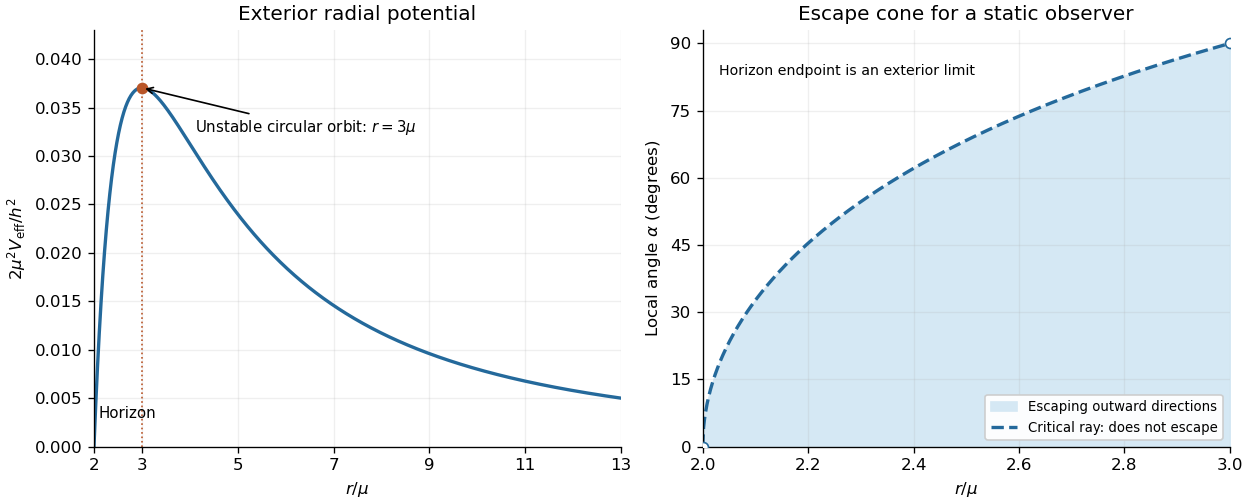
Schwarzschild null radial potential and the static-observer escape cone inside the photon sphere
. Original dimensionless plots. The left panel shows the exterior potential and its maximum at ; the right panel shows the critical escape half-angle for . The horizon endpoint is a limit of exterior static observations. Details.
A photon arriving from infinity crosses the barrier precisely when exceeds the maximum in part (c):At infinity its spatial tangent has speed in affine-parameter units , while is its angular momentum per unit affine normalization. A straight asymptotic ray with impact parameter therefore has . ThusAt equality, the incoming ray approaches the unstable photon sphere asymptotically and is not captured. A larger impact parameter gives an outer turning point and scattering back to infinity.
Measure in the orthonormal tetrad of a static observer at . This specifies the local frame needed to define an angle. If is the conserved photon energy, gravitational redshift gives . The tangential local momentum is , so the impact parameter isInside the photon sphere, an outward ray must have to cross the potential barrier. The Schwarzschild photon escape cone therefore has critical half-angleThe upper bound is strict: a critical ray only approaches the circular orbit. At , the critical half-angle is , and exactly tangential light is circular. As , the cone shrinks to zero opening. No static observer exists exactly on the Schwarzschild event horizon, and no future-directed photon emitted there escapes to exterior infinity; the zero-angle result is an exterior limit.
At any event on a massive observer's worldline, choose an orthonormal tetrad with timelike basis vector . Its components obey , so locally : the Minkowski metric. A local inertial frame can also remove the Christoffel symbols at that event. Curvature cannot be removed on a finite region, and a frame following an accelerated observer need not remain inertial in its neighbourhood.
In general coordinates, labels the trajectory, while the four-velocity and four-acceleration areCoordinate values are not themselves a vector under arbitrary nonlinear coordinate changes; their tangent is. For fixed rest mass , the four-momentum is and the four-force is . With the metric signature,where is the proper acceleration. The middle identity follows by differentiating the constant velocity norm; in the instantaneous rest frame, and , proving the last identity.
The inverse transformation is , . ThusThe metric tensor in these light-cone coordinates is thereforeBoth off-diagonal entries are needed, since the quadratic line element sums over both index orders.
The Lorentz transformation is , in units . Adding and subtracting givesSince and the other factor is its reciprocal,Here is the boost rapidity. Their product is unchanged, as required by invariance of the Minkowski interval.
The proper time normalization of the astronaut's four-velocity gives . In the light-cone coordinates this isThe four-acceleration has squared norm , because is the constant proper acceleration. The same coordinate change therefore givesEquivalently write , . Their second derivatives give , so the rapidity form of one-dimensional proper acceleration makes , with sign fixing the acceleration direction.
For the stated outward-accelerating hyperbola, take positive signed proper acceleration and an initially stationary spaceship. Then , so and . The initial values are , . Integration givesTaking their half-sum and half-difference yields the hyperbolic motionThe printed position data alone do not specify the initial velocity. If the initial rapidity is an arbitrary , the equally valid positive-acceleration solution isThus the requested special expression implicitly selects .
Use the specified hyperbolic trajectory. The emitted right-moving photon follows , so its retarded null coordinate is . Interception at astronaut proper time requiresThe astronaut has velocity relative to the star and . The collinear relativistic Doppler effect givesThis is the Doppler shift for a uniformly accelerated receiver. A finite reception time exists precisely when , so the limiting emission time is , approached from below. At the photon lies on the Rindler horizon and never reaches the astronaut. If reception is restricted to , the full emission range is ; for emission after , it is .
Take , , and the negative-norm convention for a timelike curve used by the printed metric. Writing and givesSpatial translation is a Killing vector field. Equivalently, the geodesic Lagrangian has the cyclic coordinate , so its conserved momentum isTherefore the correct first integral for this metric isThe first-integral assertion in the PDF is false. Its dimensionless square root requires , and even after setting it is missing the factor . For example, the nonvertical geodesics below have proportional to .
Set . Solving for the velocity, with increasing as the time orientation, gives . The complete unparametrized family of timelike geodesics of a quadratic-time conformal metric isEach curve is restricted to a connected positive- or negative- patch; is excluded because the metric becomes degenerate. For , , and the two independent constants are and . If an explicit affine parametrization is desired,while the vertical family has . A reversal of the time orientation reverses the parameter without changing these paths.
Put and . The contracted Bianchi identity and metric compatibility giveTaking the trace of the field equation in four dimensions gives . For , eliminate :Ordinary covariantly coupled matter obeys stress-energy conservation, . Its trace need not be constant, so the trace coefficient fixed by stress-energy conservation isThis restores the Einstein tensor and is the only coefficient compatible with arbitrary conventional matter without adding a new constraint or changing the matter conservation law. Other coefficients can work for specially restricted sources with constant trace, but do not give the same universal matter coupling.
The excluded case must be treated before dividing: its trace equation requires . If stress-energy is also conserved, its divergence equation requires . It can describe a restricted traceless-source sector with constant scalar curvature, not general matter such as ordinary dust. In particular it is not the general trace-free Einstein equation with source , which is a different equation.
Interpret the orbit in the Schwarzschild metric as an unforced circular timelike geodesic and choose its plane as . Put . The radial geodesic equation at constant radius uses the Christoffel symbolsand gives the Angular velocity of a circular Schwarzschild geodesicThe proper-time normalization then yieldsOver one revolution, the Proper period of a circular Schwarzschild geodesic is thereforeBoth the gravitational and orbital kinematic contributions to time dilation are included. Circular timelike geodesics exist for ; they are stable for and unstable for , with marginal stability at .
If “circular orbit” instead means a forced trajectory with an externally chosen angular velocity, the radius alone does not fix the answer. Its elapsed time is , or per revolution. The geodesic interpretation supplies the missing angular velocity.
For rest mass and electric charge , the generally covariant Lorentz force law isHere is the electromagnetic field tensor for the chosen electromagnetic four-potential normalization, and the covariant derivative includes the spacetime Levi-Civita connection. Antisymmetry of ensures , preserving the four-velocity norm and the particle's rest mass. An uncharged particle follows a geodesic.
Let a dot denote differentiation with respect to the five-dimensional affine parameter , and define . Use the quadratic geodesic LagrangianThe assumed independence of makes it a cyclic coordinate, so the corresponding Euler-Lagrange equation isSince , this givesGeometrically, this is the conserved momentum associated with the fifth-direction Killing vector field . It is the conserved fibre momentum underlying the Kaluza-Klein geodesic Lorentz force.
An affine geodesic has constant squared tangent norm, but that constant depends on the scale of its parameter. WriteUsing in the line element givesThe affine normalization in a Kaluza-Klein geodesic reduction matters: the specific formula requested in the paper uses , namely equal to the positive five-dimensional arclength. With that normalization,A timelike four-dimensional projection has , requiring in this normalization. At the projection is null and has no proper-time four-velocity. For an arbitrary affine parameter the first boxed relation, with retained, is the general result.
Differentiate the geodesic Lagrangian before substituting the conserved quantity. For a four-dimensional index ,Its Euler-Lagrange equation, together with and , isThus the sign of the projected Kaluza-Klein Lorentz force is fixed by the printed metric:The derivative order in the PDF's proposed equation is reversed. Its right-hand side is the negative of the result above for the stated and metric. This is not repaired by renaming the field tensor, because the two explicit derivative expressions have opposite signs. For example, , gives directly from the Lagrangian, whereas the printed expression gives the opposite. The corrected equation is used below.
Normalize the five-dimensional tangent as in part (c), and let . Since , one has , soSubstitution into the corrected equation in part (d) givesThis is the Lorentz force form in four-dimensional Minkowski spacetime. The effective charge-to-mass coefficient is proportional to the conserved fifth-direction momentum: in units and a potential normalization identifying with the electromagnetic four-potential, . The factor converting the geometrical to an SI potential fixes the physical charge units. Opposite signs of give opposite effective charges, and gives a neutral inertial projection. Antisymmetry gives .
This is a Kaluza-Klein theory mechanism: a higher-dimensional geodesic appears as forced motion after projection. With the explicitly supplied base signature, the positive fibre term gives a second positive direction in the five-dimensional metric. The derivation is a valid geometrical reduction of that metric; a conventional single-time spacetime would require a spacelike extra direction and corresponding sign changes. If one instead retains the sign printed in part (d), the inferred effective charge reverses, but that version is not the geodesic equation of the metric supplied here.
Use the metric signature and throughout this question. The trace-reversed metric perturbation satisfies , so its inverse relation isSet . Substituting this inverse relation into the linearized field operator cancels the second derivatives of the trace, leavingThe imposed Lorenz gauge in linearized gravity is . Therefore the Linearized Einstein equations in vacuum reduce toThe overall sign of the field operator is immaterial for this homogeneous equation.
Let . For a nonzero symmetric amplitude, substituting the plane wave into the wave equation gives . The gauge condition gives . Thus a propagating mode satisfiesThe wavevector is null, so the gravitational wave propagates at the vacuum speed of light. The amplitude is transverse as a four-dimensional tensor in Lorenz gauge in linearized gravity. This condition alone does not set all time components or the trace to zero: residual gauge symmetry of linearized gravity remains. Of the ten symmetric components, four Lorenz constraints and four independent residual coordinate choices leave two physical gravitational wave polarizations.
For the supplied plus polarization, the perturbation is traceless, so . At a fixed longitudinal coordinate , put . With the convention chosen above, the transverse spatial metric measuring positive squared lengths isThe initial coordinate separation is and remains constant in transverse-traceless gauge: implies , so initially stationary particles stay at fixed spatial coordinates. Their measured proper length is insteadThe first expression is understood within the linearized metric; only its first-order expansion is controlled. Separation along the two transverse axes varies oppositely; at degrees there is no first-order length modulation. This is the angular response of a gravitational-wave separation, despite constant coordinate separation.
If the background is instead chosen as while keeping the same numerical spatial amplitude, the displayed length modulation has the opposite sign. The question does not state a signature here; the convention above agrees with its earlier explicitly specified Minkowski metric. The physical alternating stretch-compress pattern is unchanged by consistently redefining the signed amplitude.
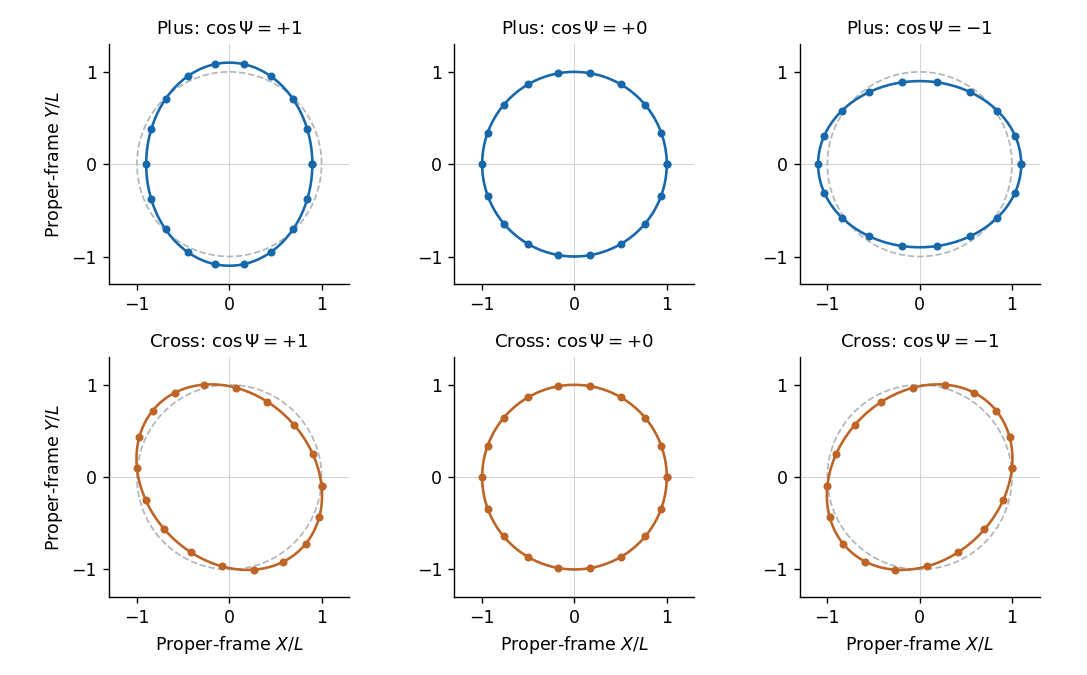

Use the plus-sign transformation rule for stated in this part. A generator with constant produces the pure-gauge plane wave in linearized gravityBecause , it obeys both and , preserving the imposed Lorenz gauge in linearized gravity.
For an explicit example choose , with constant small . Since , this givesIndeed, direct differentiation gives , whose trace is zero, so . This wave-shaped metric disturbance is only a coordinate description of flat spacetime: its linearized Riemann curvature operator vanishes. All its second-derivative terms are proportional to four factors of , and the antisymmetric curvature combinations cancel.
An independent physical solution is the cross polarizationIt is symmetric, traceless and transverse to . Unlike the pure coordinate mode, it has nonzero linearized Riemann curvature operator: for example, in the convention ,Changing the curvature sign convention reverses this component but cannot make it vanish. Gauge invariance of the linearized Riemann tensor therefore proves that this nonzero mode cannot be removed by a coordinate transformation.
The principal stretch directions are rotated by degrees relative to the plus polarization. In the same proper-length convention as part (c), its first-order angular response is . The two independent transverse patterns are the two propagating gravitational degrees of freedom.
Take and work in a connected patch with . Setting the line element to zero givesThese are the two families of Rindler null geodesics. They remain on the same side of and approach it only at infinite coordinate time. itself is not an additional geodesic within this chart, since the metric is degenerate there.
The paths can also be written . In two dimensions a null direction has only one independent orthogonal null direction, namely itself, so each smooth null curve is a geodesic after reparametrization. More explicitly, the transformation in part (d) makes these paths straight null lines. The coordinate is generally not an affine parameter.
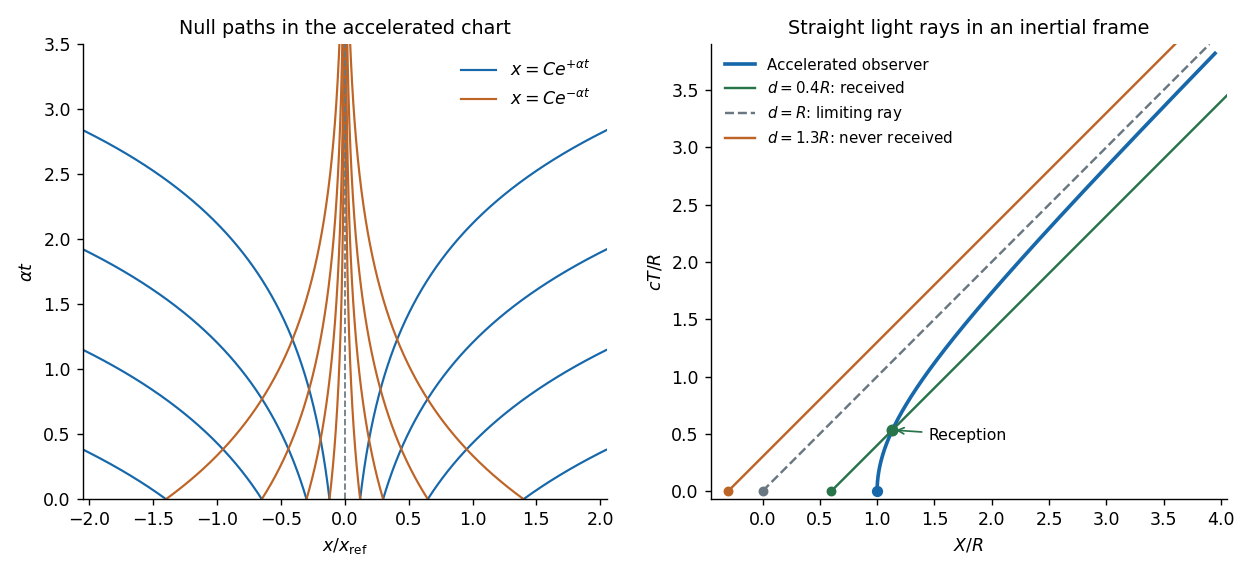
Rindler light rays and the reception horizon of a uniformly accelerated observer
. Original diagrams. The left panel shows the two exponential null families on both sides of the excluded chart boundary. The right panel uses inertial coordinates: a hyperbolic observer receives a signal emitted within its horizon, but cannot receive the horizon ray or a ray emitted farther behind. Length and time are normalized by . Details.
Put and . Radial null geodesics of the Schwarzschild metric obeyNear the horizon, satisfies describes the exterior and the interior. The exponential approach in Schwarzschild coordinate time resembles part (a), but is not a proper radial distance.
Outside, set and retain the leading near-horizon terms. The radial metric becomes the Rindler limit of a Schwarzschild horizon:It agrees with part (a) for , . Accordingly , while explains the factor two in its exponent.
Inside, write . The leading radial metric is insteadHere the radial coordinate is timelike and the Schwarzschild coordinate is spacelike. Thus in the Rindler metric does not represent the black-hole interior: stays positive on both Rindler wedges. In the black-hole interior all future-directed radial light rays move towards decreasing ; the two signs of do not mean opposite future radial directions because is no longer time.
The horizon is a coordinate singularity in Schwarzschild coordinates and in the accelerated chart, not a curvature singularity. The full Schwarzschild geometry nevertheless has genuine tidal forces; the flat Rindler metric captures its leading local radial near-horizon structure.
For coordinates the inverse metric is , . Only is nonzero, giving the Christoffel symbolswith all remaining components zero.
On the specified constant- worldline, assume . The four-velocity is , , and its norm is , so is indeed proper time. The coordinate components are constant, but the covariant acceleration is nonzero:The proper acceleration of a static Rindler observer isThe acceleration has constant components in this accelerated chart and constant invariant magnitude. It is not a covariantly constant vector: its inertial-frame components change along the hyperbolic trajectory. For , the magnitude is , with the appropriate choice of future time orientation.
Differentiating the supplied coordinates givesSubtract the squares. The cross terms cancel and , yieldingThe spacetime is flat Minkowski spacetime in Rindler coordinates. covers , the right Rindler wedge, while covers the left wedge ; neither is the whole spacetime.
The null combinations areFor the first is constant; for the second is constant. Thus part (a)'s exponentials are simply the inertial light rays . Their coordinate-time asymptotes reflect the chart's Rindler horizon, not a failure of light to move at in an inertial frame.
Let be the constant proper acceleration away from the emitter and set . Take the signal emission to be simultaneous, in the initial inertial frame, with the ship being at rest and its clock reading . Place that initial ship event at , . Its hyperbolic motion isA photon emitted from at towards the departing ship follows . At reception,Therefore light reception by a uniformly accelerated observer occurs afterThe same result follows in Rindler coordinates: the ship stays at , the emitter starts at , and the right-moving null ray has . The onboard lapse converts its coordinate catch-up time to the expression above.
If , the ray lies on the limiting null horizon and never intersects it at finite proper time; if , it never reaches the ship. The reception time diverges as the emitter approaches this Rindler horizon. For , , recovering the inertial light-travel time. A different emission time or initial relative velocity would require specifying that extra datum; the formula uses the initial-rest simultaneous-emission convention stated above.
The conserved initial four-momentum of a particle with positive rest mass satisfies . A single photon instead has null four-momentum, . Four-momentum conservation for an isolated one-body decay would require , contradicting these Lorentz invariants. Thus decay into a single photon is impossible in every inertial frame.
Equivalently, the incoming energy and momentum obey , whereas a single outgoing photon obeys . Changing the laboratory speed cannot change this mismatch of the invariant mass shell.
For motion along one spatial axis, introduce the rapidity so that the four-velocity is . Its four-acceleration isA constant signed proper acceleration therefore gives , hence . Differentiating the four-velocity twice yieldsThe zero transverse components also satisfy this equation. The constant acceleration measured on board is the proper acceleration, rather than a constant coordinate acceleration in the laboratory.
Use the geodesic Lagrangian , where dots denote an affine parameter derivative. The Euler-Lagrange equations giveThese are the geodesic equations wherever , so the Riemannian metric is nondegenerate. Substitution of , and makes both equations proportional toThus is a family of affinely parametrized geodesics, on intervals staying within one quadrant. In particular, and keep the metric nonsingular; the coordinate axes themselves are not regular points of this metric. The coordinate need not be linear in the affine parameter, despite the straight coordinate-space shape of these curves.
Use signature and local inertial coordinates . Write and , where is rest mass density. The perfect fluid in general relativity has componentsHere is energy density, is energy flux, is momentum density, and is the flux of the th momentum component through a surface normal to . In the local rest frame these reduce to energy density , zero energy and momentum flow, and isotropic pressure . The equation expresses local stress-energy conservation. Its temporal and spatial components give energy and momentum balance; in flat coordinates, for example, .
For relativistic dust, . Contracting its divergence with , and using metric compatibility together with , givesConsequently . Substituting this continuity equation back into the divergence leaves . Wherever matter is present,so the individual particles follow geodesics.
The electromagnetic four-force law must preserve the particle's rest mass. Thus , and requiring this for arbitrary timelike four-velocities makes the electromagnetic field tensor antisymmetric. Its six independent components comprise the electric field and magnetic field. With the stated signature and , one consistent convention isIt gives the spatial force and energy transfer . Under a Lorentz transformation, transforms as a rank-two contravariant tensor; its electric and magnetic components consequently mix. A four-potential supplies , unchanged by . The Maxwell equations areThese combine the source equations and the homogeneous equations into covariant tensor statements; is the four-current.
For charged relativistic dust, the matter tensor exchanges four-momentum with the electromagnetic field: , while their total stress-energy tensor is conserved. Identical particles of rest mass and electric charge have . Contraction with again gives mass continuity because . Removing that term givesUsing zero divergence for the matter tensor alone in this last step would omit the electromagnetic Lorentz force.
Write , with . On the equatorial plane, the geodesic Lagrangian isThe coordinates and are cyclic, giving . The conserved physical energy per unit rest mass is , while is the signed angular momentum per unit rest mass. The radial Euler-Lagrange equation, with , isThese are the requested geodesic equations. The equatorial condition is consistent with the polar equation by the spherical symmetry of the Schwarzschild metric.
The normalization of the four-velocity is . Insert the two conserved quantities and multiply by to obtainThis is a one-dimensional radial energy equation. Half of its left side is radial kinetic energy per unit mass plus an effective potential: the Newtonian centrifugal and gravitational terms acquire the extra attractive contribution .
A timelike circular Schwarzschild geodesic requires . Equivalently, set the derivative of to zero. At this gives , and substitution in the radial energy equation yieldsSuch timelike circular orbits require . Their coordinate angular velocity satisfies , and their proper clock rate is .
For the static North-Pole clock, . Consecutive overhead passages occur one coordinate orbital period apart, and the repeated Earth-satellite geometry gives equal signal travel delays. The comparison of circular-orbit and static Schwarzschild clocks therefore givesThis includes both gravitational and orbital-motion effects; a separate Newtonian time-dilation correction must not be added again.
For an estimate, Kepler's third law gives . The same approximate geostationary radius and period give . Expanding the ratio to first order,The satellite clock consequently gains about over a three-hour orbit in this approximation. The surface observer is taken to be static, and the spacetime model is the spherical Schwarzschild metric specified in the problem.
Articles were limited to the first 100 out of 147 total.
Articles by others on the same topic
There are currently no matching articles.