Use the metric signature and throughout this question. The trace-reversed metric perturbation satisfies , so its inverse relation isSet . Substituting this inverse relation into the linearized field operator cancels the second derivatives of the trace, leavingThe imposed Lorenz gauge in linearized gravity is . Therefore the Linearized Einstein equations in vacuum reduce toThe overall sign of the field operator is immaterial for this homogeneous equation.
Let . For a nonzero symmetric amplitude, substituting the plane wave into the wave equation gives . The gauge condition gives . Thus a propagating mode satisfiesThe wavevector is null, so the gravitational wave propagates at the vacuum speed of light. The amplitude is transverse as a four-dimensional tensor in Lorenz gauge in linearized gravity. This condition alone does not set all time components or the trace to zero: residual gauge symmetry of linearized gravity remains. Of the ten symmetric components, four Lorenz constraints and four independent residual coordinate choices leave two physical gravitational wave polarizations.
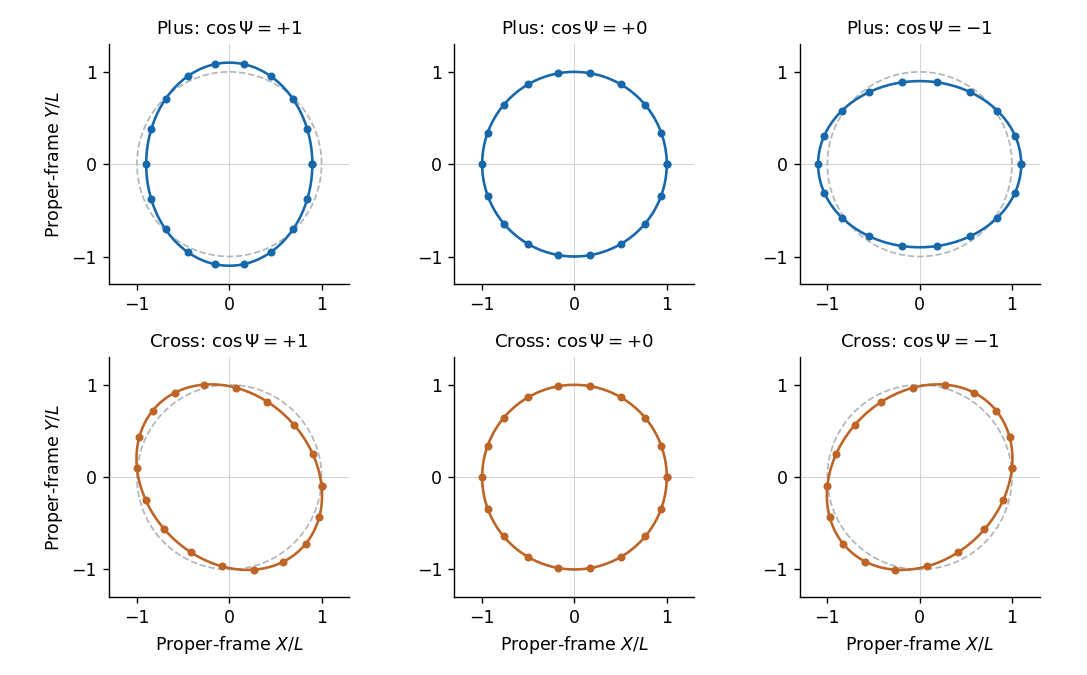
For the supplied plus polarization, the perturbation is traceless, so . At a fixed longitudinal coordinate , put . With the convention chosen above, the transverse spatial metric measuring positive squared lengths isThe initial coordinate separation is and remains constant in transverse-traceless gauge: implies , so initially stationary particles stay at fixed spatial coordinates. Their measured proper length is insteadThe first expression is understood within the linearized metric; only its first-order expansion is controlled. Separation along the two transverse axes varies oppositely; at degrees there is no first-order length modulation. This is the angular response of a gravitational-wave separation, despite constant coordinate separation.
If the background is instead chosen as while keeping the same numerical spatial amplitude, the displayed length modulation has the opposite sign. The question does not state a signature here; the convention above agrees with its earlier explicitly specified Minkowski metric. The physical alternating stretch-compress pattern is unchanged by consistently redefining the signed amplitude.

Use the plus-sign transformation rule for stated in this part. A generator with constant produces the pure-gauge plane wave in linearized gravityBecause , it obeys both and , preserving the imposed Lorenz gauge in linearized gravity.
For an explicit example choose , with constant small . Since , this givesIndeed, direct differentiation gives , whose trace is zero, so . This wave-shaped metric disturbance is only a coordinate description of flat spacetime: its linearized Riemann curvature operator vanishes. All its second-derivative terms are proportional to four factors of , and the antisymmetric curvature combinations cancel.
An independent physical solution is the cross polarizationIt is symmetric, traceless and transverse to . Unlike the pure coordinate mode, it has nonzero linearized Riemann curvature operator: for example, in the convention ,Changing the curvature sign convention reverses this component but cannot make it vanish. Gauge invariance of the linearized Riemann tensor therefore proves that this nonzero mode cannot be removed by a coordinate transformation.
The principal stretch directions are rotated by degrees relative to the plus polarization. In the same proper-length convention as part (c), its first-order angular response is . The two independent transverse patterns are the two propagating gravitational degrees of freedom.
Articles by others on the same topic
There are currently no matching articles.