For two bodies of masses M1,M2, the relative Kepler orbit has semimajor axis a and orbital period P satisfying Kepler's third lawHere a is the semimajor axis of the separation vector, not either star's individual barycentric orbit. In conventional stellar units the same relation is approximately (P/yr)2=(a/AU)3/[(M1+M2)/M⊙], with year, astronomical unit and solar mass as the units.
P2=G(M1+M2)4π2a3.
Equal radial velocity amplitudes imply equal stellar masses. Under the circular, edge-on eclipsing binary interpretation, each star moves at K=100kms−1, and the relative speed is 2K. ThusUsing P=5.45 days givesMore generally, spectroscopic binary amplitudes determine asini=P(K1+K2)1−e2/(2π) and (M1+M2)sin3i=P(K1+K2)3(1−e2)3/2/(2πG). Thus these numerical masses and separation use e=0, sini=1; eclipses alone imply high inclination rather than its exact value.
a=2π(K1+K2)P=1.499×10¹⁰m,M1+M2=2πGP(K1+K2)3.
a≃0.100AU,M1=M2≃2.26M⊙.
TODO: the source light curve, its numerical contact phases and the meanings of the four plotted time labels are absent, so unique numerical stellar radii cannot be recovered. The central eclipse contact-radius relations explain what the missing measurements would determine.
If t1,…,t4 denote the usual first through fourth contacts of a central eclipse, define T14=t4−t1 and T23=t3−t2, and let RL≥RS be the two radii. For a circular edge-on orbit,Taking half their sum and difference gives the radii. For short eclipses the familiar approximation is RL≃vrel(T14+T23)/4 and RS≃vrel(T14−T23)/4, with vrel=2K. At first and fourth contact the discs touch externally; at second and third the smaller disc is just internally tangent to the larger. Noncentral eclipses require the projected impact parameter as well.
RL+RS=asinPπT14,RL−RS=asinPπT23.
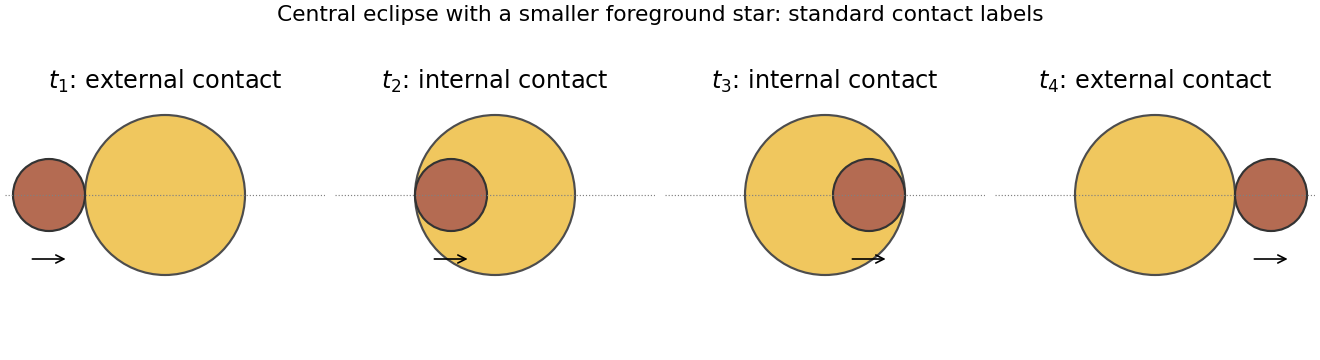
Conditional central-eclipse contact geometry; this schematic supplies no readings from the missing source light curve
. Details. 
Ancestors (10)
- S2
- 2012
- Past exam of the short options paper shared by Prelims and Parts A and B of the physics course of the University of Oxford
- Short options paper shared by Prelims and Parts A and B of the physics course of the University of Oxford
- Physics course of the University of Oxford
- Undergraduate course of the University of Oxford
- Course of the University of Oxford
- University of Oxford
- List of universities
- Home
Discussion (0)
New discussionThere are no discussions about this article yet.
Articles by others on the same topic (0)
There are currently no matching articles.