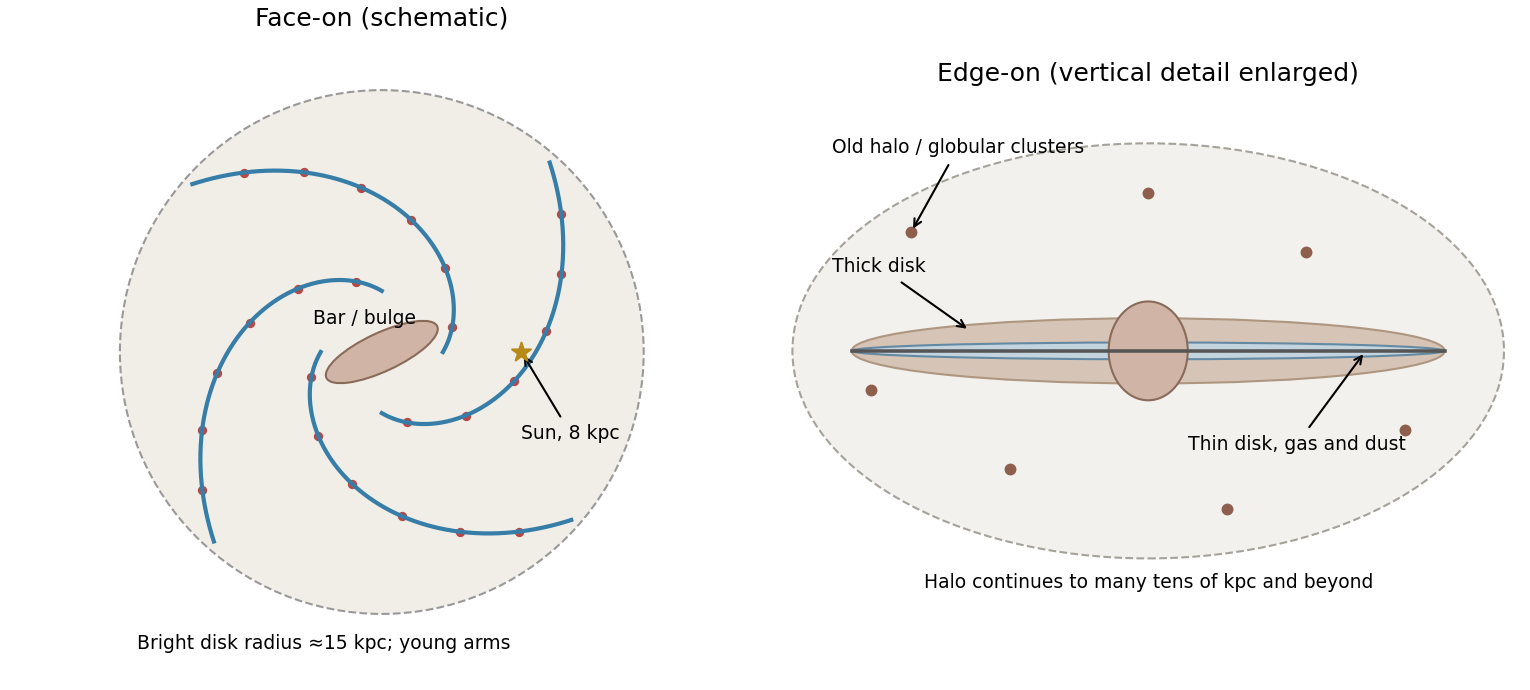
Face-on, the Milky Way is a barred spiral galaxy: a central bulge and bar of scale a few kiloparsecs lie inside a disk of stellar radius roughly , with spiral arms containing gas, dust, H II regions and young stars. Recent star formation is concentrated in molecular clouds and arm complexes. The Sun lies in the disk about from the centre in the source's convention. Old stars are also present throughout the disk, while the bulge, thick disk and extended stellar halo contain important old populations. Globular clusters occupy a roughly spheroidal halo extending well beyond the bright disk.
Figure 1.
Original schematic face-on and edge-on views of the Milky Way
. The face-on panel labels a barred centre, spiral star-forming regions, the Sun and an approximate 15 kpc bright-disk radius. The edge-on panel separates the thin dusty disk, thick disk, bulge and old halo/globular-cluster population. Halo extent is indicated schematically beyond the plotted field. Details.
Edge-on, the bright thin galactic disk forms a narrow band, with a central bulge protruding above and below it and a thinner gas-and-dust lane along the midplane. Young stars and H II regions occupy a vertical scale of a few tenths of a kiloparsec or less; a broader old thick disk has scale of order a kiloparsec. These are approximate scale heights, not sharp boundaries. The old stellar halo and globular clusters form a much larger, low-surface-brightness spheroidal component, extending to many tens of kiloparsecs or more. The dark matter halo is inferred dynamically rather than directly visible in such a sketch. The preceding figure is a structural diagram, not an external photograph or a reconstruction of a particular survey.

Articles by others on the same topic (0)

There are currently no matching articles.