Face-on, the Milky Way is a barred spiral galaxy: a central bulge and bar of scale a few kiloparsecs lie inside a disk of stellar radius roughly 15kpc, with spiral arms containing gas, dust, H II regions and young stars. Recent star formation is concentrated in molecular clouds and arm complexes. The Sun lies in the disk about 8kpc from the centre in the source's convention. Old stars are also present throughout the disk, while the bulge, thick disk and extended stellar halo contain important old populations. Globular clusters occupy a roughly spheroidal halo extending well beyond the bright disk.
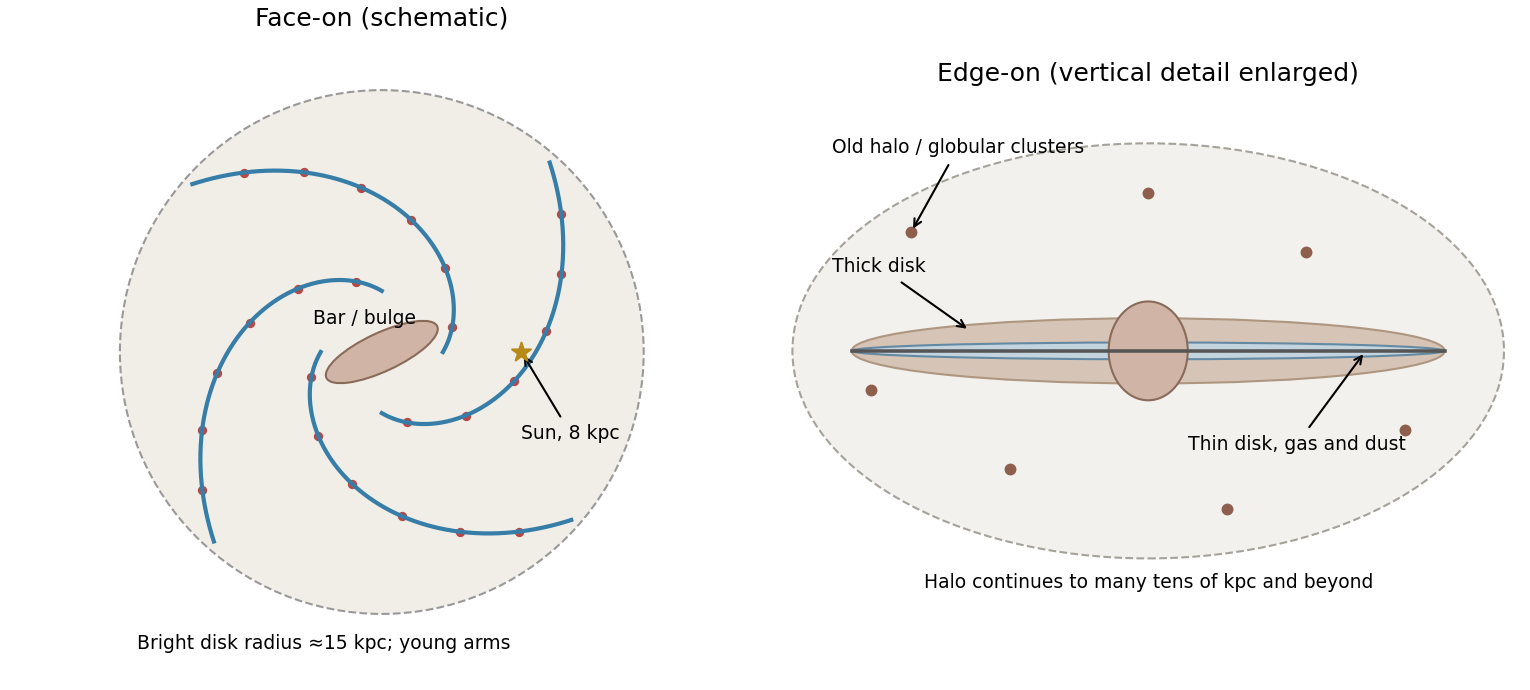
Original schematic face-on and edge-on views of the Milky Way
. The face-on panel labels a barred centre, spiral star-forming regions, the Sun and an approximate 15 kpc bright-disk radius. The edge-on panel separates the thin dusty disk, thick disk, bulge and old halo/globular-cluster population. Halo extent is indicated schematically beyond the plotted field. Details.
Edge-on, the bright thin galactic disk forms a narrow band, with a central bulge protruding above and below it and a thinner gas-and-dust lane along the midplane. Young stars and H II regions occupy a vertical scale of a few tenths of a kiloparsec or less; a broader old thick disk has scale of order a kiloparsec. These are approximate scale heights, not sharp boundaries. The old stellar halo and globular clusters form a much larger, low-surface-brightness spheroidal component, extending to many tens of kiloparsecs or more. The dark matter halo is inferred dynamically rather than directly visible in such a sketch. The preceding figure is a structural diagram, not an external photograph or a reconstruction of a particular survey.
Massive young stars emit ionizing ultraviolet radiation that creates H II regions. Recombination and radiative cascades produce H-alpha emission, including the n=3→2 transition. Shocks or other ionizing sources can also produce it, but disk star-forming gas is the natural interpretation for an extended spiral-galaxy rotation measurement.
The systemic redshift and inclination of an intrinsically circular thin disk areThe rotation-induced half-width is (689.7−688.5)/2=0.6nm. Divide by the systemic observed wavelength to remove the common redshift factor before applying the small-velocity Doppler shift:The circular-orbit and thin-disk assumptions neglect intrinsic thickness, warps and noncircular gas motion.
z=656.3689.1−656.3≃0.04998,cosi=307.5=41,i≃75.52∘.
vlos=c689.10.6≃261.0kms−1,vmax=sinivlos≃269.6kms−1.
Use the low-redshift Hubble law, neglecting peculiar velocity and cosmological distance corrections:The angular radius is 15 arcseconds, half the stated major-axis diameter. A spherical dynamical estimate givesIt estimates mass inside the observed disk radius, not the entire unobserved halo. Disk geometry changes the exact coefficient.
d≃H0cz≃211Mpc,R≃d20626515≃15.35kpc.
M(<R)≃Gvmax2R≃2.59×10¹¹M⊙.
Using the same approximate distance for the distance modulus,For an illustrative stellar mass-to-light ratio of 1--5 in solar V-band units, M∗∼1.5×10¹⁰--7.4×10¹⁰M⊙, below the dynamical estimate. This suggests substantial nonluminous matter under the adopted assumptions. Gas, stellar-population uncertainty, inclination, extinction and geometry also affect the comparison; luminosity alone cannot uniquely fix a stellar mass. The single-distance approximation at z≃0.05 is the intended introductory estimate.
MV=16−5log10(10pc211×106pc)≃−20.62,
LV,⊙LV=100.4(4.8−MV)≃1.47×10¹⁰,LVMdyn≃17.6LV,⊙M⊙.
Use a Tully-Fisher relation L∝vmax4. A simple justification assumes comparable mean surface brightness, so L∝R2, and comparable total mass-to-light ratio, so M∝L. The virial scaling v2∼GM/R then gives v4∝M2/R2∝L. Calibrating to the previous galaxy yieldsThis is a rough luminosity estimate: the empirical slope depends on passband and population, and the assumed constant surface brightness and mass-to-light ratio are approximations rather than exact properties of every spiral galaxy.
L2≃1.47×10¹⁰(269.6100)4LV,⊙≃2.79×10⁸LV,⊙.
For a spherical mass distribution with constant circular speed vc,For vc=220kms−1, this is about 0.0140(r/8kpc)−2M⊙pc−3. It is the spherical model's total density; it is singular if extrapolated to the very centre and is intended only over the flat-rotation region.
M(<r)=Gvc2r,ρ(r)=4πr21drdM=4πGr2vc2.
For a sharp outer truncation at r∗, the exterior mass is fixed at M∗=vc2r∗/G. Integrating the gravitational work from r to the boundary and then to infinity givesThusThe exterior contribution cannot be dropped: at r=r∗ it correctly gives the point-mass escape speed 2vc.
21vesc2=∫rr∗svc2ds+∫r∗∞s2GM∗ds=vc2[logrr∗+1].
vesc(r)=2vc1+log(r∗/r).
If the fastest measured radial speed is assumed to approximate both the total speed and the local escape speed of a bound star, then at r=8kpc,Without those extra assumptions, the measurement gives only a bound: a bound star's total speed is at least its radial component, and the sample maximum need not reach escape, so r∗≳19.9kpc within this model. An unbound interloper would invalidate even that bound. This is not a determination of the real Milky Way halo edge.
r∗≃rexp(2(220)24302−1)≃19.9kpc.
Ancestors (10)
- S26
- 2012
- Past exam of the short options paper shared by Prelims and Parts A and B of the physics course of the University of Oxford
- Short options paper shared by Prelims and Parts A and B of the physics course of the University of Oxford
- Physics course of the University of Oxford
- Undergraduate course of the University of Oxford
- Course of the University of Oxford
- University of Oxford
- List of universities
- Home
Discussion (0)
New discussionThere are no discussions about this article yet.
Articles by others on the same topic (0)
There are currently no matching articles.