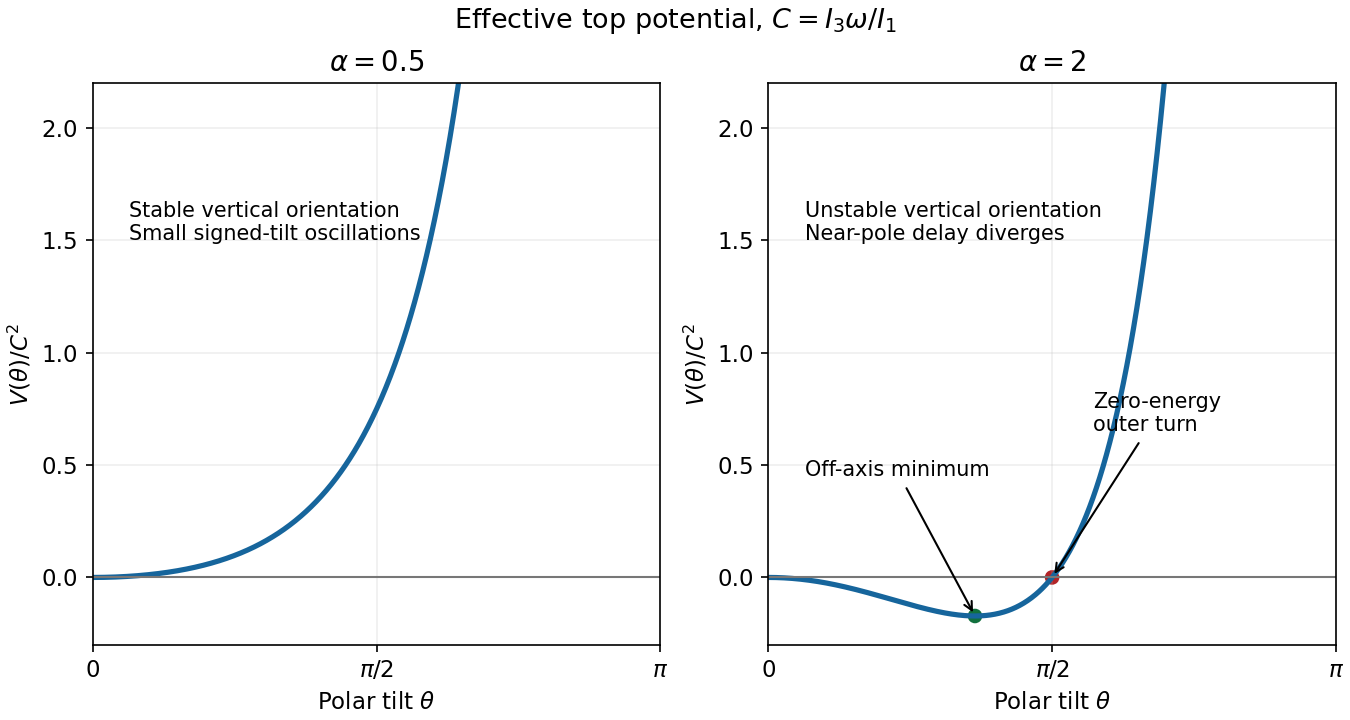
Put u=cos2(θ/2). Then V/C2=u−1−1−α+αu. For α<1 it increases from zero at the north pole to infinityas θ→π and has no interior minimum. The vertical orientation is stable. Near zero,
The locally signed tilt oscillates at angular frequencyΩ, while the azimuth precesses approximately at C/2. The nonnegative polar coordinate is θ≃θmax∣sinΩt∣, so its successive pole-to-pole excursions have period π/Ω and angular repetition frequency2Ω. Stating this convention avoids confusing a signed small displacement with the polar-angle magnitude. The full axis direction combines that excursion with precession.