Only Az depends on position. Taking the curl,The field reverses across x=0. Its divergence is zero, as required for a magnetic field; the vanishing field on the midplane is important for the crossing and separatrix trajectories below.
B=∇×A=LB0xy^.
With zero scalar potential, the nonrelativistic charged-particle Lagrangian in SI units is kinetic energy plus qA⋅r˙. ThusThe velocity-dependent magnetic term changes canonical momentum but does not contribute to the mechanical energy.
L=2m(x˙2+y˙2+z˙2)−2LqB0x2z˙.
Define a=qB0/(2L)>0. Differentiating the Lagrangian with respect to each generalized velocity givesThe coordinates y and z are cyclic, so py and pz are conserved. The momentum px is generally not conserved: its equation is p˙x=−2axz˙. In particular, conserved canonical pz is not the same as conserved mechanical mz˙, which changes as the particle moves across the magnetic-field gradient.
px=mx˙,py=my˙,pz=mz˙−ax2.
The Legendre transform cancels the term linear in velocity and givesIt equals the mechanical kinetic energy. The Hamiltonian has no explicit time dependence, so H is conserved. This is also a direct consequence of the magnetic force doing no work: qv⋅(v×B)=0.
H=2mpx2+py2+(pz+ax2)2.
Since py=0 initially and remains constant, the motion stays in a plane of constant y. Setting P=2mH0 and p=pz0 givesThe allowed interval obeys ∣p+ax2∣≤P. The sign of x˙ is set by the initial direction and changes at a turning point. The specified x0 fixes the starting position on the energy orbit, but the data do not specify which sign of the initial transverse velocity is chosen.
z˙=mp+ax2,x˙=±mP2−(p+ax2)2.
Dividing the two velocities givesHere z˙=ax2/m≥0: the orbit always advances toward increasing z, except for instantaneous zeros at each midplane crossing x=0. The transverse motion oscillates between −X and X. At these outer turning points x˙=0 and the trajectory is tangent to the z direction; at the midplane x˙=0 while z˙=0, so the tangent is along x. The sign of the initial x˙ only chooses the phase or reflected trace.
dzdx=±ax2P2−a2x4,−X≤x≤X,X=P/a.
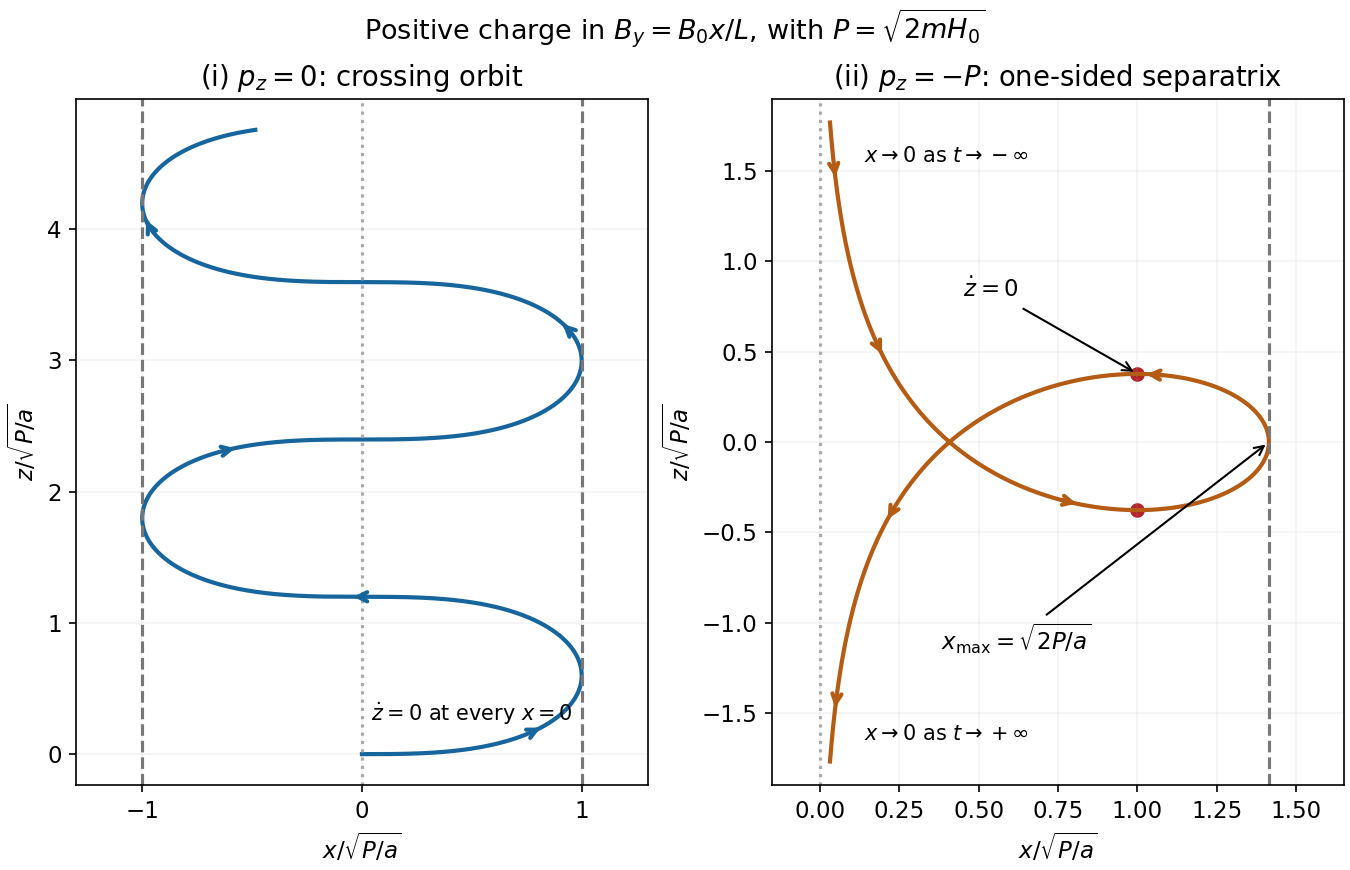

With p=−P, the allowed range is ∣x∣≤X2, where X2=2P/a. But an orbit starting with x=0 never crosses the midplane in finite time, becauseOne positive-side separatrix, with u=ω(t−tc) and ω=2Pa/m, isThe negative-side orbit is its reflection in x=0. For the positive branch, x rises from zero asymptotically, reaches X2 at u=0, then returns asymptotically to zero. Thus the infimum is zero but it is not attained in finite time on this nontrivial branch. Since z˙=(P/m)(2sech2u−1), the two axial-velocity zeros occur at x=P/a. Motion is toward decreasing z near either asymptotic midplane tail and toward increasing z near the outer excursion. These directions are marked in part i.
x˙2=m2a2x2(X22−x2).
x=X2sechu,z=zc+mωP(2tanhu−u).
The exactly midplane initial state x=0, x˙=0 is a separate straight trajectory with z˙=−P/m; it must not be described as a finite-time crossing of the separatrix.
Differentiation givesThe angles ϕ and ψ are cyclic, so their canonical momenta are conserved. The Lagrangian is autonomous, so the total energy is also conserved. The momentum pθ is not generally constant because gravity and the angular kinetic terms depend on θ.
pθ=I1θ˙,pψ=I3(ψ˙+ϕ˙cosθ),pϕ=I1ϕ˙sin2θ+pψcosθ.
At the initially vertical configuration, the two conserved momenta coincide:The apparent 0/0 angular term at θ=0 is interpreted by its regular limit with these equal momenta. Substitution into energy conservation, followed by 1−cosθ=2sin2(θ/2), givesWriting C=I3ω/I1 yieldsThe zero of the potential at the vertical configuration includes the initially specified transverse kinetic energy separately as ω02.
pϕ(t)=pψ(t)=I3ω,H(t)=2I1ω02+2I3ω2+mga.
ω02=θ˙2+I12I32ω2tan22θ−I14mgasin22θ.
V(θ)=C2sin22θ[sec22θ−α],α=I32ω24mgaI1.
Use the conserved pϕ=pψ=I3ω in the canonical-momentum equation. For a nonzero tilt,Cancelling with the half-angle identities givesIts regular limit at the north pole is C/2, although the azimuth itself is not a uniquely defined coordinate at that pole.
I1ϕ˙sin2θ=I3ω(1−cosθ).
ϕ˙=I1(1+cosθ)I3ω=2cos2(θ/2)C.
Put u=cos2(θ/2). Then V/C2=u−1−1−α+αu. For α<1 it increases from zero at the north pole to infinity as θ→π and has no interior minimum. The vertical orientation is stable. Near zero,For ω0/C≪1, away from the marginal case α=1, this givesThe locally signed tilt oscillates at angular frequency Ω, while the azimuth precesses approximately at C/2. The nonnegative polar coordinate is θ≃θmax∣sinΩt∣, so its successive pole-to-pole excursions have period π/Ω and angular repetition frequency 2Ω. Stating this convention avoids confusing a signed small displacement with the polar-angle magnitude. The full axis direction combines that excursion with precession.
V≃4C2(1−α)θ2.
θmax≃C1−α2ω0,Ω=2C1−α.
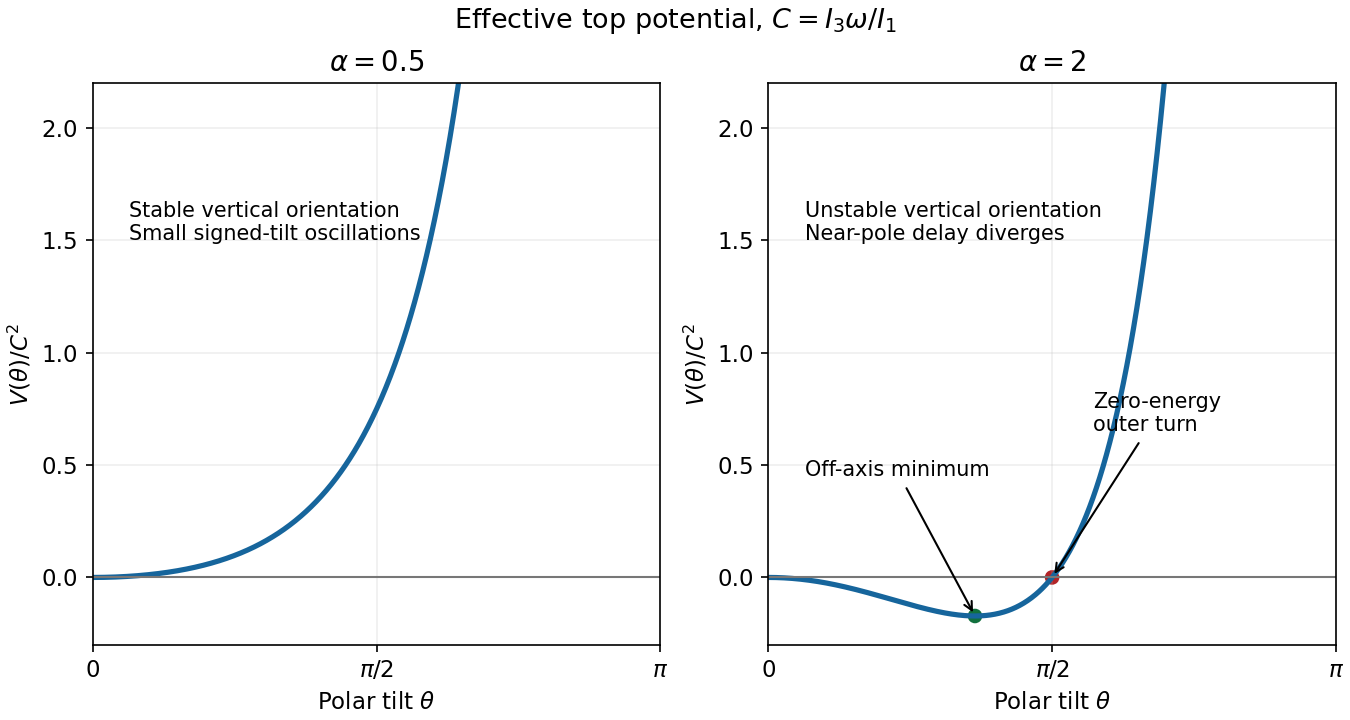
The vertical spinning top changes from a stable minimum to an unstable maximum
. Dimensionless effective potentials are shown for alpha equal to 0.5 and 2. The second panel marks the off-axis minimum and the zero-energy turning angle approached by a near-separatrix excursion. Details.
For α>1, θ=0 is an unstable stationary point and the interior minimum satisfies u=α−1/2. HenceThe potential then diverges at π. For ϵ=ω0/C, the turning point is specified exactly by the smaller quadratic rootFor small positive ω0, this approaches θmax≃2arccosα−1/2, a finite excursion even when the initial impulse is arbitrarily small. An excursion from the north pole to the outer turning angle and back has periodNear the unstable pole, V≃−Ωu2θ2 with Ωu=Cα−1/2. The near-pole contribution gives Tθ∼(2/Ωu)log(constant×C/ω0), so the period diverges logarithmically as ω0→0. The exactly unperturbed top can remain at the unstable vertical orientation; the limiting excursions spend ever longer close to it. The direction also precesses according to part c.
θmin=2arccosα−1/4,Vmin=−C2(α−1)2.
uturn=2α1+α+ϵ2−(1+α+ϵ2)2−4α,θmax=2arccosuturn.
Tθ=2∫0θmaxω02−V(θ)dθ.
For each canonical coordinate and momentum, Hamilton's equations areThey use canonical rather than arbitrary mechanical momenta, a distinction important in a magnetic field. The bracket convention printed in the source is consistent with F˙=[F,H] for a function with no explicit time dependence.
q˙i=∂pi∂H,p˙i=−∂qi∂H.
Apply the chain rule to the phase-space function:Thus [F,H]=0⟹F is conserved. If an explicitly time-dependent function is allowed, the correct equation is dF/dt=∂tF+[F,H], so a vanishing bracket alone would not suffice. The source specifies F(q,p), for which that extra term is absent.
dtdF=∑i(Fqiq˙i+Fpip˙i)=∑i(FqiHpi−FpiHqi)=[F,H].
The radial and azimuthal Hamilton equations giveAlso θ˙=pθ/(mr2) and p˙θ=pϕ2cosθ/(mr2sin3θ). Differentiating the angular-momentum square,Therefore both pϕ and J2=pθ2+pϕ2/sin2θ are constants. Rotational symmetry conserves the full angular-momentum vector; these are its axial component and squared magnitude in spherical canonical variables.
r˙=mpr,ϕ˙=mr2sin2θpϕ,p˙ϕ=0.
dtdJ2=2pθp˙θ−sin3θ2pϕ2cosθθ˙=0.
In the equatorial plane,Differentiating the given combination produces a cosine termand a sine term prpϕϕ˙sinϕ/m−pϕ2r˙sinϕ/(mr2)=0. Thus G˙=0. The expression is a Cartesian component of the Laplace-Runge-Lenz vector with a conventional overall normalization, reflecting the additional symmetry of the inverse-square-force problem.
r˙=pr/m,ϕ˙=pϕ/(mr2),p˙r=pϕ2/(mr3)−k/r2,p˙ϕ=0.
−mpϕ(mr3pϕ2−r2k)cosϕ+(mrpϕ2−k)mr2pϕcosϕ=0
With the apsidal origin chosen as specified, G=0. For pϕ=0, rearrangement givesLet u=1/r. Since du/dϕ=−pr/pϕ, the equation is u′=−(u−mk/pϕ2)tanϕ. Its solution, continued through points where the intermediate division fails, isAs printed, e has units of inverse length and is not the usual dimensionless eccentricity. Writing ℓ=pϕ2/(mk) gives the standard form r=ℓ/(1+εcosϕ) with ε=eℓ. The orbit is an ellipse for ∣ε∣<1, parabolic for unit magnitude and hyperbolic for magnitude greater than one on its allowed angular interval. The purely radial case pϕ=0 must be handled separately and is excluded by these divisions.
pr=(rpϕ−pϕmk)tanϕ.
r1=pϕ2mk+ecosϕ.
Ancestors (9)
- 2018
- Past exam of the short options paper shared by Prelims and Parts A and B of the physics course of the University of Oxford
- Short options paper shared by Prelims and Parts A and B of the physics course of the University of Oxford
- Physics course of the University of Oxford
- Undergraduate course of the University of Oxford
- Course of the University of Oxford
- University of Oxford
- List of universities
- Home
Discussion (0)
New discussionThere are no discussions about this article yet.
Articles by others on the same topic (0)
There are currently no matching articles.