Differentiation givesThe angles ϕ and ψ are cyclic, so their canonical momenta are conserved. The Lagrangian is autonomous, so the total energy is also conserved. The momentum pθ is not generally constant because gravity and the angular kinetic terms depend on θ.
pθ=I1θ˙,pψ=I3(ψ˙+ϕ˙cosθ),pϕ=I1ϕ˙sin2θ+pψcosθ.
At the initially vertical configuration, the two conserved momenta coincide:The apparent 0/0 angular term at θ=0 is interpreted by its regular limit with these equal momenta. Substitution into energy conservation, followed by 1−cosθ=2sin2(θ/2), givesWriting C=I3ω/I1 yieldsThe zero of the potential at the vertical configuration includes the initially specified transverse kinetic energy separately as ω02.
pϕ(t)=pψ(t)=I3ω,H(t)=2I1ω02+2I3ω2+mga.
ω02=θ˙2+I12I32ω2tan22θ−I14mgasin22θ.
V(θ)=C2sin22θ[sec22θ−α],α=I32ω24mgaI1.
Use the conserved pϕ=pψ=I3ω in the canonical-momentum equation. For a nonzero tilt,Cancelling with the half-angle identities givesIts regular limit at the north pole is C/2, although the azimuth itself is not a uniquely defined coordinate at that pole.
I1ϕ˙sin2θ=I3ω(1−cosθ).
ϕ˙=I1(1+cosθ)I3ω=2cos2(θ/2)C.
Put u=cos2(θ/2). Then V/C2=u−1−1−α+αu. For α<1 it increases from zero at the north pole to infinity as θ→π and has no interior minimum. The vertical orientation is stable. Near zero,For ω0/C≪1, away from the marginal case α=1, this givesThe locally signed tilt oscillates at angular frequency Ω, while the azimuth precesses approximately at C/2. The nonnegative polar coordinate is θ≃θmax∣sinΩt∣, so its successive pole-to-pole excursions have period π/Ω and angular repetition frequency 2Ω. Stating this convention avoids confusing a signed small displacement with the polar-angle magnitude. The full axis direction combines that excursion with precession.
V≃4C2(1−α)θ2.
θmax≃C1−α2ω0,Ω=2C1−α.
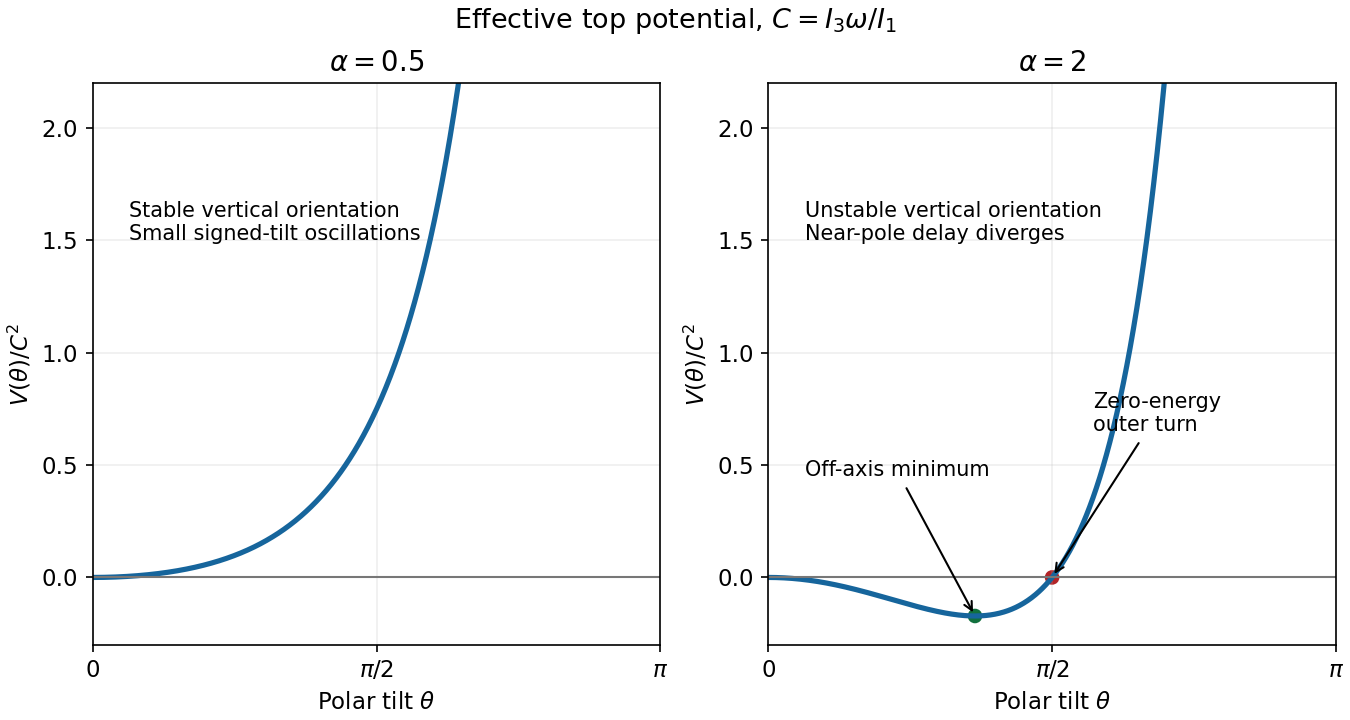
The vertical spinning top changes from a stable minimum to an unstable maximum
. Dimensionless effective potentials are shown for alpha equal to 0.5 and 2. The second panel marks the off-axis minimum and the zero-energy turning angle approached by a near-separatrix excursion. Details.
For α>1, θ=0 is an unstable stationary point and the interior minimum satisfies u=α−1/2. HenceThe potential then diverges at π. For ϵ=ω0/C, the turning point is specified exactly by the smaller quadratic rootFor small positive ω0, this approaches θmax≃2arccosα−1/2, a finite excursion even when the initial impulse is arbitrarily small. An excursion from the north pole to the outer turning angle and back has periodNear the unstable pole, V≃−Ωu2θ2 with Ωu=Cα−1/2. The near-pole contribution gives Tθ∼(2/Ωu)log(constant×C/ω0), so the period diverges logarithmically as ω0→0. The exactly unperturbed top can remain at the unstable vertical orientation; the limiting excursions spend ever longer close to it. The direction also precesses according to part c.
θmin=2arccosα−1/4,Vmin=−C2(α−1)2.
uturn=2α1+α+ϵ2−(1+α+ϵ2)2−4α,θmax=2arccosuturn.
Tθ=2∫0θmaxω02−V(θ)dθ.
Ancestors (10)
- S7
- 2018
- Past exam of the short options paper shared by Prelims and Parts A and B of the physics course of the University of Oxford
- Short options paper shared by Prelims and Parts A and B of the physics course of the University of Oxford
- Physics course of the University of Oxford
- Undergraduate course of the University of Oxford
- Course of the University of Oxford
- University of Oxford
- List of universities
- Home
Discussion (0)
New discussionThere are no discussions about this article yet.
Articles by others on the same topic (0)
There are currently no matching articles.