Conformal invariance of planar Brownian motion means invariance after changing the clock, not preservation of the original speed. If is a conformal bijection and is planar Brownian motion stopped on exiting , putThen has the law of planar Brownian motion started at and run at time , up to the corresponding lifetime. Equivalently, composing with the inverse clock produces ordinary Brownian motion in .
Indeed, the real and imaginary parts of a holomorphic function are harmonic, so Itô's formula gives zero drift. The Cauchy-Riemann equations give equal coordinate brackets and zero cross bracket. The Lévy characterization of multidimensional Brownian motion after time change identifies the image. In particular the harmonic measure of boundary arcs is carried to their conformal images.
Let and . The Möbius transformation sends the semicircle endpoints toAlso . Therefore the left semicircle maps to the unit-circle arc centered at with angular width .
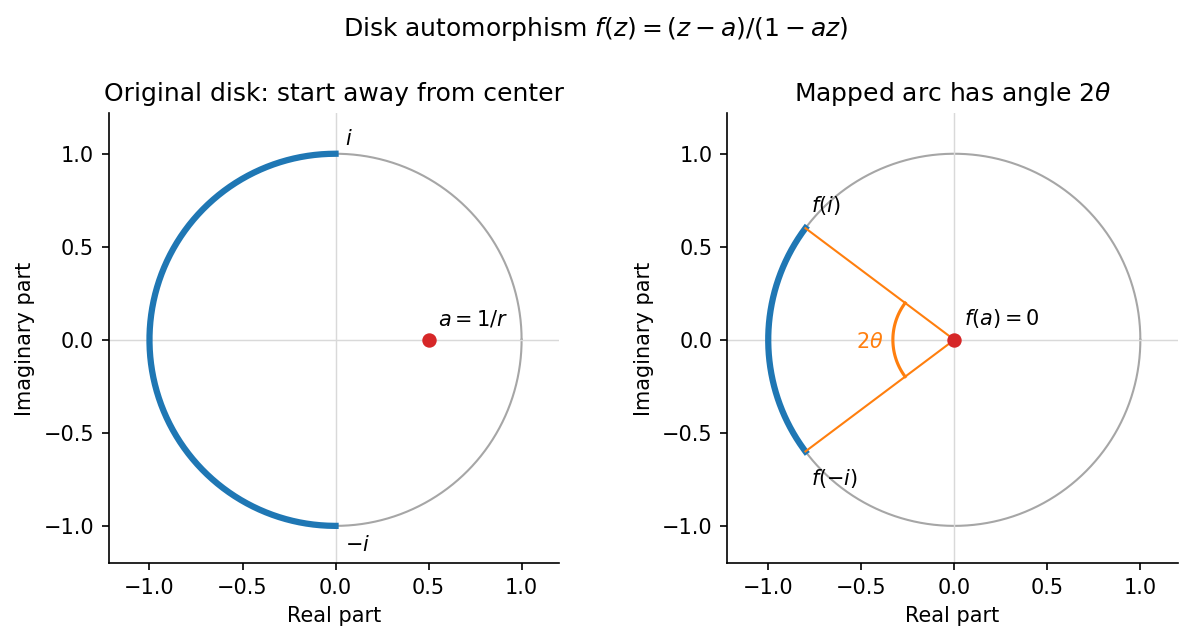
The left semicircle becomes a shorter arc viewed from the mapped starting point
. Details. 
By conformal invariance of harmonic measure, its exit probability from the starting point equals the probability of this image arc for Brownian motion started at zero. Rotational symmetry makes the latter exit angle uniform. ThusFor scaling, if starts at , then is planar Brownian motion started at one. Its unit-disk exit becomes radius- exit, and multiplication by the positive number preserves the sign of the real part. This proves exactly the same formula for .
Continuity and the regularity of zero for a one-dimensional Brownian coordinate make the first contact with the imaginary axis. The Strong Markov property and symmetry of the subsequent real increments imply that reversing those increments after preserves the Brownian law. The imaginary coordinate is unchanged, so is again planar Brownian motion started at one.
Reflection preserves distance to the origin, hence pathwise. On , the path exits through the right semicircle and reflection has not yet acted. On , reflection reverses the sign of the exit real part. ThusThe two circular points on the imaginary axis have zero exit probability, so they cause no extra term. Subtracting proves the reflection identity for Brownian exit from a half-disc requested in the question.
Both processes have the same exit law. With from part (b),The final trigonometric identity follows from for .
Articles by others on the same topic
There are currently no matching articles.