Conformal invariance of planar Brownian motion means invariance after changing the clock, not preservation of the original speed. If is a conformal bijection and is planar Brownian motion stopped on exiting , putThen has the law of planar Brownian motion started at and run at time , up to the corresponding lifetime. Equivalently, composing with the inverse clock produces ordinary Brownian motion in .
Indeed, the real and imaginary parts of a holomorphic function are harmonic, so Itô's formula gives zero drift. The Cauchy-Riemann equations give equal coordinate brackets and zero cross bracket. The Lévy characterization of multidimensional Brownian motion after time change identifies the image. In particular the harmonic measure of boundary arcs is carried to their conformal images.
Let and . The Möbius transformation sends the semicircle endpoints toAlso . Therefore the left semicircle maps to the unit-circle arc centered at with angular width .
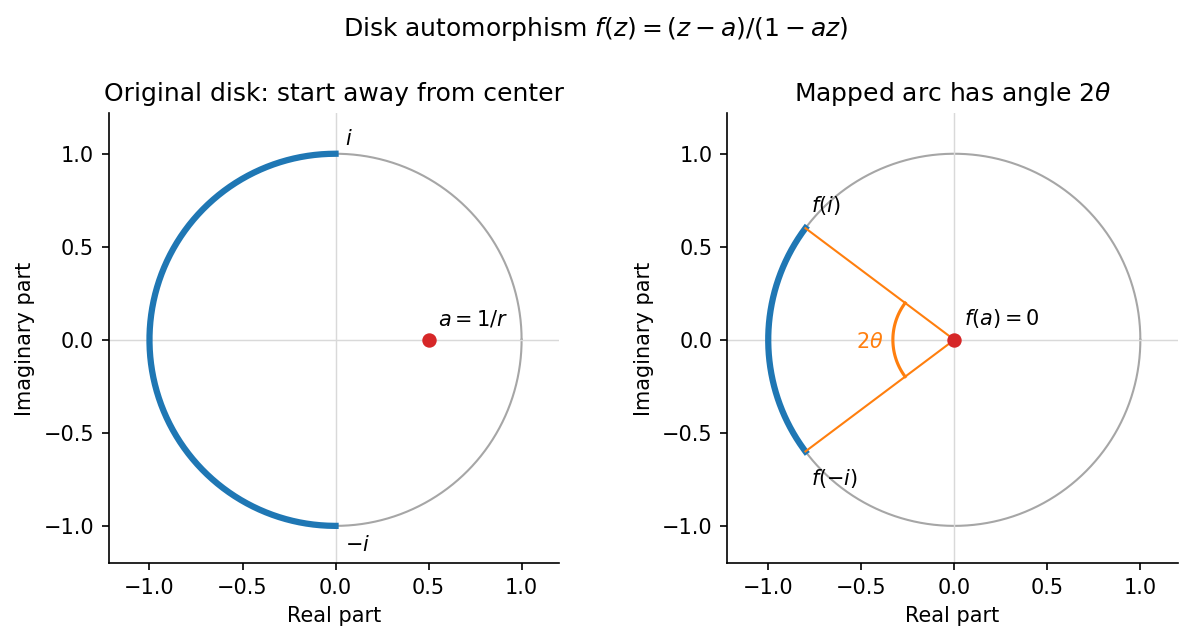
The left semicircle becomes a shorter arc viewed from the mapped starting point
. Details. 
By conformal invariance of harmonic measure, its exit probability from the starting point equals the probability of this image arc for Brownian motion started at zero. Rotational symmetry makes the latter exit angle uniform. ThusFor scaling, if starts at , then is planar Brownian motion started at one. Its unit-disk exit becomes radius- exit, and multiplication by the positive number preserves the sign of the real part. This proves exactly the same formula for .
Continuity and the regularity of zero for a one-dimensional Brownian coordinate make the first contact with the imaginary axis. The Strong Markov property and symmetry of the subsequent real increments imply that reversing those increments after preserves the Brownian law. The imaginary coordinate is unchanged, so is again planar Brownian motion started at one.
Reflection preserves distance to the origin, hence pathwise. On , the path exits through the right semicircle and reflection has not yet acted. On , reflection reverses the sign of the exit real part. ThusThe two circular points on the imaginary axis have zero exit probability, so they cause no extra term. Subtracting proves the reflection identity for Brownian exit from a half-disc requested in the question.
Both processes have the same exit law. With from part (b),The final trigonometric identity follows from for .
A continuous nondecreasing function with has moderate growth if for some fixed and finite ,Iteration and monotonicity then give such an inequality, with a different constant, for every fixed dilation factor. Powers , , are standard examples.
The Burkholder-Davis-Gundy inequalities say that for a real continuous local martingale with and any stopping time , there are positive finite constants , depending only on , such thatHere . Expectations may be infinite, with the inequalities understood by localization. For , these compare the th moment of the running maximum with the th moment of quadratic variation.
Set , , and . On the event , one has and the Brownian path remains in throughout the next time units after .
For Brownian motion started at , let be its first exit time from . The martingale , stopped at , gives . Monotone convergence first proves finite mean exit time, and dominated convergence for the bounded stopped position then givesThus Markov's inequality yields . Remaining in the closed interval for a fixed positive duration has the same probability as avoiding boundary exit: Brownian motion crosses immediately after first hitting an endpoint.
Condition on . The event is measurable there because is a stopping time, and future Brownian increments are independent of this sigma-algebra. The preceding bound is uniform in the current point inside the interval. ThereforeThis is a good-lambda bound for Brownian stopping time and maximum.
Put and . Splitting according to whether , the good-lambda bound for Brownian stopping time and maximum givesIntegrate against the positive measure . The tail integral formula for expectation in Stieltjes form yieldsBy moderate growth, choose with . ThenFix and choose small enough that . Absorb the last term and apply moderate growth once more to the fixed dilation . This provesTo avoid subtracting infinities, perform the argument first for , where Brownian maxima have all finite polynomial moments and moderate growth is at most polynomial, and then use monotone convergence. Applying the Dambis-Dubins-Schwarz theorem transfers this Brownian estimate to continuous local martingales, giving the lower-maximum side of the Burkholder-Davis-Gundy inequalities.
Let , the initial distance from the annulus center, and . The function is harmonic on the annulus, so its value along stopped planar Brownian motion is a local martingale by Itô's formula. It is bounded between and before exit, hence is a true bounded martingale.
By the assumed almost sure finiteness of , continuity, and dominated convergence,where is the inner-boundary exit probability. Solving gives the harmonic measure of an annulus:The two probabilities sum to one, as the exit must lie on one of the two circles.
Suppose first that . Apply part (a) with inner radius and outer radius :Each event implies finite hitting time of the circle, so that hitting probability is one. If , the hitting time is zero. If , it is the exit time from a bounded disk. The martingale , stopped before that exit, gives a finite mean exit-time bound . Thus the asserted hitting time is almost surely finite in this case too.
For alternating visits, choose two closed smaller disks strictly inside the given open disks , so their distance is positive. Define successive first hitting times of . Translation invariance and the Strong Markov property apply the just-proved hitting result from every successive starting point. A countable intersection makes all these times finite almost surely, with the required disk memberships.
These increasing times cannot accumulate at a finite time. On a compact time interval a continuous Brownian path is uniformly continuous, whereas every consecutive visit must cross the fixed positive distance between and . ThereforeThis is the recurrence of planar Brownian motion in neighborhoods; it does not assert that every individual point is hit.
Write and . Since is entire, is a harmonic function, so . The two-dimensional Itô formula givesThe drift vanishes. Stop on successively larger disks to bound the derivatives and define the stochastic integrals without global growth assumptions. ThusThis is the harmonic functions of Brownian motion principle.
Assume that a nonconstant polynomial has no zero. Then is entire. The leading polynomial term makes as , so there. On any remaining compact disk, continuity and absence of zeros bound . Consequently is bounded on the entire plane.
Part (c)(i) makes a bounded local martingale, hence a true bounded martingale. The martingale convergence theorem says it converges almost surely as .
The harmonic function cannot be constant. Otherwise the Cauchy-Riemann equations would make both derivatives of zero, so and then would be constant. Choose points with . Continuity supplies two disjoint disks on which the ranges of are separated by a positive gap. By part (b), the Brownian path visits these disks alternately at times tending to infinity. The corresponding subsequences of then remain separated, contradicting its almost sure convergence.
The zero-free assumption is impossible. Hence
Every nonconstant complex polynomial has a complex root.
This proves the fundamental theorem of algebra using recurrence and martingale convergence, without invoking Liouville's theorem as a prior algebraic shortcut.
Every nonconstant complex polynomial has a complex root.
This proves the fundamental theorem of algebra using recurrence and martingale convergence, without invoking Liouville's theorem as a prior algebraic shortcut.
Articles by others on the same topic
There are currently no matching articles.