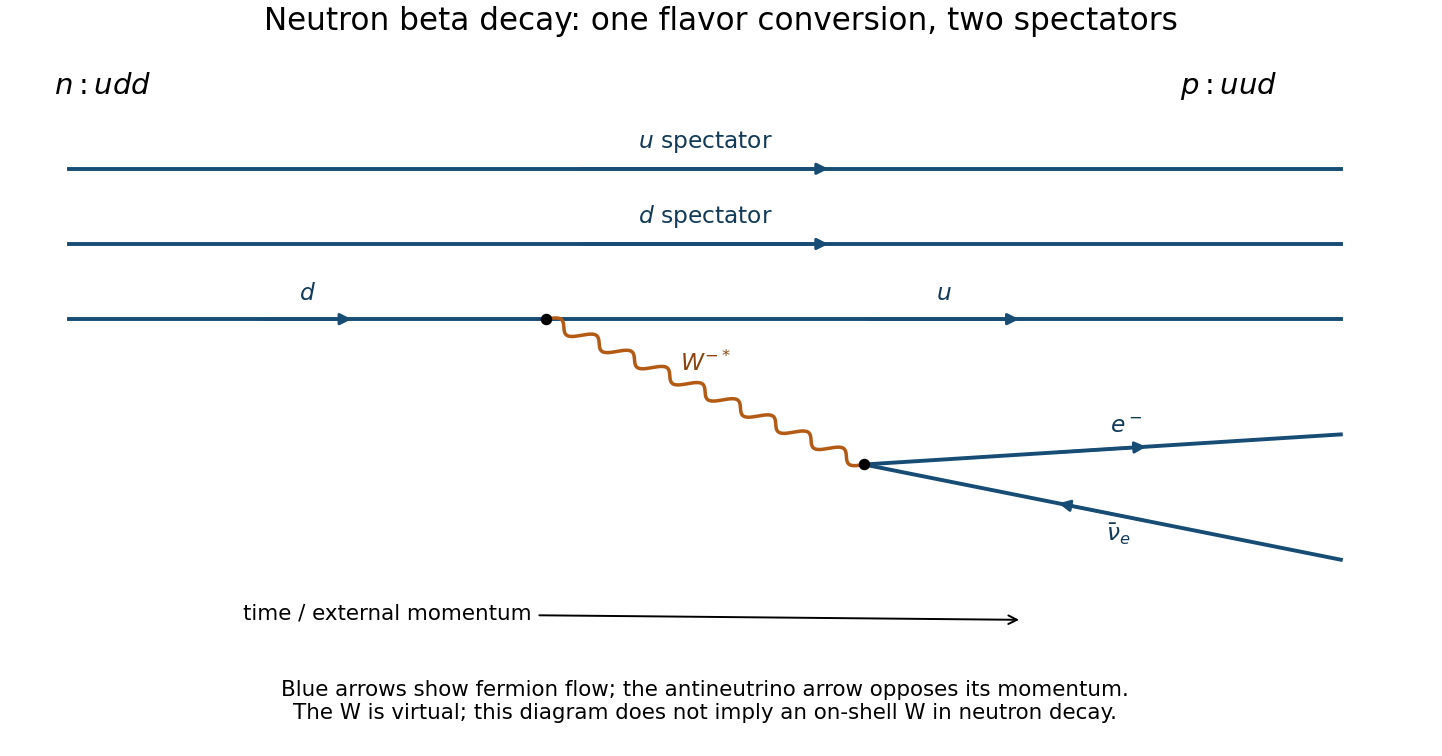
The charged weak current changes one neutron down quark into an up quark:The other two valence quarks are spectators in this tree-level Feynman diagram. The intermediate W boson is highly virtual; the available neutron decay energy is far below its on-shell rest energy. Charge is conserved at each vertex, and the electron's lepton number is balanced by the electron antineutrino.
The reversed quark-level charged current is allowed as an interaction, but a free proton cannot decay as because . Four-momentum conservation leaves no accessible final-state Lorentz-invariant phase space. The absence of this free-proton beta-plus decay is therefore kinematic, not an absence of a weak vertex. Binding-energy differences in a nucleus, or incoming energy in a collision, can change whether the corresponding conversion is possible. Exotic baryon-number-violating proton decay is a separate question and is not generated by this ordinary charged-current diagram.

Articles by others on the same topic
There are currently no matching articles.