The neutron has valence content and total spin ; its ground-state parity is positive. The two down quarks contribute charge and the up quark contributes , giving net charge zero. “Three valence quarks” specifies the net flavor quantum numbers, rather than excluding gluons or additional sea quark–antiquark components from the full Quantum chromodynamics state.
In the approximate light-flavor SU(3) classification, the neutron belongs to the ground-state baryon octet, containing eight hadrons:These are eight particle species, without counting their antiparticles again as extra members of the same octet. The corresponding antibaryons form the conjugate particle set. Within the smaller SU(2) isospin classification, the neutron instead belongs to the two-member nucleon doublet . Stating the symmetry distinguishes the usual eight-member flavor multiplet answer from the also valid two-member isospin multiplet. The baryon decuplet has different ground-state spin and is not the neutron's octet.
Uniform probability per volume does not give a uniform radial distribution. A shell of radius and thickness occupies volume , so the radial probability density function isIt integrates to one. The second radial moment isThe radial uncertainty scale in a uniform sphere supplies the position-uncertainty scale as instructed by the toy model. It is not literally the standard deviation of the scalar radius: and . Nor is a uniform spatial probability density sufficient to determine a unique momentum space wavefunction. This explicit distinction keeps the order-of-magnitude assumption separate from a fully specified quantum bound-state calculation. Replacing the radial density by a uniform density in would give a different second moment because it omits the spherical volume element.
Adopt the lower-bound scale of the Heisenberg uncertainty principle, , with the prescribed radial scale from a. Using MeV fm,For a one-sided exponential distribution of a positive momentum magnitude, , both its mean and its standard deviation are . Under the additional identification made in this estimate, set the characteristic momentum to . This identification concerns a positive magnitude; the mean of a signed momentum component in an isotropic stationary state would instead vanish.
Use the relativistic energy-momentum relation, not a nonrelativistic kinetic-energy approximation, because the momentum-energy scale is much larger than the stipulated quark rest energy:This is a characteristic energy estimated at the characteristic momentum. It is not an exact evaluation of over a fully specified three-dimensional wavefunction. An order-of-magnitude convention would give an answer about twice as large; the uncertainty principle by itself specifies a bound, not a unique confinement energy.
Adding the three characteristic quark energies from b givesThe estimate recovers a sub-GeV scale but underestimates the stated neutron mass by a factor of a few. This is consistent with its deliberately crude uncertainty and geometry assumptions; it is not a precision mass prediction.
A better model needs the actual spatial and momentum correlations, a confining interaction, and the energy in the quark and gluon fields. In Quantum chromodynamics, hadron masses are not simply the sum of three freely moving particles with tiny masses. The supplied MeV rest-energy scale resembles a light current-quark scale; a phenomenological constituent-quark mass includes substantial dressing and is a different parameter. Color, spin correlations, relativistic dynamics and sea components all matter when defining a more realistic bound-state Hamiltonian operator or performing a lattice QCD calculation. The prescribed uniform-sphere model supplies none of those extra dynamical inputs, so its discrepancy should not be repaired by an unannounced change of the given radius or mass.
The charged weak current changes one neutron down quark into an up quark:The other two valence quarks are spectators in this tree-level Feynman diagram. The intermediate W boson is highly virtual; the available neutron decay energy is far below its on-shell rest energy. Charge is conserved at each vertex, and the electron's lepton number is balanced by the electron antineutrino.
The reversed quark-level charged current is allowed as an interaction, but a free proton cannot decay as because . Four-momentum conservation leaves no accessible final-state Lorentz-invariant phase space. The absence of this free-proton beta-plus decay is therefore kinematic, not an absence of a weak vertex. Binding-energy differences in a nucleus, or incoming energy in a collision, can change whether the corresponding conversion is possible. Exotic baryon-number-violating proton decay is a separate question and is not generated by this ordinary charged-current diagram.
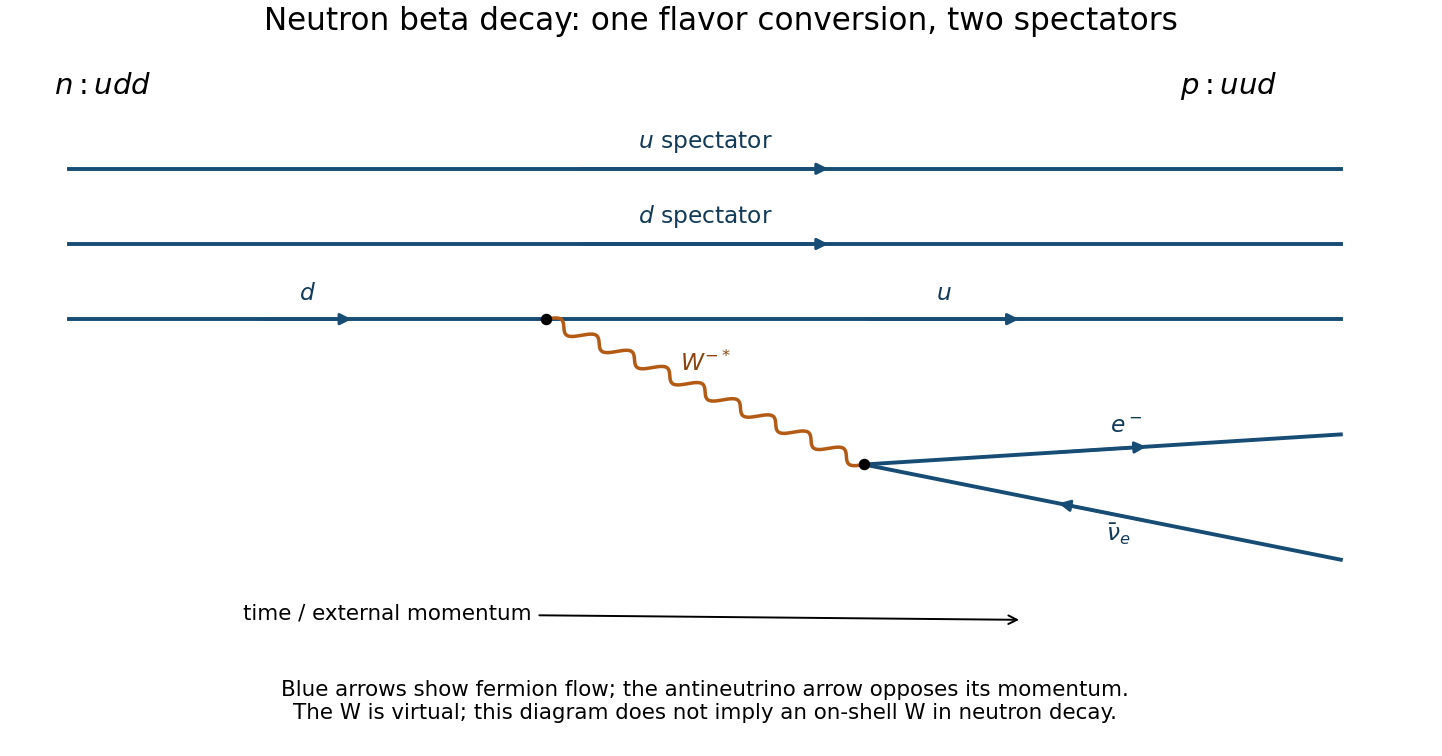

Work first in units . In the neutron rest frame, let . From ,The electron's minimum possible total energy is its rest energy. This configuration has the electron at rest while the proton and massless antineutrino move back to back with equal momentum magnitudes. Their common momentum satisfies a two-body energy balance for the remaining mass :For the maximum electron energy, minimize . Since the massless antineutrino has nonnegative energy, , with the boundary reached as its energy tends to zero. ThenAt this limiting endpoint the electron and proton have equal and opposite momenta. The proton recoils; it is not at rest. A massless neutrino has no rest frame, so “neutrino at rest” must be replaced by the precise soft-energy limit . The electron's maximum kinetic energy is the displayed total energy minus , rather than the same number. These endpoint configurations lie on phase-space boundaries; their kinematic existence does not imply a nonzero event density exactly at the boundary.
For exponential decay with mean lifetime , the state amplitude evolves as and its survival probability is . Hence the energy decay width isThe exceptionally small energy width expresses the long lifetime of this weak decay. Use , not , because is an energy width in the complex-energy convention; changing to a frequency convention introduces the appropriate factor of . The quoted lifetime is treated as the mean lifetime. If a half-life were supplied instead, one would first use . No extra logarithm is needed for the given mean-lifetime interpretation. This calculation uses the source's approximate 15-minute value rather than silently replacing it with a more precise contemporary neutron-lifetime measurement.
Articles by others on the same topic
There are currently no matching articles.