Each on-shell particle satisfies . Thus for a selected subset ,It is Lorentz invariant when the same particle labels and physical states are compared, with each energy and momentum transformed as that particle's four-momentum. No requirement that the particles share a velocity is needed. Their energies can change under interactions while their individual fixed rest masses remain the same.
A frame-dependent rule for choosing “half” is more delicate: different subsets can have different sums of rest-mass squares. If every particle has the same rest mass and the number selected is fixed, however, the displayed sum is unchanged even if the selected identities change. In a massless plasma it is identically zero for every subset. The precise condition is constancy of the selected scalar sum, not a blanket claim that every frame-dependent selection must change it.
The covariance of a selected particle momentum sum follows because, for a fixed set of particle four-momenta, their sum is a four-vector by linearity of the Lorentz transformation. Thereforeis invariant. The subset need not comprise the entire plasma, and its particles need not move together. This expression includes cross terms between different particles; it is not the sum of their individual rest-mass squares in a.
The comparison must use the same subset and the transformed four-momenta at the same chosen events. Selecting “the lowest-energy half” anew in each frame need not do that. For example, take four photons along , with energies in each direction. The two lowest in the original frame are an opposite pair and have invariant energy squared . After a boost at along , both forward photons are redshifted enough to become the lowest pair; that new collinear pair has zero invariant mass. This does not contradict covariance, because the subset changed.
If energies are resampled on a different simultaneity slice in an interacting plasma, they can also refer to different events. A physical conserved subsystem total must then include exchanged field energy and any boundary flux as appropriate. Such operational conservation requirements are distinct from the exact algebraic covariance of a sum of fixed four-vectors.
Choose the kaon momentum along and the first pion along . Momentum conservation givesBoth pions have mass . Apply the on-shell condition to the second pion, using :Substitute and . The equal daughter masses cancel, leavingWith the supplied rest energies and MeV,The second pion travels below the parent axis, atReflection in the axis gives the equivalent opposite-sign configuration. The condition requires MeV for this perpendicular first-pion geometry. The given MeV lies within that range; the geometry cannot be extrapolated to an arbitrarily boosted kaon.
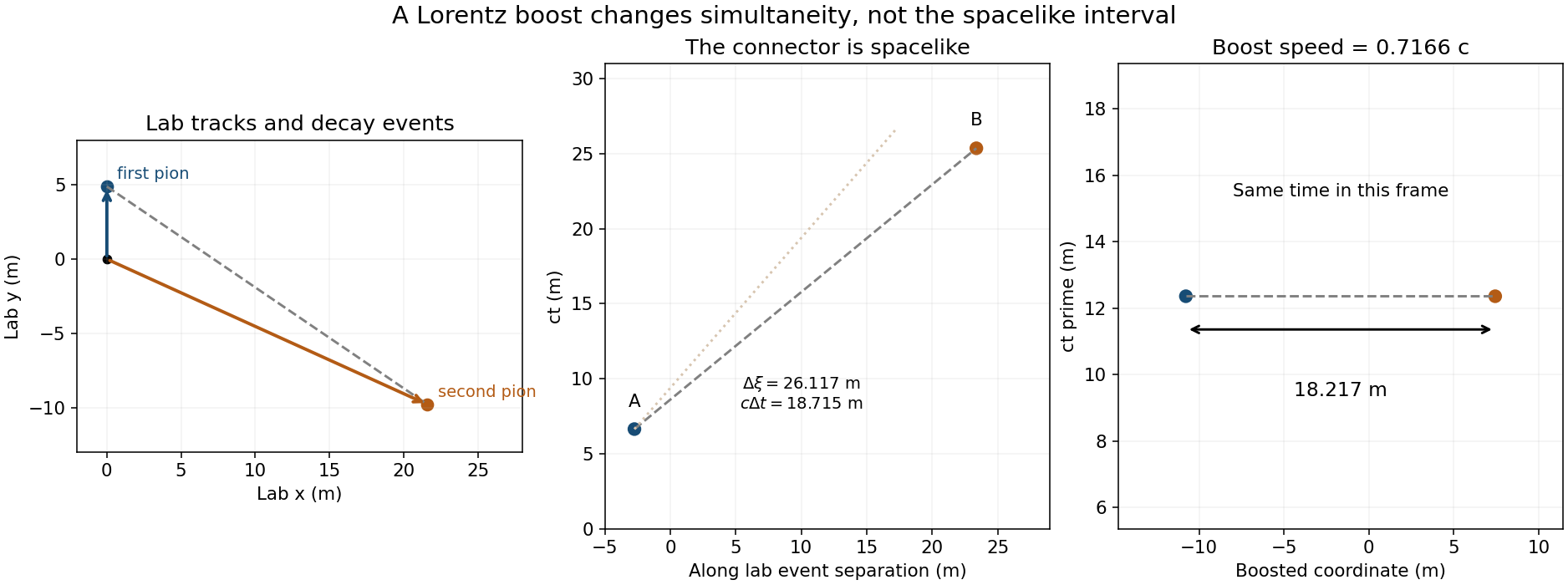

Take the kaon decay as the common origin. A pion traveling freely with constant momentum has lab decay time and position . The supplied proper survival times therefore giveConsequently the separation from the first decay event to the second isThe requested distance is the separation of the two events, not the sum of the two individual pion path lengths.
Here , so the separation is a spacelike separation. There is an inertial frame in which the events are simultaneous; in that frame their distance equals the invariant spacelike length:One such frame moves along with , of speed . The simultaneity condition is then .
The spacelike distance between daughter decay events provides an independent invariant check: the daughter four-velocity contraction givesIt produces the same distance without using the particular kaon laboratory boost. A simultaneous frame exists only when this expression is positive, as it is for these two survival times.
Articles by others on the same topic
There are currently no matching articles.