Assume and temperature-independent for the local model. The zero-field stationary points obeyFor , the favoured ordered sign is opposite to . The nonzero extrema first appear at ; their existence is not yet a coexistence condition. To find the equilibrium transition, require both and . Substituting into the free energy givesHenceAt coexistence the entire potential factorizes:It has equal minima at zero and separated by a barrier. Every fixed nonzero cubic coefficient produces a first-order transition in this quartic model, with a finite magnetization jump before the quadratic coefficient reaches zero.
For , the ordered minimum is metastable and zero is globally stable. For , the ordered state is globally stable and zero is metastable. At the zero minimum loses local stability. Thus the spinodals are and , distinct from . For , the opposite-sign nonzero state can also be a local minimum, but the cubic term favours the state of sign .
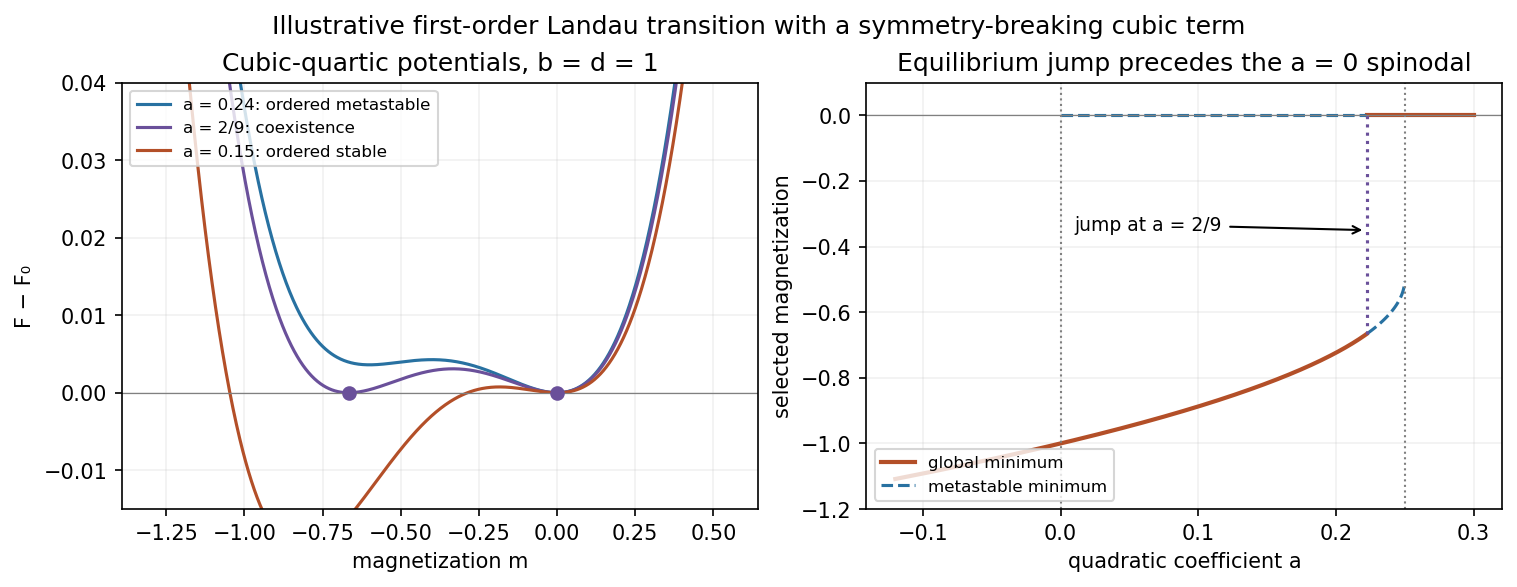

If , the transition is shifted to . With constant and , the entropy jump from the disordered to ordered phase is , giving a latent heat of magnitude . As , the jump and shift vanish and the original continuous transition is recovered.
A genuine zero-field uniaxial ferromagnet with exact spin-reversal Z2 symmetry forbids this cubic term. The modified model therefore presumes that symmetry has been changed; it must not be presented as a symmetry-allowed correction for the original ferromagnet.
Articles by others on the same topic
There are currently no matching articles.