Measure both angles from the downward vertical, as in the PDF. With the support as origin and downward coordinate ,Thus . The requested expression implicitly uses a zero-rest-length spring: its energy is . The exact Lagrangian for equal masses isExpand the cosines and count angles and velocities as first order. The cosine correction multiplying is fourth order and is dropped. After removing constants,The positive spring term in means the spring lowers its energy when the straight assembly bends. If its natural length were , this term would instead be . An unspecified ordinary natural length cannot simply be ignored; the displayed target fixes the zero-length idealization.
Put and . Applying the Euler-Lagrange equations to the quadratic Lagrangian givesA nonzero motion satisfying the specified equal-and-opposite initial displacements can have one frequency only if is a normal-mode vector. Its acceleration terms are proportional to , while the restoring terms are proportional to . HenceandThe rods swing oppositely. The hinge mass moves sideways, while the final mass has no first-order displacement: the two horizontal contributions cancel and its vertical change is quadratic in angle. In the corresponding geometric ansatz it moves vertically at twice the small-oscillation frequency to leading nonzero order, but the displayed single-frequency solution is a linearized result. The trivial case imposes no parameter condition.
Removing the hinge mass gives the exact LagrangianThe stated equations again concern its small-angle quadratic approximation. In the sum and difference coordinates this becomesConsequentlyFor unequal squared frequencies, : the rods remain aligned to first order and the end mass swings like a pendulum of length . This degenerate Lagrangian gives the difference coordinate no quadratic kinetic term, so its equation is an algebraic constraint, not a second oscillator. If , the quadratic action loses all dependence on . Its motion is then undetermined at this order; nonlinear terms or a small hinge mass must resolve the degeneracy. For larger spring stiffness the straight constrained branch is not a minimum of the bending potential, despite the absence of a finite-inertia growing mode in this strictly massless quadratic description.
Write and . With the printed Fourier transform convention, a time derivative transforms to . The retarded Green function isIts poles are , both in the upper half-plane. For close the contour above; for close below, where there are no poles. Residues giveIt is continuous at and has derivative jump , reproducing the Dirac delta function source. Thus the solution initially at rest isand vanishes for . Set . Evaluating the integral givesThe homogeneous solution constants are and . Substitution at zero gives . Causality selects this response; an arbitrarily excited prehistory would add a homogeneous solution.
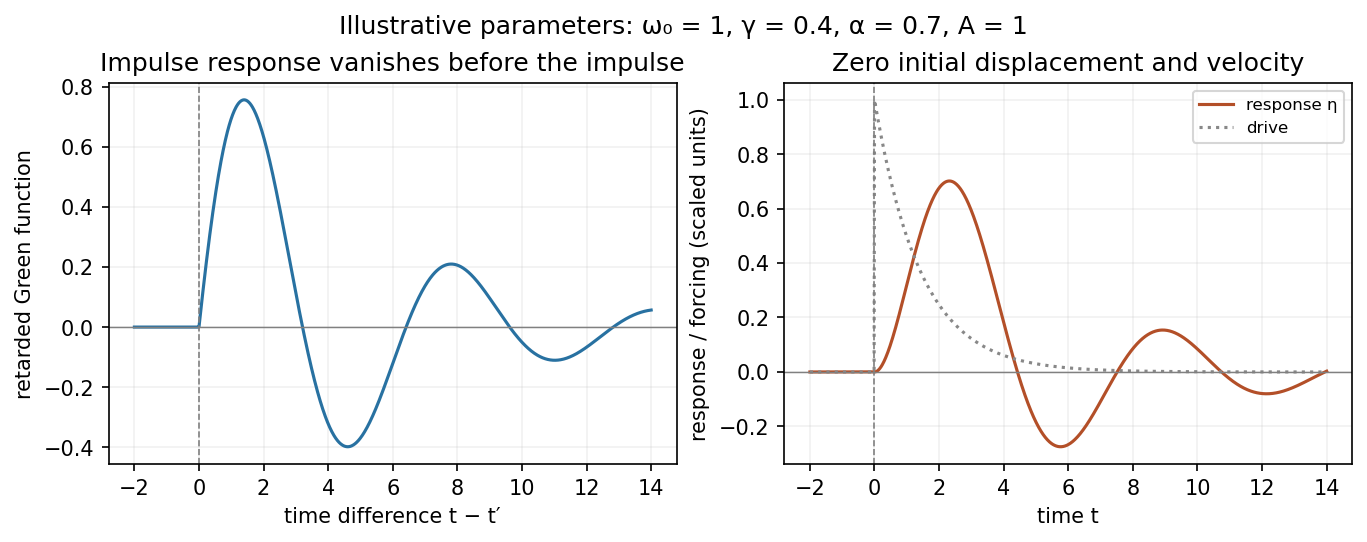
Illustrative retarded impulse response and initially resting response to a decaying drive
. Details. Use the magnetic-coupling convention of the supplied Hamiltonian; electromagnetic unit factors are absorbed into the stated and . Let and , soThe kinetic energy separates into . The symmetric gauge coupling becomesThe scalar triple product identity givesDiscarding times that total derivative, which changes endpoint terms and canonical momenta but not the trajectories, leaves
For this neutral Coulomb pair in a uniform magnetic field, the reduced Lagrangian gives the canonical momentaInvert these relations and take the Legendre transform. The velocity-linear terms cancel against their momentum contributions, givingThere is no explicit time dependence, so . There is no dependence on , so . The distinction between kinetic momentum and magnetic pseudomomentum matters: the conserved vector is , not generally . The mechanical centre-of-mass momentum generally varies as the separation changes. A neutral pair can therefore have accelerated centre-of-mass motion in a magnetic field.
Interpret as the zero-pseudomomentum sector, rather than assuming the mechanical centre of mass is at rest. Define . Hamilton's equations areFor example, differentiating the relative kinetic term with respect to gives because the cross-product matrix is antisymmetric. Hamilton's minus sign then gives the positive cross-product term in . The Coulomb force is attractive. A change to a moving frame need not preserve a pure magnetic external field, so setting is a restriction on the chosen solution family.
Differentiate and substitute the previous momentum equation:For a planar vector, , which gives the two component equations with the printed signs.
For circular relative motion of a neutral Coulomb pair of separation radius , and . ThusSince , the two signed frequencies areOne is positive and the other negative. At they give the two senses of an ordinary Coulomb circular orbit; equal masses remove the term linear in from their average. With negligible Coulomb attraction and , the branches approach and , the appropriate signed free cyclotron limits.
The actual particle paths follow by integrating the centre-of-mass velocity:Both particles move on circles about the same fixed guiding centre with a constant separation and common signed frequency, with a possible relative phase reversal encoded by a negative coefficient. Their mechanical centre of mass also generally circles. This is consistent with magnetic deflection plus a central mutual force; central interaction alone does not eliminate the external Lorentz forces.
In canonical coordinates, the Poisson bracket isIn particular, , , and . Hence and the coordinate–coordinate and momentum–momentum brackets vanish.
The chain rule along a Hamiltonian trajectory givesThe Poisson bracket of time-dependent conserved quantities follows by defining . The ordinary product rule and Jacobi identity implyTo see the Hamiltonian part explicitly, Jacobi rearranges to . Therefore implies , even when the conserved functions depend explicitly on time.
A locally invertible time-independent canonical transformation is canonical whenThe proposed coordinates are locally independent only for , since their configuration-space Jacobian has determinant . Work on one sign branch of .
The mixed brackets first requireThe last bracket condition isExpressing in the coordinates turns this into . Thus their shift one-form is closed and locally is the differential of an arbitrary smooth function . The canonical momenta for a squared coordinate therefore have the general local formConversely, any such satisfies all bracket conditions. This does not give one nonsingular transformation through , or identify the two sign branches globally.
Choose . Then
For a real scalar triplet, with metric signature , differentiating the Lagrangian density gives and . HenceFor a constant internal rotation parameter, the variation isEach bracketed tensor is symmetric in , so its contraction with the antisymmetric symbol vanishes. This rotates the three field components, not the space coordinates; both the kinetic term and common mass term are invariant.
For a first-principles Noether current derivation, temporarily let depend on spacetime. The terms proportional to still cancel, leavingOn a solution of the field equations, the action variation for a compactly supported vanishes after integration by parts. Thus . To match the charges printed in the question, use the equivalent overall sign convention for the SO(3) Noether current of a real scalar tripletArbitrariness of gives three continuity equations. Their charges are exactlyAn overall reversal of all currents is immaterial; the minus sign above keeps the generator convention distinct from the supplied charge convention.
Direct verification is also short:The mass term and the products of equal-type derivatives cancel by antisymmetry; integration by parts produces the boundary term. The charges are conserved when these integrals exist and the net boundary flux vanishes: sufficiently decaying fields on all space, periodic boundary conditions, or suitable symmetry-preserving no-flux boundaries suffice. Arbitrary open boundaries do not. A common constant is necessary for this internal symmetry; its positivity is a stability issue, not needed for the algebraic conservation proof.
The Euler-Lagrange field equation is . ThereforePut , , and . The chain rule gives and . Cross terms cancel and , soThus the boosted scalar field is another solution for any constant rapidity. The nonlinear term in the nonlinear Klein-Gordon equation is unchanged because it is a local function of the scalar itself.
Use the amplitude placement in the original PDF: . Introduce the actual peak and , so . Its derivatives satisfyThe static equation is . Matching the constant and terms givesChanging the sign of leaves the profile unchanged. If is instead defined as an outside prefactor, as in the held TeX transcription, its value is , not the PDF's . This notation discrepancy does not change the physical profile.
The nonconstant positive power-law nonlinear Klein-Gordon pulse is even, smooth, has peak at zero and decays as . The requested sketches below compare several powers with illustrative . For odd , its negative is also a solution. A separate constant branch occurs for : the positive equilibrium has , or in the PDF convention. The zero solution is another equilibrium, obtained as a limiting profile rather than finite positive .
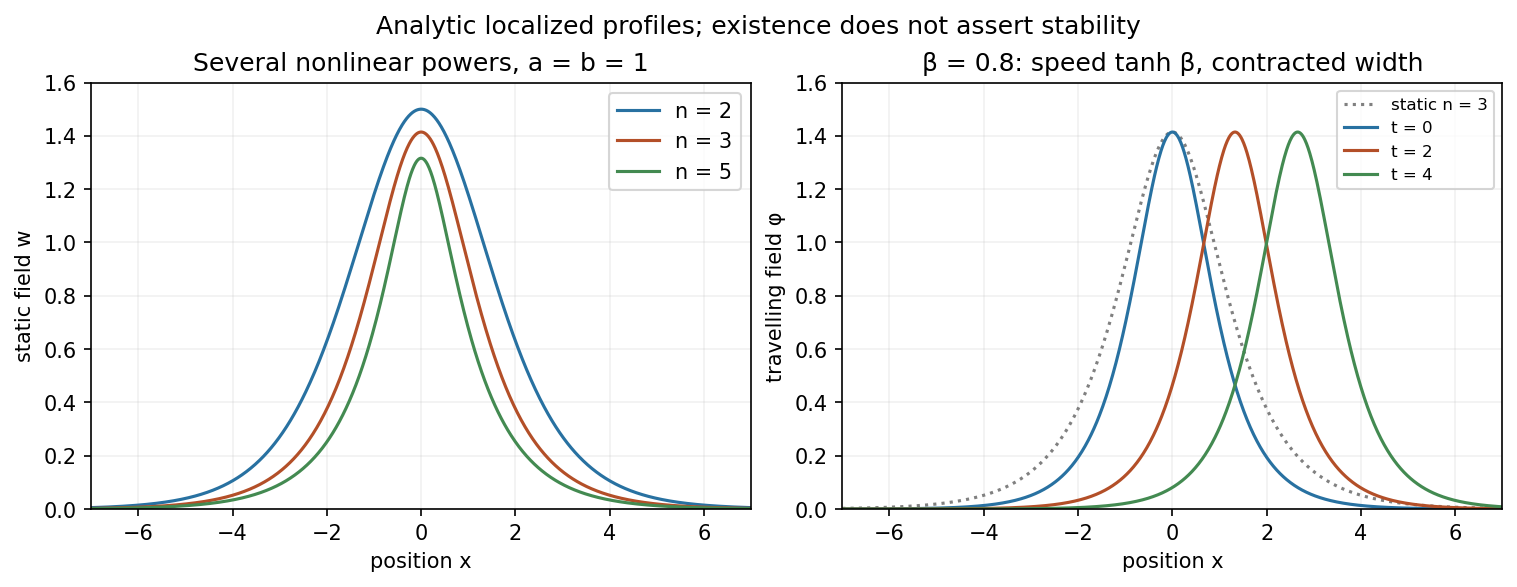
Now apply the Lorentz boost with rapidity to the static field. It givesFor positive , the centre moves to the right at , with speed one the wave-speed unit. The peak stays and the width contracts by . The shape translates without changing in time. This establishes a travelling solitary pulse; it does not by itself prove stability or elastic multi-pulse scattering.
The expansion is a local phenomenological description in a small scalar order parameter near a transition. Its coefficients summarize microscopic physics and generally depend smoothly on temperature. At zero field, spin-reversal Z2 symmetry requires even powers of magnetization; the conjugate field supplies the term . The additive does not affect minimization with respect to .
For the ordinary continuous-transition quartic model, ensures stability, and the quadratic coefficient changes sign, with . If vanishes or is negative, stabilizing higher powers are required and the phase structure can change. Treating one uniform magnetization neglects spatial gradients, fluctuations and domains; the resulting exponents are predictions of mean-field theory.
Equilibrium requires . On the critical isotherm , soHere is defined by at the critical temperature, or equivalently . The positive quartic coefficient selects a stable equilibrium, including the flat but stable zero-field thermodynamic critical point.
Differentiate the equation of state at fixed temperature:Above the transition, zero-field equilibrium has . Below it the stable pure phases have . ThusThis is the mean-field magnetic-susceptibility amplitude ratio. Below the transition, take a one-sided response in a selected ordered phase: the globally minimizing magnetization switches discontinuously between opposite phases when crosses zero. Its two-sided derivative at precisely zero field is therefore not the finite pure-phase magnetic susceptibility used in the ratio.
Assume and temperature-independent for the local model. The zero-field stationary points obeyFor , the favoured ordered sign is opposite to . The nonzero extrema first appear at ; their existence is not yet a coexistence condition. To find the equilibrium transition, require both and . Substituting into the free energy givesHenceAt coexistence the entire potential factorizes:It has equal minima at zero and separated by a barrier. Every fixed nonzero cubic coefficient produces a first-order transition in this quartic model, with a finite magnetization jump before the quadratic coefficient reaches zero.
For , the ordered minimum is metastable and zero is globally stable. For , the ordered state is globally stable and zero is metastable. At the zero minimum loses local stability. Thus the spinodals are and , distinct from . For , the opposite-sign nonzero state can also be a local minimum, but the cubic term favours the state of sign .
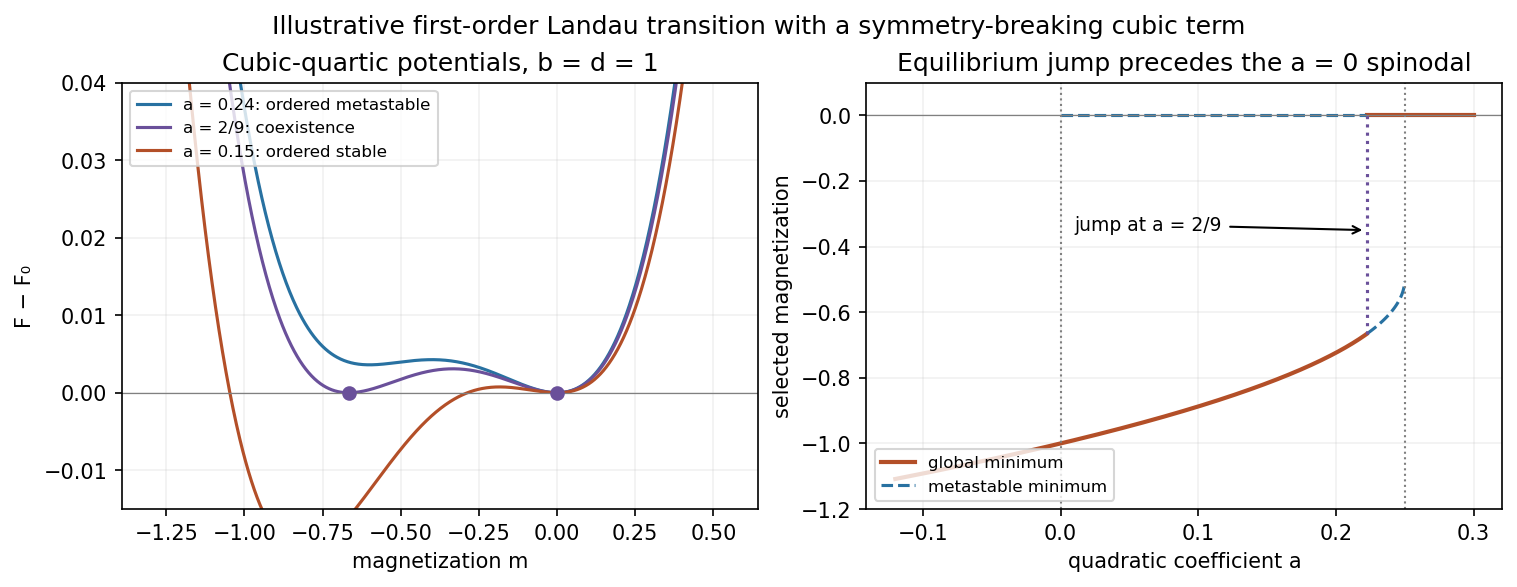


If , the transition is shifted to . With constant and , the entropy jump from the disordered to ordered phase is , giving a latent heat of magnitude . As , the jump and shift vanish and the original continuous transition is recovered.
A genuine zero-field uniaxial ferromagnet with exact spin-reversal Z2 symmetry forbids this cubic term. The modified model therefore presumes that symmetry has been changed; it must not be presented as a symmetry-allowed correction for the original ferromagnet.
Articles by others on the same topic
There are currently no matching articles.