For the supplied Lagrangian, variation with respect to usesThus . In the Lorenz gauge,For real external fields and driving, the conjugate equation has acting on . The supplied model has no term; one must not insert such a term from a different minimally coupled Lagrangian.
First fix the source at the spatial origin. Fourier transform replaces by and by in the free term. Multiplication by a static background becomes a momentum convolution; the derivative in acts on the Green function, so it carries the internal momentum . ConsequentlyThe transformed point source supplies the right-hand side one. The signs follow from in these conventions.
Source-position qualification. For a nonuniform , the general Green function is not translation invariant. In the printed basis , its coefficient must also depend on , and the convolution contains an extra factor . The displayed source equation is valid for , or with the background itself expressed in coordinates centred on that source. Equivalently, a general spatial Fourier Green function has two momentum arguments and a momentum-delta-function source. Staticity alone permits the time-difference transform, not a general position-difference-only transform.
The delta function in the artificial constant potential collapses the convolution. Put and . ThenInverse Fourier transform gives the stated real-frequency integral with exponential . For , the poles have opposite real parts and common imaginary part . For , both are imaginary, at . They remain in the upper half-plane if , or the lower half-plane if . At equality they merge into a second-order pole at . For one pole reaches the real axis, requiring a prescription.
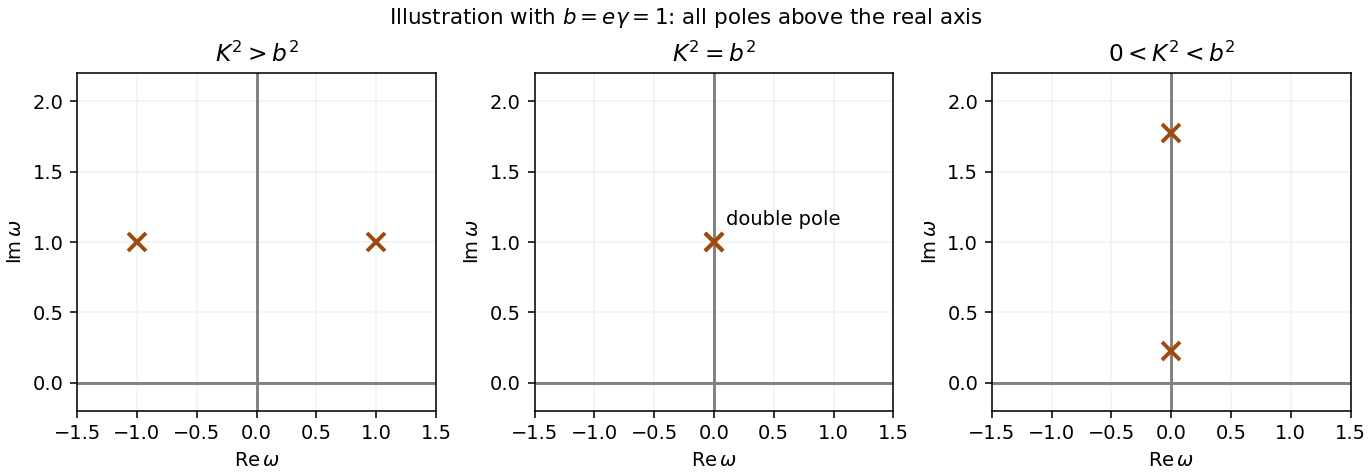

Let and . Because , close below for and above for . The lower closure is clockwise. The two residues sum to . Hence, for nonzero ,In particular, the printed sign with gives zero for and an advanced Green function for . Reversing that sign puts the poles below and gives a retarded Green function. Both solutions have the unit derivative jump required by . If , the bare integral has real-axis poles and requires an additional contour prescription; a unique retarded or advanced answer cannot be inferred without one.
Articles by others on the same topic
There are currently no matching articles.