Take positive toward positive from the downward vertical, as in the source diagram. The mass has position and velocityThus and . Expanding the squared speed givesThe prescribed support coordinates are functions of time, rather than additional dynamical variables. Terms depending only on time do not affect the Euler-Lagrange equation for , but have been retained here to obtain the inertial-frame kinetic and potential energies directly.
The derivatives needed in the Euler-Lagrange equation areThe terms proportional to cancel after differentiation, leavingWith and ,Hence the vector equation is . In the translating support frame, is the inertial force. The rod's tension passes through the hinge and contributes no torque about it. The same torque equation therefore has an immediate mechanical interpretation.
For horizontal forcing the exact angular equation isWrite with slowly varying and . To leading order in the slow-to-fast frequency ratio, , which balances the rapid forcing. Expand the right-hand side to first order in :During one fast period treat as fixed. The averages and vanish, whereasThe leading averaged equation is thereforeThe effective force comes from correlation between the rapid displacement and the rapidly varying driving torque; simply averaging the driving cosine to zero misses it. This keeps the leading nonzero fast-motion contribution, proportional to , while neglecting terms suppressed by additional powers of or of the slow rate divided by . The gravitational expansion at order is smaller in the stated high-frequency regime. The resulting slow frequencies must also remain small compared with for averaging to be self-consistent.
For a fixed-pivot pendulum the angular inertia is , so . Integrating the averaged force gives, up to an arbitrary additive constant,Linearizing about givesHence the downward state becomes linearly unstable forAt its quadratic restoring term vanishes: the leading quartic coefficient is positive, so it is marginal at linear order, rather than already a local maximum. Above threshold the two stable tilted equilibria satisfy . Horizontal vibration therefore destabilizes the downward orientation and produces tilted minima; it does not stabilize the upward orientation in this model. Because , the threshold is compatible with the assumed small support excursion.
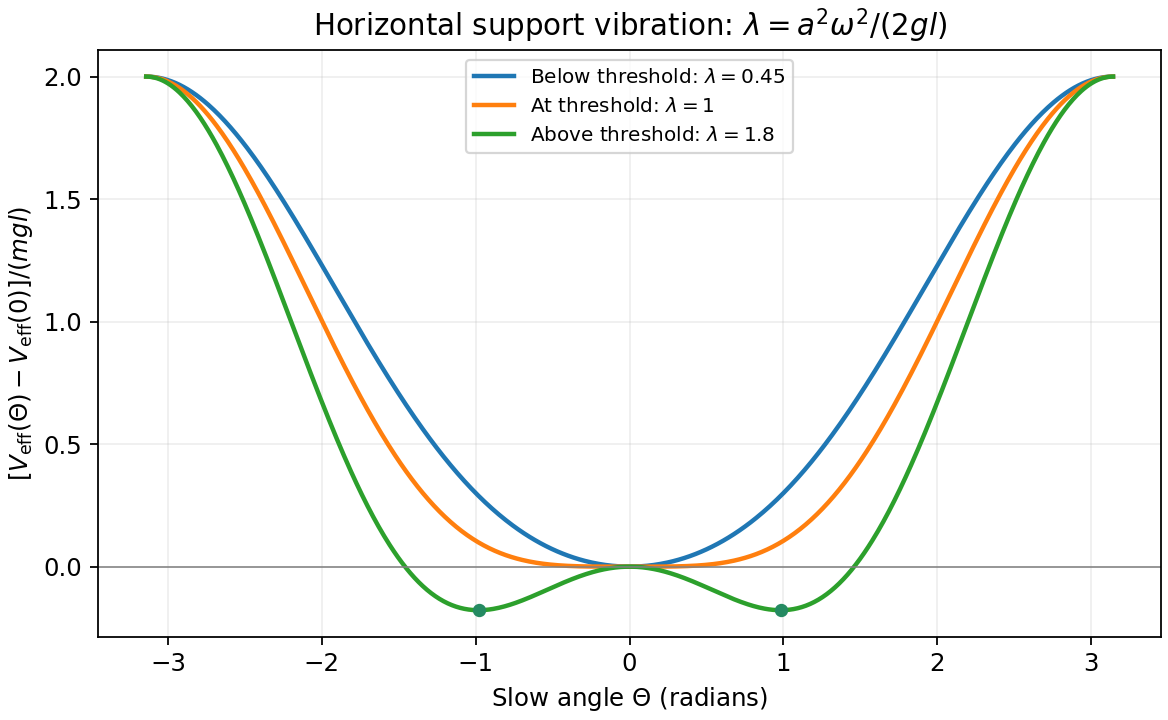
Original averaged pendulum potentials below, at and above the horizontal-vibration instability threshold
. Details. 
Articles by others on the same topic
There are currently no matching articles.