The sign can be checked independently by multiplying the equation by . With ,For periodic motion the total-derivative near-field term averages to zero, so positive gives a radiative energy loss, consistent with the slow poles' damping. Negative acts as energy gain in this model.
For the comparison equation as printed, , the response denominator instead is , with exact polesThus ordinary positive damping in that sign convention requires , the opposite sign from slow radiation damping in the third-derivative equation. The word “damped” does not override the explicitly printed minus sign. With the usual equation , positive gives the familiar lower-half-plane poles.
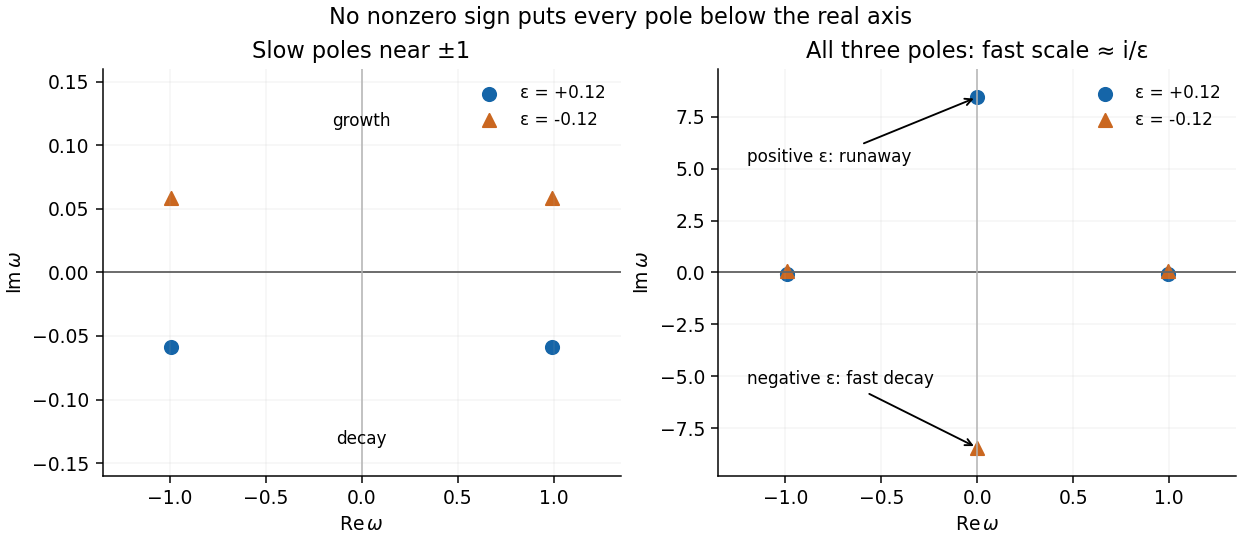
Exact pole locations for small positive and negative radiation-reaction parameters, including the singular fast pole
. Details. 
Articles by others on the same topic
There are currently no matching articles.