Use exactly the supplied inverse Fourier transform convention , with . Then and . The transformed equation isThis algebraic inverse still needs a pole prescription to select the time-domain solution, particularly when a pole is on the real integration contour.
A retarded Green function obeys for andFor a bounded or suitably tempered response represented by the real-axis Fourier integral, analyticity in the upper frequency half-plane is required, with suitable behaviour at infinity. For negative , decays on a large upper semicircle. If that half-plane has no singularities, contour closure gives zero response before the source. Lower-half-plane poles give factors decaying for positive time. Real poles are approached from below for a retarded prescription; at , for example, .
The causality versus stability of a Green function distinction matters: an unstable initial-value problem can still have a strictly causal response that grows exponentially. Such a response has no ordinary real-axis Fourier transform. Its inverse Laplace transform must run on a frequency contour above its growth poles. Thus “upper poles violate causality” is correct only with the stable/tempered real-axis Fourier assumptions, not as an unconditional theorem about differential equations.
At the algebraic poles are ; a retarded limiting prescription displaces them infinitesimally below the real axis. Set , with and . The denominator becomesConsequentlyFor positive these two poles move below the real axis, giving slowly damped oscillations. For negative they move above it and the slow oscillations grow. This is only the slow part of the radiation-reaction oscillator pole structure; the third pole must still be examined.
The sign can be checked independently by multiplying the equation by . With ,For periodic motion the total-derivative near-field term averages to zero, so positive gives a radiative energy loss, consistent with the slow poles' damping. Negative acts as energy gain in this model.
For the comparison equation as printed, , the response denominator instead is , with exact polesThus ordinary positive damping in that sign convention requires , the opposite sign from slow radiation damping in the third-derivative equation. The word “damped” does not override the explicitly printed minus sign. With the usual equation , positive gives the familiar lower-half-plane poles.
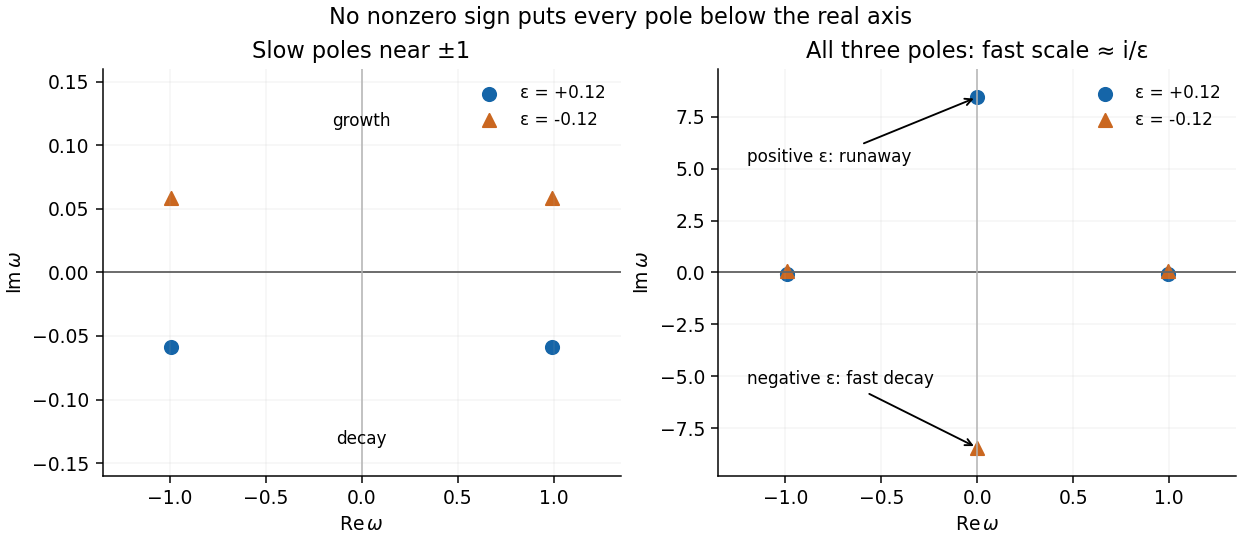
Exact pole locations for small positive and negative radiation-reaction parameters, including the singular fast pole
. Details. 
Substitute into the cubic denominator. Its leading terms areThe nonzero large root obeys , soThe sum of the three roots is exactly . Combining this with the two slow-root expansions gives the refinement .
For physical radiative sign , the fast pole lies high in the upper half-plane. Its homogeneous mode is , a runaway. It prevents a bounded retarded response with the real-axis Fourier prescription even though the two slow poles are damped. If , the fast pole decays but the slow pair grow. No nonzero real sign puts every pole in the lower half-plane.
There are two distinct boundary choices. A strictly causal initial-value Green function exists and includes the growing mode for ; it must be represented by a Laplace/Bromwich contour above that pole rather than the stated ordinary Fourier integral. Alternatively the real-axis inverse gives a bounded stationary no-runaway response and preacceleration: for , upper closure encloses the fast pole and yields a nonzero response before the force. Its leading contribution isThis follows from the upper-pole residue and the factor from upper contour closure. Eliminating runaway growth by a future boundary condition therefore sacrifices strict retardation on the short scale .
The singular root also shows why a perturbative expansion around only misses the problem. For a low-frequency effective description, order reduction of a radiation-reaction oscillator uses in the small correction and gives . For positive this approximate second-order equation has a causal damped response and discards the fast mode outside its intended regime; it does not make the original third-order equation simultaneously bounded and retarded.
Articles by others on the same topic
There are currently no matching articles.