Under with constant real , the field and its complex conjugate acquire opposite phases. These cancel in , , , and . The Lagrangian density therefore has the particle-number phase symmetry, a global circle group .
For a spacetime-dependent real ,Writing , the change in the Lagrangian density isThis is not generally zero or a boundary term. Thus the symmetry is global, with no arbitrary local phase symmetry. A compensating gauge field and gauge-covariant derivative of a charged scalar field would be required to promote it to a local redundancy.
Treat independently in the Legendre transform in mechanics. Their canonical momenta areThe time-derivative terms cancel in , giving the Hamiltonian densityThe first-order time dependence makes the momenta constrained; this direct calculation still gives the canonical density. In physical terms this is the grand-canonical Hamiltonian of a Bose field, . The physical energy density is obtained by adding back. A stationary field in this chemical-potential frame has the usual factor in the physical frame.
Complete the square:For uniform or periodic boundary conditions, or in the homogeneous bulk, both nonconstant terms are nonnegative and vanish simultaneously atThe ground states form a circle. A particular nonzero is changed by every nontrivial phase rotation, although the full family is invariant. Selecting one such mean-field theory state therefore exhibits spontaneous symmetry breaking of . This describes phase selection in the thermodynamic limit; an exact finite-system particle-number eigenstate need not itself have a nonzero field expectation.
Choose the real representative . For ,and the fourth power through quadratic order isIn , the linear terms and the terms cancel because . The remaining potential contribution is .
The time-derivative contribution isIts first term is a total derivative and contributes only a temporal boundary term for fixed endpoint fields. Since is uniform, the gradient contribution is simply . Dropping that boundary term and the constant, the quadratic condensate fluctuation Lagrangian isThe omitted cubic and quartic interactions describe scattering between these small fluctuations; they do not enter the linear normal mode calculation.
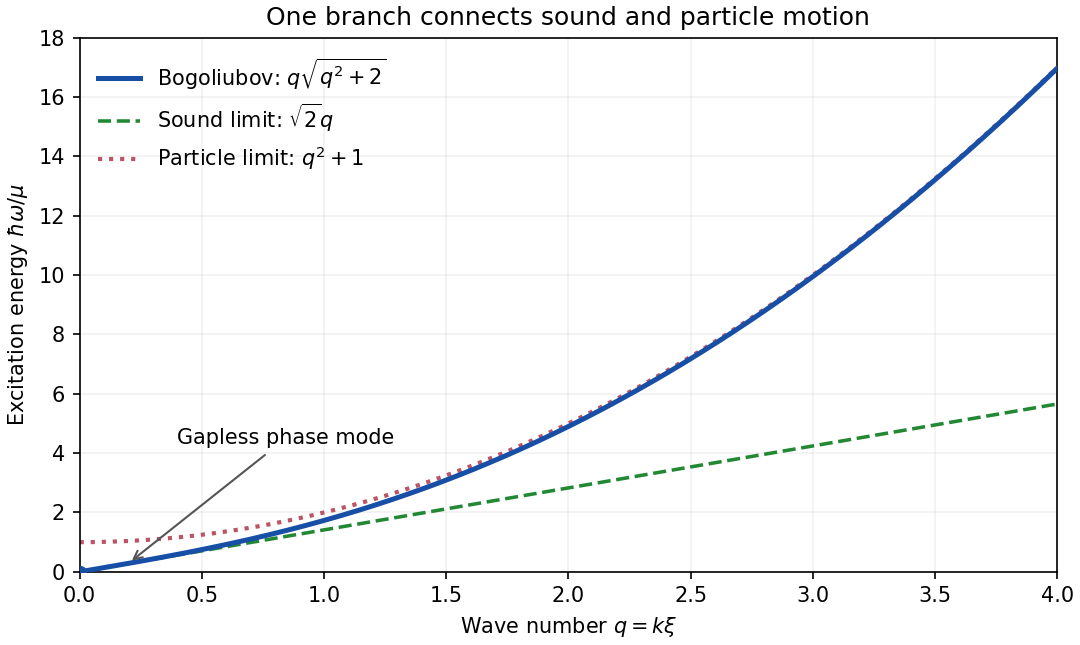
For independent , the derivatives needed in the Euler-Lagrange field equation areConsequently the two conjugate field equations areWrite with real components, and put . Separating real and imaginary parts givesFor each real field take the real part of a complex plane wave amplitude, . With the two equations becomeA nonzero normal mode requires their determinant to vanish, soThe positive-frequency Bogoliubov quasiparticle dispersion is thereforeThere is also the negative-frequency conjugate solution, as required for real component fields. Since , , consistent with the stability of the chosen uniform ground state.
At long wavelength,This is the sound-like Goldstone mode of the broken global continuous symmetry. A spatially uniform infinitesimal phase change is , entirely in the direction, and costs no potential energy. Slow spatial variations acquire gradient energy and propagate as sound. Thus the dispersion relation realizes Goldstone's theorem through a gapless excitation; it is not a massive phase oscillation.
The amplitude and phase are canonically paired by the first-order time derivative in the quadratic condensate fluctuation Lagrangian. There is one positive-frequency branch, rather than an additional independent amplitude branch of a relativistic second-order-time theory. At high momentum,so the same branch becomes particle-like. The healing length sets the crossover scale.

Articles by others on the same topic
There are currently no matching articles.