For a short-range potential, an incident plane wave of unit amplitude and wave vector has the large-distance scattering wavefunctionThe coefficient is the scattering amplitude. For a central potential it depends only on the scattering angle . The incident probability current is , while the scattered radial current is to leading order. Their ratio givesThese are the differential scattering cross-section and total cross section for elastic scattering with the same incident and outgoing wave number.
The expression is asymptotic: it specifies the outgoing wave's leading term, not its finite-distance radial corrections or its form inside the interaction region. In particular, for angle-dependent , the spherical term by itself has an angular-Laplacian contribution of order to the free wave equation, which is cancelled by subleading terms in the exact solution.
In the first Born approximation, with incident and outgoing wave vectors , put . For elastic scattering,Choose the polar axis along . The angular integral isThe radial Dirac delta distribution then givesThus, introducing the dimensionless shell strength ,The forward value is the continuous limit . This is the delta-shell Born amplitude, with its angular dependence expressed through the momentum transfer.
Away from the shell, the reduced radial equation is free. Regularity at the origin and the definition of the S-wave phase shift giveThe reduced radial wave function is continuous at ; otherwise its second derivative would contain a delta derivative not present in the equation. Integrating the equation across the shell gives the jumpDivide by the common shell value and substitute the two free solutions. This yieldsIf the shell value vanishes, use the undivided matching equations or a continuous limit rather than this logarithmic-derivative division. For an explicit phase shift of a delta-shell potential, write and . The cotangent addition formula givesThe phase is defined modulo ; choose its branch continuously as energy or coupling varies. At zero coupling the physical phase shift is zero.
The scattering length is . Since and , the exact phase shift gives, away from the pole,Thus plot against , so that both axes are dimensionless.
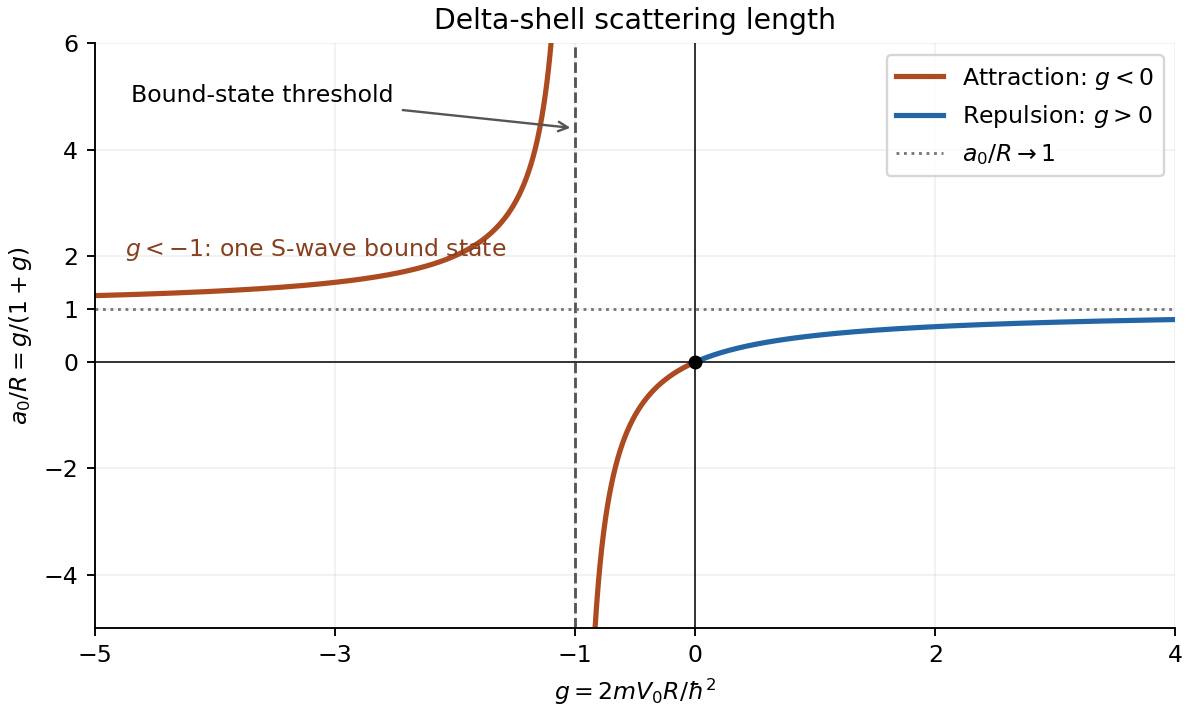
Delta-shell scattering length versus dimensionless coupling, with the bound-state threshold at g = −1
. Details. 
For repulsion, , the curve rises from zero to the horizontal asymptote , staying between zero and one. For weak attraction, , the scattering length is negative and tends to as . For stronger attraction, , it is positive and greater than , tending to as and to as . Its only zero is .
The pole at is the zero-energy threshold of an S-wave bound state. To see this directly, use inside and outside for energy . The same derivative jump givesThis approaches as and admits a positive for . At the threshold the scattering length diverges; this is a zero-energy scattering resonance, not a divergence of the finite-energy cross-section beyond its partial-wave unitarity bound. These are the main features of the scattering length of a delta-shell potential.
The delta-shell Born amplitude is first order in the potential strength:It retains finite-energy angular dependence and includes the leading weak-coupling contributions of all partial waves. By contrast, the supplied is the zero-energy limit of the exact S-wave scattering amplitude. It is isotropic, depends nonlinearly on , and captures the scattering-length pole missed by first-order perturbation theory.
At finite energy the exact S-wave amplitude is insteadwhich is generally complex and obeys elastic unitarity. Its zero-energy limit is for finite scattering length. Thus the two expressions printed in the question represent different approximations; the energy-independent S-wave expression is not the full finite- result of part (c).
Their common regime requires both weak coupling and low energy:Then , soConsequentlyin that joint regime. Low energy alone does not remove the nonperturbative denominator , while weak coupling alone does not remove higher-partial-wave angular dependence.
Articles by others on the same topic
There are currently no matching articles.