With the Minkowski metric , the momentum conjugate to the real field vector is . The Hamiltonian density isAssume the potential has a global minimum and the boundary conditions permit a constant minimizing field. ThenThe bound is attained byThe homogeneous vacuum minimum criterion proves existence of a homogeneous lowest-energy configuration under those assumptions. On infinite space one subtracts the constant vacuum energy before comparing finite energy differences. This identifies the classical vacuum configuration; it does not assert that the quantum field has no fluctuations.
The claim does not follow from “no derivative dependence in ” alone. For example, the allowed functional form is unbounded below, so there is no state of lowest energy to identify. Boundary conditions forcing different vacua at opposite ends can instead require an inhomogeneous minimum, such as a domain wall. The positive quartic potential used in the following parts does have homogeneous minima, so these caveats do not obstruct its vacuum calculation.
Any constant real orthogonal matrix acting by preserves both the Euclidean field-space norm and the kinetic term. The full internal symmetry is , with connected component ; reflections add a discrete component.
For , the vacuum manifold is the circle . Expand about the chosen point as , . The potential becomesThe kinetic terms remain canonically normalized real-scalar kinetic terms. Comparing the quadratic potential with givesThere is one massive radial mode and one massless tangential Goldstone boson. A chosen vacuum leaves only the reflection that fixes that point, so there is one broken continuous generator. For negative the chosen point lies on the opposite side of the same circle and the mass depends on ; the radius is . If , the vacuum circle collapses to the origin, no continuous generator is broken, and both quadratic masses vanish without either field being a Goldstone mode. The nonzero- assumption is essential to the spontaneous-breaking interpretation.
At an arbitrary nonzero vacuum write , where . The Hessian matrix of the potential isOn the vacuum circle this reduces toIt has eigenvalue along and eigenvalue zero along the one perpendicular direction. Rotating the vacuum conjugates this matrix by an orthogonal matrix and cannot change its eigenvalues. Thus every point on the circle has exactly one tangential massless Goldstone boson.
Geometrically, motion along the circle costs no potential energy whereas motion normal to it does. The circle's dimension, equivalently , is independent of its point. Counting the number of real field components would instead give two and would incorrectly count the massive radial direction as a Goldstone mode.
A real antisymmetric generator of the connected rotation group isChoose . Under and , the gauge covariant derivative transforms in the same way as the field. Include the canonical gauge kinetic term so the vector's mass normalization is specified.
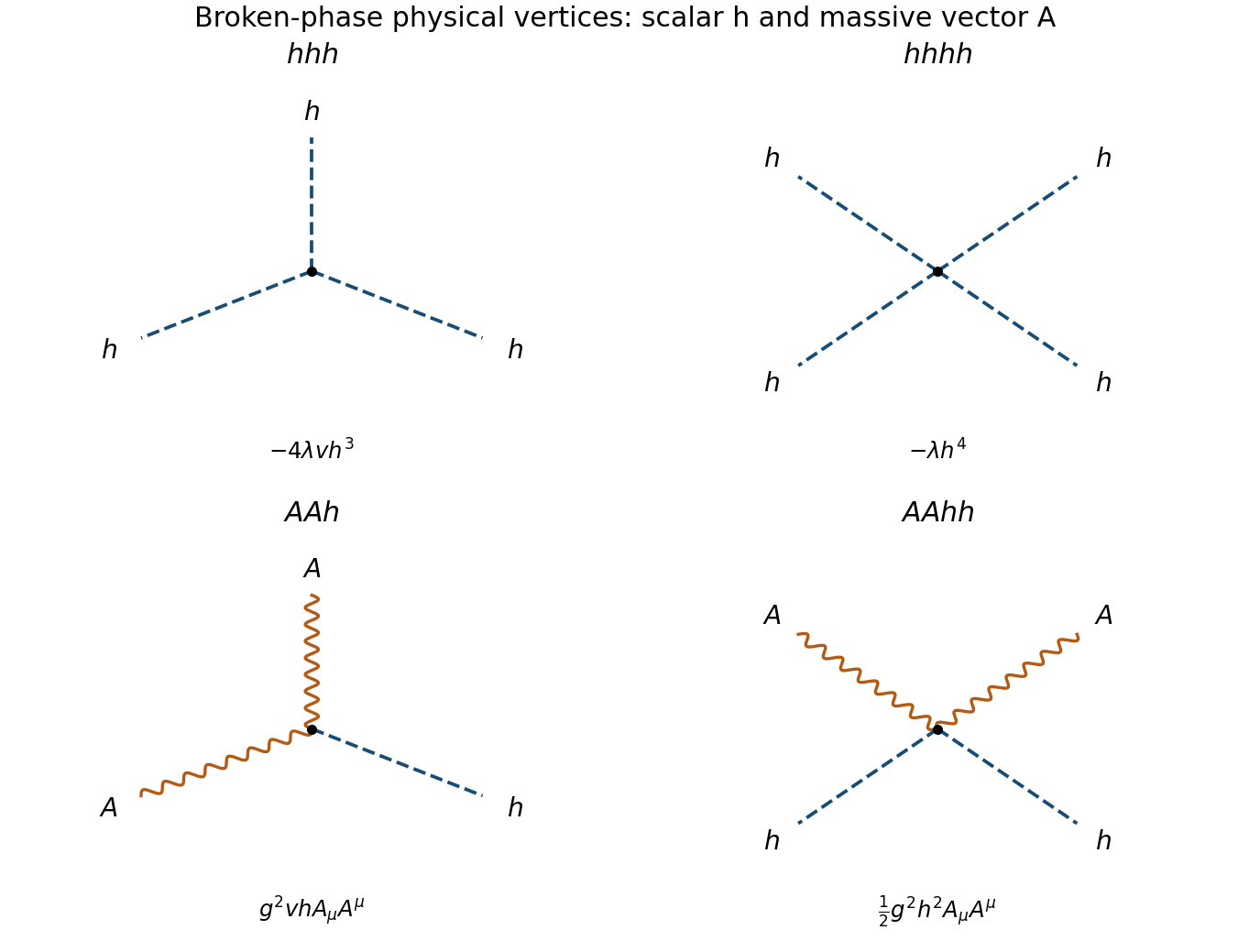
In unitary gauge, . The relevant Lagrangian density isReading the quadratic vector term as givesThe angular scalar supplies the longitudinal polarization of the massive vector; it is not a separate physical massless particle after gauging. The physical scalar still has .
The interactions among the physical fields areThus the complete physical vertex list is , , , and . An Abelian gauge kinetic term generates no or self-interaction. Gauge-dependent Goldstone vertices in another gauge do not add physical particle species to this list. These statements concern the broken phase ; when the unitary-gauge broken-phase parametrization is unavailable.

Articles by others on the same topic
There are currently no matching articles.