There are exactly four homeomorphism types: the two-sphere, real projective plane, torus, and Klein bottle.
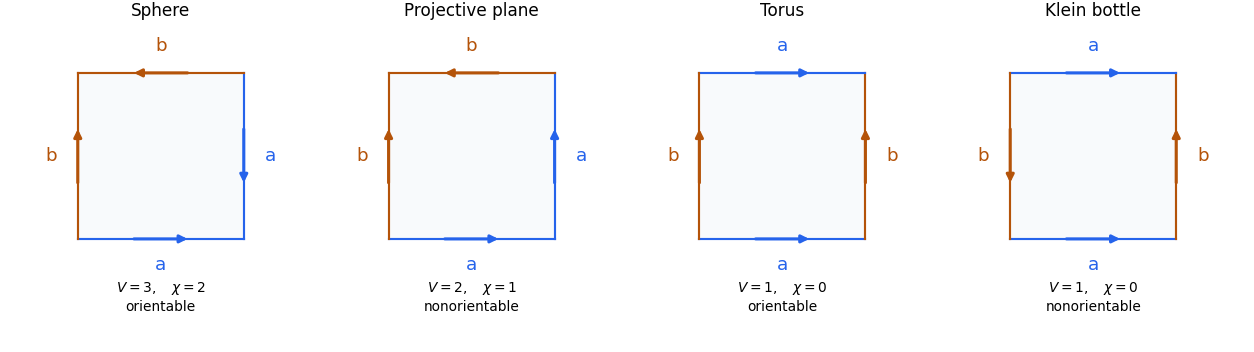
For completeness, enumerate all pairings. Four sides have three pairings; each pair can be matched in either direction, giving twelve signed pairings before symmetries. Up to cyclic relabelling, the repeated labels are either adjacent, of form , or alternating, of form , where . The second adjacent pattern rotates to the first. Endpoint identification gives the following table:Here the quotient always has two edge classes and one face, so its Euler characteristic is . To reproduce the vertex count, label consecutive square vertices . For paired sides , a same-direction pairing identifies with and with ; a reversed-direction pairing identifies with and with , with indices modulo four. Taking the generated equivalence classes gives exactly the displayed values of .
The quotient is orientable precisely when each label is traversed once positively and once negatively around the boundary: then the face orientation extends across every paired edge. A same-direction pair obstructs such an orientation. Thus the two possibilities are distinguished as the orientable torus and nonorientable Klein bottle; the other rows are fixed by Euler characteristic and the classification theorem for surfaces.
Explicit square representatives areAll edge interior points have disk neighbourhoods by joining two half-disks, and each identified vertex has a cyclic sequence of corner sectors, again a disk neighbourhood. There are no leftover boundary edges. The enumeration therefore describes closed surfaces, and the twelve signed pairings leave no additional cases.

Articles by others on the same topic
There are currently no matching articles.