The standard simplex of dimension isIt is the convex hull of the coordinate vectors, and its faces of a simplex arise by setting selected coordinates to zero.
An abstract simplicial complex is a pair where is the vertex set and consists of finite nonempty subsets of , contains every singleton, and contains every nonempty subset of each member. A member with vertices is an -simplex.
Its geometric realization is obtained by gluing one standard simplex for each member along the faces specified by common vertex subsets. Equivalently, its points have barycentric coordinates with finite support, nonnegative entries summing to one, and support a simplex of . Use the topology induced by this gluing, equivalently the weak topology of a simplicial realization.
List the finite vertex set as . Map a point to its barycentric coordinates:On each simplex this is an affine map and therefore continuous. The definitions agree on every common face, so the quotient topology defining the realization makes continuous on all of . Barycentric coordinates are unique after zero coordinates are added, so is injective.
Since Euclidean space is Hausdorff, distinct images have disjoint open neighbourhoods. Their inverse images separate the original points. Hence is Hausdorff. A continuous injection into a Hausdorff space is enough for this conclusion; no prior Hausdorff assumption on the domain is being used.
An -dimensional topological manifold is a Hausdorff, second countable topological space in which every point has an open neighbourhood homeomorphic to an open subset of . Equivalently, charts can be chosen onto open balls. This is the without-boundary convention.
A topological surface is a two-dimensional topological manifold. When connectedness is included in the convention for a surface, impose it as well; in the classification statement below the surface is explicitly connected. A closed surface means a compact surface without boundary, rather than merely a closed subset of another space.
Here is an explicit simplicial complex on six vertices. Take every subset of one of the following ten triangular facets:For example, denotes , with all its edges and vertices included. Its one-skeleton has all fifteen edges of the complete graph. Every edge belongs to exactly two triangles. The links of a simplex at the six vertices are the following cycles, with the first vertex understood to repeat at the end:Thus every vertex has a disk neighbourhood, as do edge and face interior points. The realization is a compact connected surface without boundary. Its Euler characteristic isThe classification theorem for surfaces identifies the unique closed connected surface with this Euler characteristic as the real projective plane. Consequently this complex triangulates . The explicit facet and link checks make this a genuine simplicial complex, not a polygon whose boundary identifications have been mistaken for simplicial faces.
A polygon with a complete set of side-identifications consists of a closed polygonal disk, a pairing of all its boundary sides, and a specified endpoint-matching homeomorphism for each paired pair. Form the quotient by these side maps, leaving interior points distinct. A convenient encoding labels paired sides by the same letter and gives them arrows; traversal in the arrow direction contributes , and traversal against it contributes to the boundary word. Every letter occurs exactly twice.
The orientations determine whether matched endpoints are identified in the same or reverse boundary-traversal order. This endpoint data is essential: pairing the same geometric sides with different directions can produce nonhomeomorphic surfaces. Subdividing the disk and the paired sides gives a triangulation of the resulting surface.
The classification theorem for surfaces states that every connected closed combinatorial surface is homeomorphic to exactly one of:
- the two-sphere;
- an orientable surface of orientable genus , the connected sum of tori;
- a nonorientable surface of crosscap number , the connected sum of real projective planes.
The orientable family has Euler characteristic ; the nonorientable family has Euler characteristic . Orientability together with Euler characteristic distinguishes the entries.
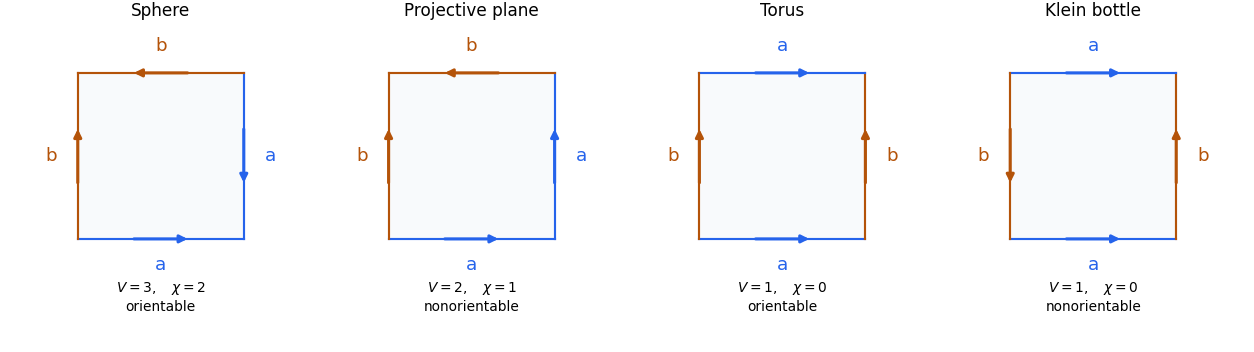
Boundary words giving the required polygonal schemas areA two-sided polygon here means a disk with its boundary split into two arcs; subdivision produces an ordinary polygon with more sides without changing the quotient. Alternatively the square word represents the sphere. Each four-letter block in the orientable word adds a torus handle; each repeated-letter block in the nonorientable word adds a projective-plane summand.
There are exactly four homeomorphism types: the two-sphere, real projective plane, torus, and Klein bottle.
For completeness, enumerate all pairings. Four sides have three pairings; each pair can be matched in either direction, giving twelve signed pairings before symmetries. Up to cyclic relabelling, the repeated labels are either adjacent, of form , or alternating, of form , where . The second adjacent pattern rotates to the first. Endpoint identification gives the following table:Here the quotient always has two edge classes and one face, so its Euler characteristic is . To reproduce the vertex count, label consecutive square vertices . For paired sides , a same-direction pairing identifies with and with ; a reversed-direction pairing identifies with and with , with indices modulo four. Taking the generated equivalence classes gives exactly the displayed values of .
The quotient is orientable precisely when each label is traversed once positively and once negatively around the boundary: then the face orientation extends across every paired edge. A same-direction pair obstructs such an orientation. Thus the two possibilities are distinguished as the orientable torus and nonorientable Klein bottle; the other rows are fixed by Euler characteristic and the classification theorem for surfaces.
Explicit square representatives areAll edge interior points have disk neighbourhoods by joining two half-disks, and each identified vertex has a cyclic sequence of corner sectors, again a disk neighbourhood. There are no leftover boundary edges. The enumeration therefore describes closed surfaces, and the twelve signed pairings leave no additional cases.

Articles by others on the same topic
There are currently no matching articles.