A topological surface is a Hausdorff space with a countable basis of a topology in which each point has a neighbourhood homeomorphic to an open subset of . This definition has no boundary; allowing half-plane charts gives a surface with boundary. A closed surface is compact and has no boundary.
The classification theorem for closed combinatorial surfaces states that the realization of a finite connected closed combinatorial surface is homeomorphic to exactly one of:
- the sphere ;
- a connected sum of surfaces of tori, the orientable surface of genus ;
- a connected sum of real projective planes, a nonorientable surface with crosscaps.
The orientable family, including the sphere at , has Euler characteristic ; the nonorientable family has characteristic . If disconnected complexes are permitted, apply the list to each connected component.
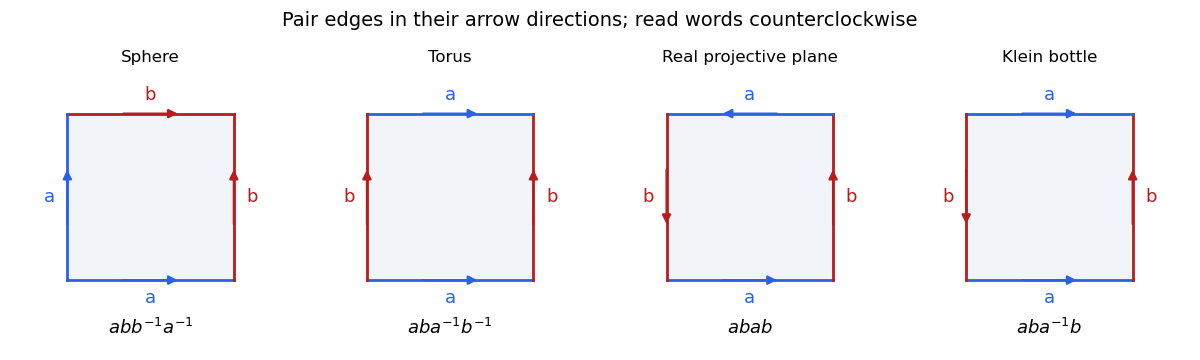
For polygon descriptions, read the boundary counterclockwise and pair equally labelled edges in the direction of their arrows. An inverse exponent means that the arrow runs against this boundary traversal. The following standard polygon words for closed surfaces give the required models:For the last model is a digon; alternatively the square word , identifying antipodal boundary points, gives the real projective plane. A square with word gives the Klein bottle, the case . All polygon sides are paired, so these models have no boundary.

Articles by others on the same topic
There are currently no matching articles.