An abstract simplicial complex is a pair , where is a set of vertices and is a family of finite nonempty subsets of satisfying two conditions: every singleton is in , and every nonempty subset of a member of is again in . Its members are the simplexes; a face with vertices has dimension .
To form its topological realization, take a disjoint copy of the standard geometric simplex for every , label its vertices by , and identify shared labelled faces using affine face inclusions. Give the resulting space the quotient topology of this disjoint union. Equivalently, its points have finite-support barycentric coordinates with and positive support belonging to .
The topology is part of the definition: is open exactly when is open in each closed geometric simplex. This is the weak topology of a simplicial realization, used below for the infinite complex. For finite complexes it coincides with the usual Euclidean realization topology.[ref]
Topology and Groups by Marc Lackenby. Definitions I.17–I.18, printed pp. 8–9: abstract complexes and face-gluing realization
A topological surface is a Hausdorff space with a countable basis of a topology in which each point has a neighbourhood homeomorphic to an open subset of . This definition has no boundary; allowing half-plane charts gives a surface with boundary. A closed surface is compact and has no boundary.
The classification theorem for closed combinatorial surfaces states that the realization of a finite connected closed combinatorial surface is homeomorphic to exactly one of:
- the sphere ;
- a connected sum of surfaces of tori, the orientable surface of genus ;
- a connected sum of real projective planes, a nonorientable surface with crosscaps.
The orientable family, including the sphere at , has Euler characteristic ; the nonorientable family has characteristic . If disconnected complexes are permitted, apply the list to each connected component.
For polygon descriptions, read the boundary counterclockwise and pair equally labelled edges in the direction of their arrows. An inverse exponent means that the arrow runs against this boundary traversal. The following standard polygon words for closed surfaces give the required models:For the last model is a digon; alternatively the square word , identifying antipodal boundary points, gives the real projective plane. A square with word gives the Klein bottle, the case . All polygon sides are paired, so these models have no boundary.
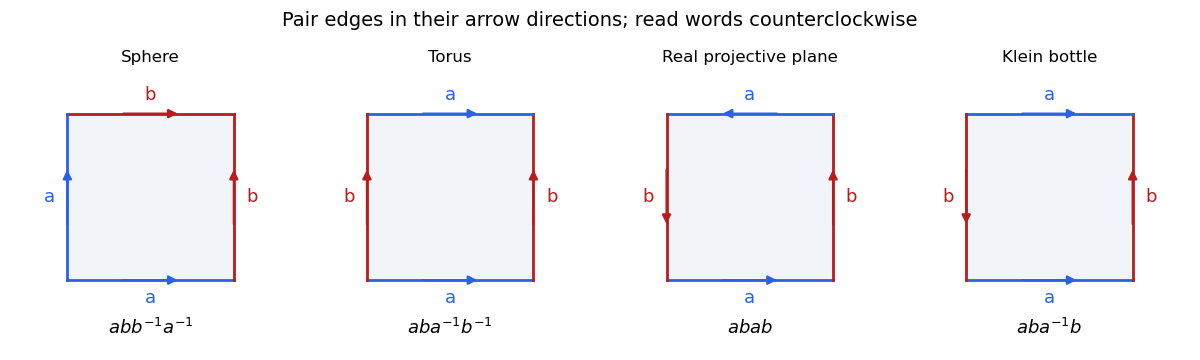

Use a convex representative of the marked polygonal schema, retaining the side-pairing parametrizations. This does not change the quotient up to homeomorphism: a matching boundary homeomorphism extends over the two polygonal discs by radial extension in disc coordinates. Join an interior point to every vertex, producing finitely many triangles. Orient radial edges away from the interior point and choose boundary-edge orientations consistently with the side identifications. Each triangle then has a local vertex ordering with the centre first; the other two vertices are ordered along its boundary-edge arrow. These orderings agree on shared edges, so the quotient is a finite delta-complex whose underlying space is the prescribed polygon quotient.
This need not yet be an abstract simplicial complex: two vertices of a triangle may become identified, or different triangles may have the same vertex set. Apply barycentric subdivision twice.
In the first subdivision, every small simplex corresponds to a flag of faces of strictly increasing dimensions. Identifications preserve dimension, so its vertices are distinct. In the second subdivision, a vertex records an actual cell of the first subdivision. A set of such vertices determines their order by dimension. Inside any one first-subdivision simplex, distinct vertices make each face inclusion uniquely determined by its vertex subset; hence a flag has at most one realization. Therefore different second-subdivision simplexes cannot share the same vertex set, and they meet in precisely their common faces. Thus the second subdivision is an abstract simplicial complex .
The affine subdivision maps are compatible with every face identification, so their realizations are homeomorphisms. Consequentlywhere is finite. This proves triangulation of a polygon with paired sides by the second barycentric subdivision of a delta-complex construction.[ref]
Algebraic Topology by Allen Hatcher. §2.1, exercise 23, p. 133: distinct vertices after one subdivision and a simplicial complex after two
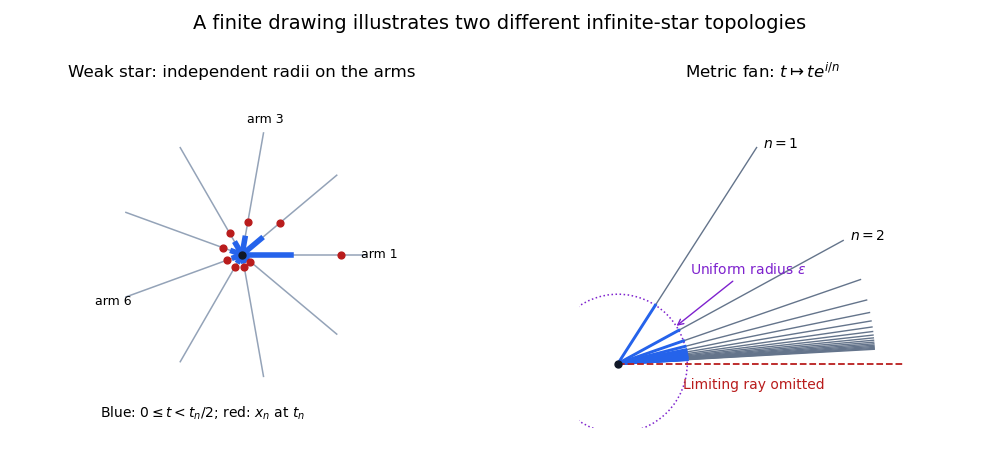
With the quotient realization defined in part (i), the answers are no and no. Write as countably many closed arms with all their zero endpoints identified to .
First, the outer vertices form a closed discrete subset. Its intersection with every closed arm is the closed singleton at coordinate one, so is closed by the weak topology. The terminal half-arm is an open neighbourhood of meeting only there. Thus is infinite, closed and discrete. Since closed discrete subsets of compact spaces are finite, is not compact. A homeomorphism to a compact subset of the plane would make compact, which is impossible.
For the stronger obstruction, suppose were a countable neighbourhood basis at . Each contains an initial interval in arm , so choose on that arm with coordinate . Define to meet arm in . It is an open neighbourhood of , because each of these intersections is open in the closed interval . But for every , so no is contained in . This contradicts the basis condition.
Hence is not first countable. Every metric space is first-countable, with local basis of balls of radius , and this property passes to subsets with the subspace topology. Thus is not homeomorphic to any subset of . This is the weak realization of a countable star.
The realization convention matters. For the metric realization of a simplicial complex using Euclidean distance on barycentric coordinates, the second answer would be yes: map the point on arm at parameter to . Each ray is isolated away from zero, and at zero both spaces have neighbourhood bases given by a single radius on all arms. This gives the metric realization of a countable star as a planar subset, still noncompact. It does not give the quotient topology used in part (i).

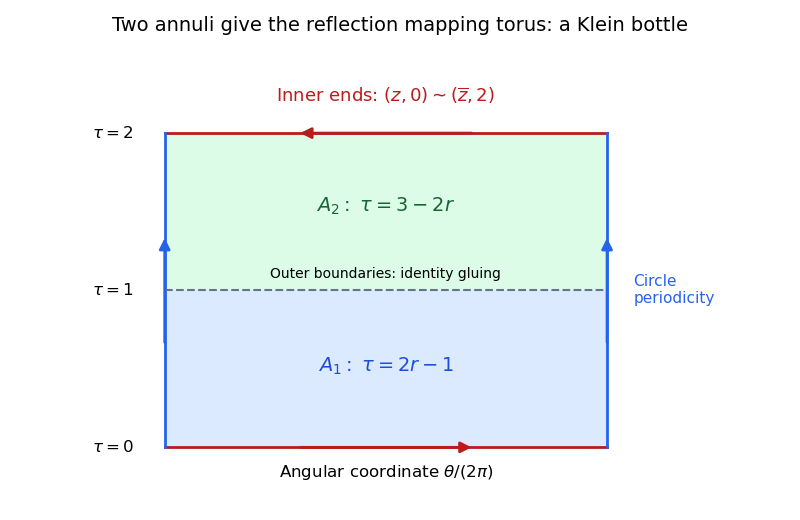
Use for the angular coordinate and for the radius. Parametrize the first annulus by , running from its inner to its outer boundary. Parametrize the second by , running from its outer to its inner boundary. The outer-boundary identity gluing puts them together at . The remaining inner-boundary identification reverses the angle, so the entire quotient isThis is the mapping torus of reflection of a circle, after rescaling the interval.
To verify the homeomorphism, send in the first annulus to in , and in the second to . Both formulas are continuous, agree under the outer gluing, and agree under the reflected inner gluing. They therefore descend by the universal property of the quotient topology. Conversely, on the lower half of the cylinder send to the class of in the first annulus; on the upper half send it to the class of in the second. The formulas agree at , and at the identified endpoints. The pasting lemma and the quotient property give a continuous inverse. Thus the two quotient descriptions are homeomorphic.
The quotient is compact. Its equivalence relation on the compact Hausdorff cylinder is closed: it is the union of the diagonal and the two graphs of the boundary reflection. Therefore is Hausdorff by compact Hausdorff quotient by a closed equivalence relation. Away from the seam its local charts are circle arcs times open intervals. At the seam, an arc near at glues to its conjugate arc at ; using the reflection as the transition gives another open rectangle. These are disc neighbourhoods, and a finite choice of such charts gives a countable basis. Hence is a closed surface.
Cutting the circle coordinate gives a rectangle with its vertical sides matched and its horizontal sides reflected. The reflection changes the sign of the angular coordinate while leaving the interval direction unchanged, so an orientation transported around the interval loop comes back reversed. Thus is a nonorientable surface. The rectangle quotient has one vertex, two edges and one face, giving Euler characteristic zero. By the classification theorem for closed combinatorial surfaces, the nonorientable genus is , so . This is the gluing annuli with one reflected boundary construction.

Articles by others on the same topic
There are currently no matching articles.