First, the product order is a partial order. Reflexivity and transitivity hold in each coordinate. If and , antisymmetry in gives and , proving antisymmetry in the product.
Let be a nonempty directed set in . Its coordinate projectionsare directed sets. For example, if , choose . Directedness supplies above both, so is a common upper bound of inside . The argument for is identical.
By the assumed directed-complete partial order property, and exist. Every satisfies and , so is an upper bound of . If is any other upper bound, then bounds and bounds . Hence , , proving leastness. ThusThe printed definition of a directed set also permits .[ref]
Calculus, probability, linear algebra, discrete mathematics, logic and proof, and models of computation examination paper by the University of Oxford (2003). Printed p. 5, definitions preceding Question 7
Under that convention, the hypotheses require to have least elements, namely the least upper bounds of their empty subsets. Their pair is the least element of the product and is there. This handles the empty case as well; under the convention restricting directed sets to nonempty sets, only the preceding nonempty argument is needed.Take the five-element partially ordered set . Its strict comparisons are , , and , , , , together with their transitive consequences. The elements are incomparable, as are .
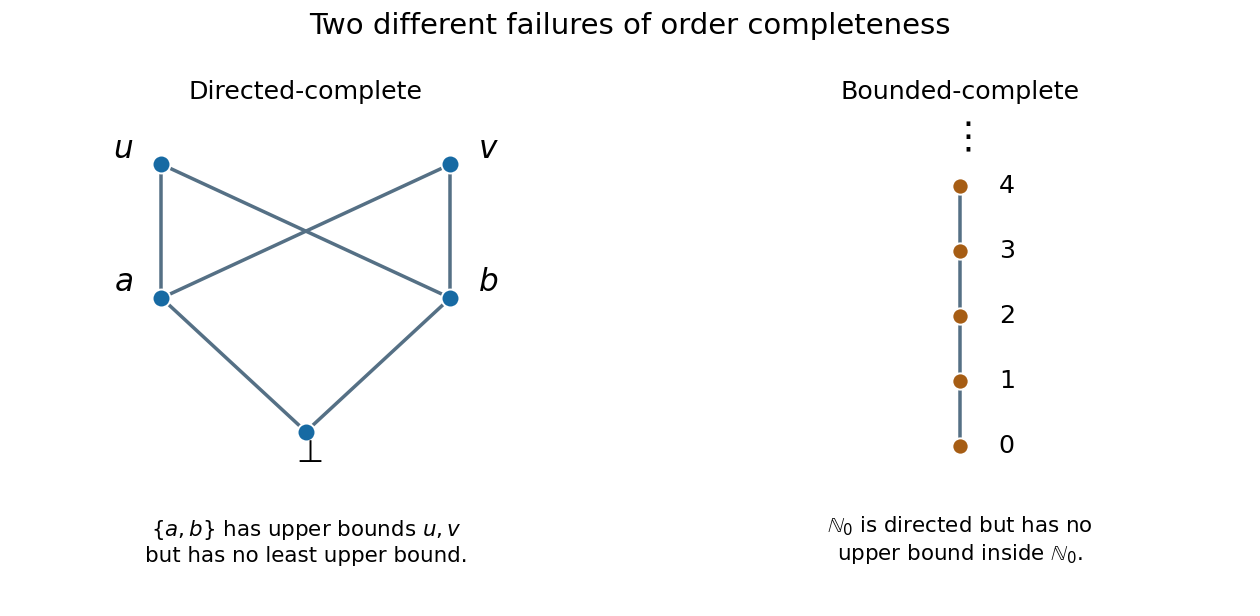
Two different failures of order completeness
. Details. 
A finite directed set has a greatest element whenever it is nonempty: list its elements and repeatedly use directedness to find an internal upper bound of the previously chosen element and the next one. The final element is above every member of the directed set, and is its least upper bound. Thus every nonempty directed set in has a least upper bound. The empty subset also has a least upper bound, namely . Therefore satisfies the paper's completeness condition under either convention.
However, is bounded above by both and . A least upper bound would have to be an upper bound lying below both and . Neither nor has that property, and none of is an upper bound of . Hence
Take the natural numbers including zero with their usual total order:A nonempty subset with an upper bound is contained in the finite set . It therefore has a greatest element, which is its least upper bound. The empty subset has least upper bound . Thus is a bounded-complete partially ordered set.
But is a directed set, since is above any two members. It has no upper bound in : for any proposed bound , the member is larger. It therefore has no least upper bound. Hence
Articles by others on the same topic
There are currently no matching articles.