Original examination: Calculus, probability, linear algebra, discrete mathematics, logic and proof, and models of computation examination paper by the University of Oxford (2003).
The repeated root of the characteristic equation suggests factoring out . Set . The product rule givesThus the ordinary differential equation reduces to , with general solution . The first initial condition gives . Since , the other initial condition gives . ThereforeSubstitution into the reduced ordinary differential equation and the two initial conditions verifies the result.
For , the derivatives are and . Consequently the left-hand side of the ordinary differential equation iswhere .
Use reduction of order, writing . A direct application of the product rule givesFor the resulting first-order ordinary differential equation is whenever . Integration yields and ; the case is already included. Henceon either interval or . The two displayed solutions of a differential equation are linearly independent, so they span the solution space of a homogeneous linear differential equation on either interval. The point is a singular point of a differential equation and cannot be crossed by a nonzero member of this family that remains finite there.
Multiplying the ordinary differential equation by two suggests using the dependent variable , whose derivative is . On the interval through , this gives the linear ordinary differential equationAfter integration, . The initial condition gives . As , continuity selects the positive branch:The interval is the maximal real interval through the given initial condition: at the formula approaches , but its derivative is unbounded, so it does not extend through zero as a differentiable solution of a differential equation.
Assume all partial derivatives needed below are continuous. The multivariable chain rule iswhere the partial derivatives of are evaluated at . Apply the product rule and the multivariable chain rule once more:Clairaut's theorem gives , soDifferentiating with respect to instead gives
For this change of variables,and . The second derivative chain rule therefore givesThus the transformation rule for the Laplacian isFor , its Laplacian is zero. At every point with , division by provesThis conclusion applies to each local inverse branch of the change of variables: its Jacobian determinant is , so such a branch exists away from the origin by the inverse function theorem. A single globally defined cannot represent on the entire plane, since and give the same but generally opposite values of . Nor can a differentiable represent this in a neighborhood of the origin: the multivariable chain rule there would give , contradicting . The requested harmonic function conclusion is therefore a local statement on nonsingular branches.[ref]
Write in the new coordinates. Sincethe partial differential equation becomesFor a twice continuously differentiable solution of a differential equation, is independent of , so integration first in and then in givesThis is the decomposition of the one-dimensional wave equation into waves traveling in opposite directions.
The first initial condition gives . The second initial condition gives . Differentiating the first relation and combining the two relations yields . Thus and . The constants cancel, and the cosine addition formula givesBoth initial conditions and the partial differential equation follow directly by differentiation.
For a linear map , its image of a linear map and kernel of a linear map areTheir dimensions define the rank of a linear map and nullity:The image of a linear map measures which output vectors can occur, while the kernel of a linear map measures which input vectors are sent to zero.
The rank-nullity theorem states that a linear map with finite-dimensional satisfiesChoose a basis of and use basis extension to obtain a basis of . We prove that is a basis of .
Every is a linear combination of the extended basis. Applying kills the terms, so is a linear combination of . This proves the linear span assertion. For linear independence, if , then belongs to the kernel of a linear map. Hence for some scalars . The linear independence of the extended basis forces every and to vanish. Consequently and , while , proving the theorem.
By diagonalizability, has an eigenbasis with . Arrange the basis so that and the remaining eigenvalues are nonzero. If there are no zero or no nonzero eigenvalues, the corresponding linear span below is simply the zero vector subspace.
For , the equation holds precisely when for every . ThusEvery output is in , and conversely for each . ThereforeThese two disjoint parts of a basis span and their linear spans intersect only at zero. This is exactly the direct sum of vector spaces assertion
Take the linear mapIts kernel of a linear map consists of all , and its image of a linear map is the same line:Their set intersection is nonzero and their sum is only one-dimensional. In particular, cannot be written as a sum of one vector from each of these vector subspaces. The nonzero set intersection also prevents an internal direct sum of vector spaces. ThusThe matrix is a nonzero nilpotent matrix; its failure of diagonalizability explains why the preceding result does not apply.
The three elementary row operations are:
- interchange two distinct rows, ;
- multiply a row by a nonzero scalar, with ;
- add a scalar multiple of another row, with .
The nonzero requirement in the second operation ensures that each elementary row operation is reversible.
For a square matrix, the corresponding changes in its determinant areThese follow respectively from the alternating property, multilinearity in the rows, and the fact that a determinant with two equal rows vanishes.
Conversely, suppose . Use Gaussian elimination to reduce to row echelon form . Each elementary row operation multiplies the determinant by a nonzero factor, so . If this square matrix had fewer than pivots, its row echelon form would have a zero row and hence zero determinant, a contradiction. Therefore it has a pivot in every row and column, and further elementary row operations reduce it to .
Each elementary row operation is multiplication on the left by an invertible matrix, its inverse being the reverse operation. Thus implies , a product of invertible matrices. Hence
Let denote the given tridiagonal matrix and put , including for the empty determinant. The starting values areFor , apply the following elementary row operations in the indicated order, always using the updated rows:The first three rows now beginwith the fourth column omitted if . When , also use . The resulting block upper triangular matrix has a upper triangular matrix with diagonal entries all one in its top left corner, and in its bottom right corner. All elementary row operations preserved the determinant except the single row interchange. ThereforeApplying this recurrence relation to the three starting values proves by mathematical induction thatEquivalently, the sequence is periodic with period six, with values starting at . A compact closed form is .
A square matrix is an invertible matrix exactly when its determinant is nonzero. The preceding recurrence relation therefore gives
For events with , the conditional probability isIt measures the probability of after restricting the sample space to and renormalizing. This quotient does not define conditional probability given an event of zero probability.
The partition theorem is the law of total probability. If form a finite or countable partition of a sample space into pairwise disjoint events with positive probabilities, then for any event ,Indeed, is the disjoint union of the events , so countable additivity gives the formula after applying the definition of conditional probability. Zero-probability members can be omitted.
Let be the indicator random variable that coin shows a head. Each expectation is , so linearity of expectation gives the expected number of heads:For the game, write for the probability that eventually holds all coins when starting with . The states are absorbing, so and . Conditioning on the first toss and using the law of total probability givesThus : successive differences are constant, and . The boundary values give , , hence the gambler's ruin answer isFor completeness, the game terminates with probability one. From any nonabsorbing state, a run of consecutive heads would reach within the next tosses, and that run has probability . Conditional on survival, the same bound applies to the next block. Therefore the probability of surviving tosses is at most , which tends to zero.
Let be the event that wins, and the event that his first toss is a tail. For a nontrivial starting state , a first tail has probability and changes his holding to . By the chain rule for probabilities,Since , the definition of conditional probability givesIn particular, when , losing the first coin would end the game in defeat, so the conditional answer is zero. At conditioning on victory is undefined, while at the game has already ended and no first toss occurs.
Let be the number of heads in the initial allocation tosses. Then has the binomial distribution with parameters and . Given , the winning probability is , including the already finished games . The law of total probability and linearity of expectation giveThus, for ,
The binary relation on the natural numbers is not a Euclidean relation. Choose , , . Then and , but . Thus
The divisibility binary relation on positive natural numbers is not a Euclidean relation. With , , , we have and but . Therefore
Equality of remainders after division by eight is a Euclidean relation. If , have the same remainder and , have the same remainder, then , have the same remainder. In the notation of modular arithmetic,Hence
Inequality on a domain containing at least two people is not a Euclidean relation. Choose distinct people and put , . Both premises hold, but the conclusion would be . ThusThe possibility matters: the defining universal quantifiers do not require distinct arguments. On a domain with at most one element the inequality binary relation is empty and the condition holds by vacuous truth.
The “same age” binary relation is a Euclidean relation, with age understood as one consistently measured value at a fixed time. If has the same age as both and , the ages of and are equal. HenceThis is another instance of equality of the values of a function inducing an equivalence relation.
A binary relation on a set is an equivalence relation when it is a reflexive relation, a symmetric relation, and a transitive relation. In first-order logic, these three requirements are
Suppose is an equivalence relation, and , . Since it is a symmetric relation, . Since it is a transitive relation, together with implies . This proves
Suppose is a reflexive relation and a Euclidean relation. To prove it is a symmetric relation, assume . Reflexivity gives , so applying the Euclidean implication to and gives .
To prove it is a transitive relation, assume and . The symmetry just established gives . Apply the Euclidean implication with common predecessor to and ; the conclusion is . Thus all three requirements hold:
On the nonempty set take the empty binary relation . There are no triples for which holds. The defining implication is therefore true for every triple by vacuous truth, making a Euclidean relation.
The answer is no, even when both original binary relations are equivalence relations. On , let have equivalence classes and have equivalence classes . Each is a transitive relation and, by the earlier proof, a Euclidean relation.
Use exactly the paper's convention for composition of relations: means and for some . The possible successors areIndeed, from or the first step can reach or , whose successors together exhaust ; from the first step must stay at , whose successors are only . Consequently and , but not . Therefore
First, the product order is a partial order. Reflexivity and transitivity hold in each coordinate. If and , antisymmetry in gives and , proving antisymmetry in the product.
Let be a nonempty directed set in . Its coordinate projectionsare directed sets. For example, if , choose . Directedness supplies above both, so is a common upper bound of inside . The argument for is identical.
By the assumed directed-complete partial order property, and exist. Every satisfies and , so is an upper bound of . If is any other upper bound, then bounds and bounds . Hence , , proving leastness. ThusThe printed definition of a directed set also permits .[ref]
Calculus, probability, linear algebra, discrete mathematics, logic and proof, and models of computation examination paper by the University of Oxford (2003). Printed p. 5, definitions preceding Question 7
Under that convention, the hypotheses require to have least elements, namely the least upper bounds of their empty subsets. Their pair is the least element of the product and is there. This handles the empty case as well; under the convention restricting directed sets to nonempty sets, only the preceding nonempty argument is needed.Take the five-element partially ordered set . Its strict comparisons are , , and , , , , together with their transitive consequences. The elements are incomparable, as are .
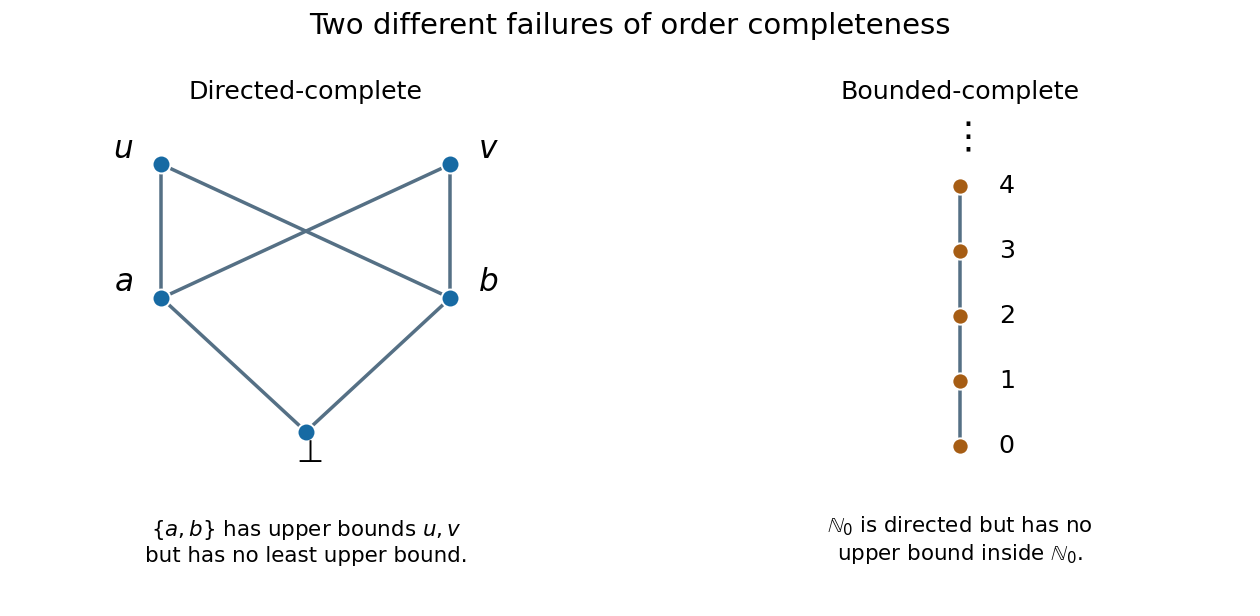
Two different failures of order completeness
. Details. 
A finite directed set has a greatest element whenever it is nonempty: list its elements and repeatedly use directedness to find an internal upper bound of the previously chosen element and the next one. The final element is above every member of the directed set, and is its least upper bound. Thus every nonempty directed set in has a least upper bound. The empty subset also has a least upper bound, namely . Therefore satisfies the paper's completeness condition under either convention.
However, is bounded above by both and . A least upper bound would have to be an upper bound lying below both and . Neither nor has that property, and none of is an upper bound of . Hence
Take the natural numbers including zero with their usual total order:A nonempty subset with an upper bound is contained in the finite set . It therefore has a greatest element, which is its least upper bound. The empty subset has least upper bound . Thus is a bounded-complete partially ordered set.
But is a directed set, since is above any two members. It has no upper bound in : for any proposed bound , the member is larger. It therefore has no least upper bound. Hence
With all variables ranging over the domain of the partially ordered set, the three first-order logic formulas areThe middle formula defines an antisymmetric relation; it does not forbid for distinct , but forbids both directions simultaneously for distinct elements.
Let be the one-element partially ordered set with . Taking witnesses the existential quantifier, and the only is comparable with . Thus .
Let be the two-element antichain , with consisting only of and . This is a partial order. If , choose , and if , choose . In either case both and are false. Therefore no witness for the existential quantifier exists:
In the language of first-order logic, defineThus a least element lies below every element, whereas a minimal element merely has no distinct element below it. The latter definition allows multiple incomparable minimal elements.
Here is a formal natural deduction proof, with the antisymmetry axiom available as a premise. Assume and take a fresh arbitrary variable . Assume . By universal elimination applied to , obtain . By conjunction introduction, obtain . Instantiate antisymmetry at , and use modus ponens rule to obtain . Discharge the assumption by implication introduction, obtaining . Since was arbitrary and is free in no undischarged assumption, universal introduction gives . Discharge the initial assumption and universally quantify to concludeOnly antisymmetry was needed for this implication; reflexivity and transitivity are part of the ambient partial order axioms.
The assertion is true. Every single finite string over is denoted by the regular expression . The empty string is denoted by . Hence if is a finite formal language, the regular expressiondenotes precisely , with each read as its concatenation of symbols. This uses the defining union and concatenation operations for regular expressions. For , use the regular expression . Therefore
The assertion is false. Use the pumping lemma for regular languages: if is a regular language, there is such that every with admits a factorization with , , and for every integer .
Suppose the stated formal language were a regular language, and take . This string has twice as many zeros as ones, so it belongs to . In every allowed factorization, the first positions are all zeros, forcing with . Pumping down with producesIt still has ones but fewer than zeros, contradicting the pumping lemma for regular languages. Thus
The assertion is false. Suppose the formal language were a regular language, and let be its constant from the pumping lemma for regular languages. ConsiderIn every decomposition with and , the pumped factor is with . Pumping down givesThis string has exactly two ones and ends in a one. If it were , each copy of would contain exactly one one, and each copy would end in a one. The first copy would consequently be , while the second would be . They have different lengths because , so they cannot be equal. This contradiction to the pumping lemma for regular languages proves
The assertion is true. Write and . The semantics of regular expressions reduce the claim towhere juxtaposition is concatenation of formal languages and a star is the Kleene star.
Every element of is a finite concatenation of members of , so belongs to . Concatenating any finite number of such elements still belongs to , proving .
Conversely, because one may take a single member of followed by the empty string from . Likewise by taking the empty string from . Hence any finite concatenation of members of lies in . The empty string belongs to both sides. Thus
Articles were limited to the first 100 out of 110 total.
Articles by others on the same topic
There are currently no matching articles.