Solutions to all eight questions of the 12 June 2013 paper. The Scala code uses the paper's Scala 2 conventions. Arithmetic is exact unless a machine type is explicitly discussed; in particular, Question 1 permits ignoring integer overflow. Each code block extends the implementation introduced in its question, unless it supplies a complete replacement.[ref]
Imperative Programming examination paper by the University of Oxford (2013). Cover and printed pp. 2–11, Questions 1–8
Evaluate the mixed radix representation from its most significant end, using Horner's method. There is no need to compute the positional weights separately.The digit conditions are additional preconditions. The loop invariant at the loop test isAn empty sum is zero and an empty product is one, so initialization at is correct. For the next digit, writing giveswhich preserves the loop invariant. The loop variant is . At termination , givingThe code executes exactly multiplications, meeting the bound, and uses auxiliary space. When it returns zero. For the time representation in the source, it computes .
def digsToInt(xs: Array[Int], bs: Array[Int]): Int = {
  require(xs.length == bs.length)
  val N = xs.length
  var i = N
  var acc = 0
  while (i > 0) {
    i -= 1
    acc = xs(i) + bs(i) * acc
  }
  acc
}A suitable precondition, including the empty array case, isA base of one is allowed: its only valid digit is zero. The empty product is one, so permits exactly . Each Euclidean division extracts the next least significant digit.The expensive precondition is a caller obligation, rather than a separately computed product inside the conversion. Define . The loop invariant istogether with for each processed digit. The Euclidean division identity proves preservation of the reconstruction equality. Positivity of the bases gives the digit bounds and the next bound on the quotient. The loop variant is . At exit, forces , henceThere are exactly remainder operations and divisions, hence counted operations. The returned array occupies space and the remaining auxiliary space is constant. A represented value can never exceed , as follows either by the same nested expansion or by telescoping ; thus the stated range is also necessary for positive bases.
def intToDigs(n: Int, bs: Array[Int]): Array[Int] = {
  // Pre: every base is positive, and 0 <= n < product(bs).
  val N = bs.length
  val xs = new Array[Int](N)
  var i = 0
  var q = n
  while (i < N) {
    xs(i) = q % bs(i)
    q = q / bs(i)
    i += 1
  }
  xs
}Use an abstract finite sequence of integers, initially empty. In the following trait, comments are the mathematical specification; means the abstract state on entry, and The postcondition of
result means the returned value.trait ReversableBuffer {
// Abstract state s: finite sequence of Int, initially [].
// Pre: true. Post: s = s0 ++ [x].
def append(x: Int): Unit
// Pre: true. Post: s = [x] ++ s0.
def prepend(x: Int): Unit
// Pre: 0 <= i < length(s0).
// Post: result = s0 !! i,
// s = take i s0 ++ drop (i+1) s0.
def get(i: Int): Int
// Pre: true. Post: s = reverse(s0).
def rev: Unit
}get includes removal: it is not merely indexed reading. In particular,Repeated equal values elsewhere in the sequence remain present. List concatenation, indexing and list reversal in the specification describe abstract behavior without committing to a physical representation.Use a doubly linked list, store both physical endpoints and its length, and maintain a flag for lazy reversal of a doubly linked list. This makes endpoint insertion and reversal constant time. Finding an arbitrary indexed element takes a traversal from whichever physical endpoint is nearer.Define to be the sequence of values obtained by starting at
class LLBuffer extends ReversableBuffer {
  private class Node(val value: Int) {
    var prev: Node = null
    var next: Node = null
  }
  private var first: Node = null
  private var last: Node = null
  private var size = 0
  private var backwards = false

  // Methods from (ii) go here.
}first and repeatedly following next until null. The representation invariant says that size is nonnegative; size == 0 holds exactly when both endpoints are null; otherwise there are exactly size distinct reachable linked list nodes, the final one is last, first.prev == null, last.next == null, and all neighboring links are reciprocal. These conditions make finite and the physical linked list acyclic. The abstraction function isThe flag does not change the representation invariant. An empty physical linked list represents the empty sequence for either flag value. No client receives a linked list node reference, so clients cannot invalidate its links.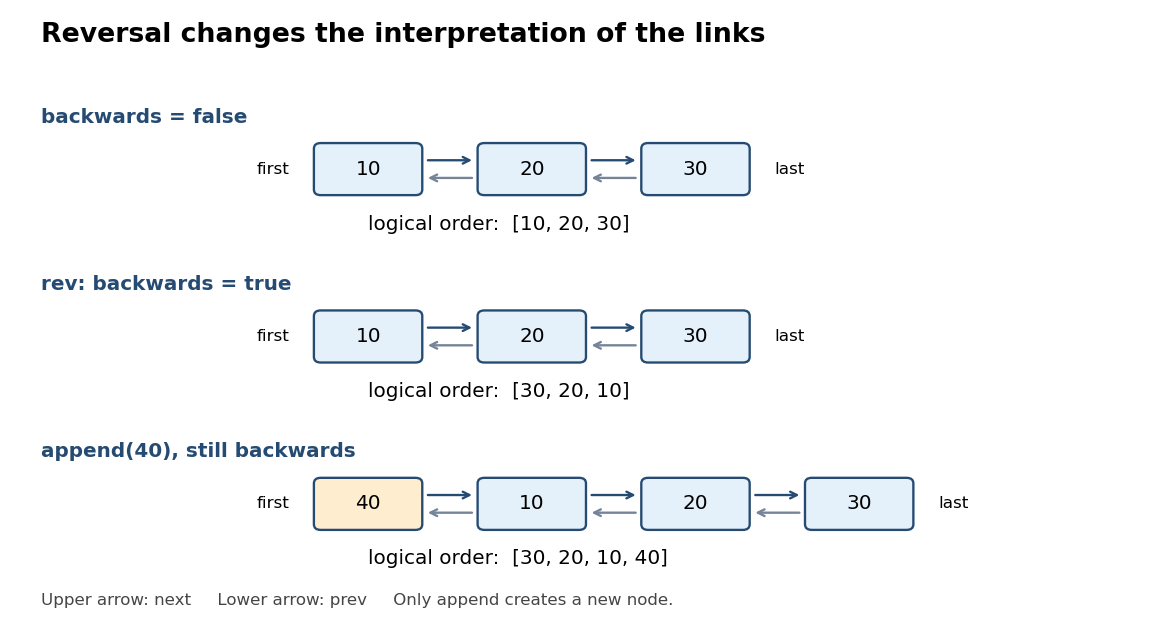
Physical doubly linked list order and logical sequence order under lazy reversal of a doubly linked list
. Details. 
Place these methods inside the In the forward traversal, the loop invariant is that
LLBuffer class. The two private insertion methods operate on physical endpoints; the public methods interpret logical endpoints using the reversal flag.private def addFirst(x: Int): Unit = {
val q = new Node(x)
q.next = first
if (first == null) last = q else first.prev = q
first = q
size += 1
}
private def addLast(x: Int): Unit = {
val q = new Node(x)
q.prev = last
if (last == null) first = q else last.next = q
last = q
size += 1
}
def append(x: Int): Unit = {
if (backwards) addFirst(x) else addLast(x)
}
def prepend(x: Int): Unit = {
if (backwards) addLast(x) else addFirst(x)
}
def get(i: Int): Int = {
require(0 <= i && i < size)
val j = if (backwards) size - 1 - i else i
var q: Node = null
if (j <= size - 1 - j) {
q = first
var k = 0
while (k < j) { q = q.next; k += 1 }
} else {
q = last
var k = size - 1
while (k > j) { q = q.prev; k -= 1 }
}
val x = q.value
if (q.prev == null) first = q.next else q.prev.next = q.next
if (q.next == null) last = q.prev else q.next.prev = q.prev
q.prev = null
q.next = null
size -= 1
x
}
def rev: Unit = { backwards = !backwards }q is physical node , with ; its loop variant is . In the backward traversal, q is physical node , with ; its loop variant is . Thus both locate physical index , which is exactly logical index under the abstraction function.Deletion bypasses the chosen linked list node in both directions. Deleting the first or last linked list node updates the corresponding endpoint; deleting the only linked list node sets both endpoints to null. The surviving values keep their physical relative order, so the abstraction function gives precisely the required logical deletion. Each insertion preserves reciprocal links and adds its value at the physical end corresponding to the required logical end. Toggling the flag changes to its list reversal without moving any linked list nodes. ConsequentlyThese are worst-case time complexity bounds in the constant-cost pointer model; total storage is and each operation uses constant auxiliary space.
Let be a saved mathematical copy of the original array. A precise postcondition for sorting isThe precondition is that
a is a non-null array of length . Its length and every unrelated object remain unchanged. The second clause preserves the array multiset, including all multiplicities; ordering alone would also permit overwriting the entire array with zeros. The saved is a specification device and need not be allocated by the implementation.Use three-way quicksort. Fix the pivot value before moving any entries, and group equal entries together so that none needs a recursive call. These helpers and the sorter belong inside an enclosing scope containing The array partitioning loop invariant iswith unclassified. Swaps preserve the segment's array multiset and leave all entries outside it unchanged. The loop variant decreases in every branch. When swapping an entry from the right into
a.def swap(i: Int, j: Int): Unit = {
val t = a(i); a(i) = a(j); a(j) = t
}
def split(l: Int, r: Int): (Int, Int) = {
// Pre: 0 <= l < r <= a.length.
val p = a(l)
var lt = l
var i = l
var gt = r
while (i < gt) {
if (a(i) < p) {
swap(lt, i)
lt += 1
i += 1
} else if (a(i) > p) {
gt -= 1
swap(i, gt)
} else {
i += 1
}
}
(lt, gt)
}
def quicksort(l: Int, r: Int): Unit = {
require(0 <= l && l <= r && r <= a.length)
if (r - l > 1) {
val (lt, gt) = split(l, r)
quicksort(l, lt)
quicksort(gt, r)
}
}
// Sort the whole array with quicksort(0, a.length).i, do not increment i, since the incoming entry still needs classification. At termination,Here the middle segment is nonempty because the original pivot occurs somewhere in the preserved array multiset. Both recursive segments therefore have length strictly smaller than . Mathematical induction on segment length proves that the two recursive calls sort their segments, and their ordering relative to the middle segment proves the complete sorting postcondition.There is no additional array. The call stack and returned boundary pairs still use auxiliary space. An all-equal input takes one linear scan and no nontrivial recursive calls, so its time complexity is for . Balanced partitions give time complexity; a fixed first pivot can still give on adversarial distinct inputs. The worst-case call stack has entries.
Reuse A useful loop invariant is that the pending segments are pairwise disjoint valid array segments of length at least two; the whole array multiset equals its original value; and every inverted pair of positions lies in a single pending segment. Explicitly, if and , some queued contains both and . Thus all ordering obligations are localized to queued segments.
split and swap, but replace recursive calls with a FIFO queue of unresolved segments. Enqueue only segments of length at least two.def quicksortLoop(): Unit = {
val work = scala.collection.mutable.Queue[(Int, Int)]()
if (a.length > 1) work.enqueue((0, a.length))
while (!work.isEmpty) {
val (l, r) = work.dequeue()
val (lt, gt) = split(l, r)
if (lt - l > 1) work.enqueue((l, lt))
if (r - gt > 1) work.enqueue((gt, r))
}
}Initially the only possible pending segment is the whole array. One array partitioning confines all its remaining inversions to its two child segments. Its equal middle segment is ordered, the left/middle/right boundaries have the correct ordering, and segments of length at most one cannot contain an inversion. Because array partitioning only permutes the selected segment's entries, it cannot create an inversion across a boundary that previously had no inversions. This proves preservation of the loop invariant.
The loop variant is the total pending lengthProcessing one segment removes from and adds at most , strictly less because . Thus is a nonnegative integer and decreases. At exit no pending segment exists, so no inversion exists:The FIFO queue itself can grow to pairs. The time complexity is that of the corresponding recursive quicksort, including linear behavior on equal input. Removing recursion does not make the worst-case time complexity linear or eliminate the work storage.
Traverse the trie along the input string, stopping as soon as the required child is absent. All words and letter collections in this question are assumed to use only lowercase letters The loop invariant is that
a through z; this is the alphabet represented by the given child array. Put the following methods inside the supplied Trie class.def contains(w: String): Boolean = {
var t: Trie = this
var i = 0
while (i < w.length && t != null) {
t = t.children(toIndex(w.charAt(i)))
i += 1
}
t != null && t.complete
}t is the trie node reached by the prefix w.take(i), or null if that prefix has no path, with . If t is null, no extension can be a stored word. Otherwise, following the next character preserves the loop invariant. The loop variant is . At exit,A prefix that exists but is not complete must return false. The empty string is present exactly when the root's complete flag is true. The time complexity is , with constant auxiliary space.Create only the missing nodes along the required trie path, and mark its last node complete.The loop invariant is that the path for
def add(w: String): Unit = {
  var t: Trie = this
  var i = 0
  while (i < w.length) {
    val k = toIndex(w.charAt(i))
    if (t.children(k) == null) t.children(k) = new Trie
    t = t.children(k)
    i += 1
  }
  t.complete = true
}w.take(i) exists and ends at t, while the set of complete words remains unchanged from entry. A fresh node has all children null and complete == false, so creating an unfinished path introduces no stored word. The loop variant is . At termination the full path exists; setting its final flag givesExisting paths and terminal flags are untouched, so adding an existing word is idempotent. Adding the empty string marks the root. The time complexity is because the alphabet size is fixed; at most new trie nodes are allocated.Use trie search with a letter multiset. Counts avoid generating the same result repeatedly when the input contains equal letters. The backtracking explores a letter value once, irrespective of how many indistinguishable copies remain.At entry to
def allWords(ls: String): List[String] = {
  val left = new Array[Int](26)
  var i = 0
  while (i < ls.length) {
    left(toIndex(ls.charAt(i))) += 1
    i += 1
  }
  var out = List.empty[String]

  def visit(t: Trie, prefix: String): Unit = {
    if (t.complete) out = prefix :: out
    var k = 0
    while (k < 26) {
      val child = t.children(k)
      if (left(k) > 0 && child != null) {
        left(k) -= 1
        visit(child, prefix + toChar(k))
        left(k) += 1
      }
      k += 1
    }
  }

  visit(this, "")
  out.reverse
}visit, t is reached by prefix, and left(k) is the input multiplicity of letter minus its multiplicity in prefix. All these counts are nonnegative. Each recursive call consumes one available letter, and restoration makes sibling calls see the same counts as before that child. The recursion therefore terminates at depth at most , even when the dictionary contains longer words.A completed prefix is emitted once, and the traversal continues so that longer words with the same prefix are also found. Every emitted word is in the dictionary and uses at most the available multiplicities. Conversely, every dictionary word meeting those bounds has an existing trie path whose next letter has positive remaining count at every step; the traversal reaches its terminal node. A trie has a unique root path for each word, and each child is visited at most once per reached node. ThereforeThe boxed expression specifies the set of entries in the returned list, rather than its ordering. If the dictionary includes the empty string, the method includes it once. Counting costs ; visiting reachable nodes costs apart from string copying and output construction. The presented immutable-prefix construction additionally costs the sum of the prefix lengths it constructs. The recursion depth is at most , and the letter-count array has fixed size.
Use a minimum stack: each linked list node caches the minimum of all values from that node down to the bottom. This handles duplicate minima without searching when one is removed.The representation invariant is that the chain from
class Stack {
  private class Node(val value: Int, val least: Int, val next: Node)
  private var top: Node = null

  def push(x: Int): Unit = {
    val m = if (top == null) x else math.min(x, top.least)
    top = new Node(x, m, top)
  }

  def pop(): Int = {
    require(!isEmpty)
    val x = top.value
    top = top.next
    x
  }

  def isEmpty: Boolean = top == null

  def min: Int = {
    require(!isEmpty)
    top.least
  }
}top is finite and acyclic, and every reachable node q satisfiesThe abstraction function takes the values along this chain in top-to-bottom order. Thus pushing changes to , and popping a nonempty returns its head and leaves its tail. The cached-minimum equation follows for a new node from the previously valid chain; removing a head leaves every surviving equation unchanged. ConsequentlyThe bounds use the usual constant-cost allocation and integer arithmetic model. Storage is linear in the number of entries. min and pop require a nonempty stack; min leaves it unchanged.Keep a running total in the mixin, and use only the inherited public operations. Updating after a successful superclass operation leaves the total unchanged if an empty For this trait mixed directly into
pop fails its precondition.trait SumPlugin extends Stack {
private var total = 0
override def push(x: Int): Unit = {
super.push(x)
total += x
}
override def pop(): Int = {
val x = super.pop()
total -= x
x
}
def sum: Int = total
}Stack, its representation invariant is , where is the abstract stack sequence. A successful push adds exactly its argument and a successful pop removes exactly its returned value. ThusThe mixin reads no private Stack fields. Its operations add constant time complexity. As in the paper's Int interface, an unbounded mathematical total requires excluding integer overflow, or replacing the accumulator with BigInt if the interface is allowed to change. A later mixin can transform a pushed value at a different point in the Scala trait linearization; the effect is analyzed in the next part.The doubling mixin delegates with a transformed argument.For
trait DoublePlugin extends Stack {
  override def push(x: Int): Unit = super.push(2 * x)
}A, the relevant Scala trait linearization is A, DoublePlugin, SumPlugin, Stack. A push first doubles the argument, then SumPlugin sees and sums that doubled value. The physical values are and the total is .For Equivalently,This is stackable trait modification: the order determines which arguments an outer mixin observes. In particular, the running-total specification from part (b) holds for
B, the Scala trait linearization is B, SumPlugin, DoublePlugin, Stack. SumPlugin sums the original argument, while its super.push doubles the stored value. The physical values are still , but the counter is . Hence the two lines printed are12
6A but does not survive the transforming inner mixin in B. With the given implementation, popping from B would subtract the doubled stored value, demonstrating why mixing individually sensible traits can break a combined representation invariant.A prefix-dropping iterator must preserve the first satisfying element. Reading it to test the predicate physically consumes it from the source, so keep it in a one-element buffer. Once a match is found, return the entire suffix without testing subsequent elements again.Assume the source iterator is owned by the wrapper, its
trait Iter[T] {
  def hasNext: Boolean
  def next(): T
  def copy(): Iter[T]
}

class DropUntil[T](p: T => Boolean, iter: Iter[T]) extends Iter[T] {
  private var seeking = true
  private var saved: Option[T] = None

  private def prepare(): Unit = {
    if (seeking) {
      while (saved.isEmpty && iter.hasNext) {
        val x = iter.next()
        if (p(x)) saved = Some(x)
      }
      seeking = false
    }
  }

  def hasNext: Boolean = {
    prepare()
    saved.nonEmpty || iter.hasNext
  }

  def next(): T = {
    prepare()
    saved match {
      case Some(x) => saved = None; x
      case None =>
        if (!iter.hasNext) throw new NoSuchElementException("next")
        iter.next()
    }
  }

  def copy(): Iter[T] = {
    val result = new DropUntil[T](p, iter.copy())
    result.seeking = seeking
    result.saved = saved
    result
  }
}copy meets the stated independent-cursor contract, and is a pure function. Before preparation, the logical remainder is the source remainder with its maximal initial failing prefix removed. After preparation, it is the buffered match followed by the source remainder, or simply the source remainder when the buffer is empty. This describes the abstraction function and proves that repeated hasNext calls neither lose the match nor skip more values.Copying preserves the phase flag and optional buffered value and independently copies the source iterator. It does not rerun the predicate on an already accepted match. A shallow copy of the wrapper alone would give shared iterator consumption, violating the specification. ThereforeWhen no element satisfies , a finite source yields an empty iterator. Seeking can diverge on an infinite source with no match; this is inherent in determining whether its required suffix begins anywhere. An element object is not deep-copied by this cursor operation.
These operations consume the receiver, as expected for this destructive iterator interface. For
exists stops immediately after the first successful test.trait RichIter[T] extends Iter[T] {
def foreach(f: T => Unit): Unit = {
while (hasNext) f(next())
}
def exists(p: T => Boolean): Boolean = {
while (hasNext) {
if (p(next())) return true
}
false
}
def foldLeft[U](x: U)(f: (U, T) => U): U = {
var acc = x
while (hasNext) acc = f(acc, next())
acc
}
}foreach, after iterations the supplied function has been applied in order to exactly the first entries. For exists, every consumed entry has failed the predicate unless the method is returning true. For the left fold, the loop invariant after consuming entries isEach iteration extends the expression by the next entry on the right. For a finite remaining sequence, its unconsumed length is a common loop variant. ThusAn empty iterator invokes no callback, gives false for exists, and returns from the left fold. On an infinite iterator, exists can terminate when it finds a match; the other two operations ordinarily do not terminate. With constant-cost callbacks, finite input of length takes time complexity and constant auxiliary space.A simple current-value implementation works when is a pure function, but sharing a mutable closure between copies would violate the independence requirement used in part (d). Use a memoized successor chain for stateful iterator copies: the generated sequence has shared cells, and each iterator has its own current-cell pointer.The representation invariant is that
object FunIter {
  final class Cell[T](val head: T, f: T => T) {
    lazy val tail: Cell[T] = new Cell[T](f(head), f)
  }
}

class FunIter[T](v: T, f: T => T) extends Iter[T] {
  private var cursor = new FunIter.Cell[T](v, f)

  def hasNext: Boolean = true

  def next(): T = {
    val x = cursor.head
    cursor = cursor.tail
    x
  }

  def copy(): Iter[T] = {
    val result = new FunIter[T](cursor.head, f)
    result.cursor = cursor
    result
  }
}cursor points to the next cell to be returned, and each cell's lazy tail is computed at most once. The abstraction function is the infinite sequence of heads starting at that cell. Advancing changes only this iterator's pointer. A copy starts at the same cell, so both observe the same remaining heads even when their calls are interleaved:For a stateful , the generator state must be privately owned by this shared chain; unrelated external calls to must not change it. As usual, the values and transition must allow successive results to be observed without externally mutating old results. No interface can independently clone the hidden state of an arbitrary externally mutated closure from its function type alone. The chain avoids needing such cloning: a lagging copy reuses the already generated future instead of invoking again.Each new cell needs one transition and constant bookkeeping, but retained slower copies can keep a long generated prefix alive. This is an intentional space tradeoff that permits the stateful generator in part (d). No output is possible if computing a demanded transition itself fails or diverges.
Keep the neighboring Fibonacci number in a private closure. Before calling the transition with , let its captured The transition returns and stores , preserving the paired Fibonacci recurrence. Initialization gives and , soUsing
following equal .def fibonacci(): Iter[BigInt] = {
var following = BigInt(1)
val step: BigInt => BigInt = (x: BigInt) => {
val result = following
following = x + following
result
}
new FunIter[BigInt](BigInt(0), step)
}BigInt allows all Fibonacci numbers rather than a finite prefix before integer overflow. Replacing BigInt by Int gives the source's suggested machine-integer interface with that limitation. With the FunIter implementation from part (c), each transition runs once per generated cell, and copied iterators can advance independently while sharing the privately owned generator. A simpler alternative uses a pure function on pairs, , and projects the first component; the closure above follows the source's suggested single-value approach directly.An ordinary call such as the unqualified HenceThese arrows describe the method bodies entered in order, not the class inheritance relation. An inherited method continues to use the dynamic receiver for ordinary calls; it does not acquire the defining software class as a new receiver.
f inside A.g uses dynamic dispatch on the receiver. Thus c.g enters A.g, but its call to f reaches C.f. In contrast, B.h explicitly invokes super.f, which continues after B and therefore reaches A.f. Finally A.k dynamically dispatches its call to h, reaching B.h again. The output isg in A, f in C
h in B, f in A
k in A, h in B, f in AIgnoring predefined ancestors as permitted, the Scala trait linearizations areA
super call in a trait continues to the next applicable implementation in the receiver's Scala trait linearization. It is not permanently bound to the parent named when that trait was declared.For The shared ancestor
d1.h, enter B2.h. Its super.g reaches B1.g, and that method's super.f reaches A.f. For d2.h, enter B1.h; its super.g reaches B2.g, whose super.f again reaches A.f. Therefore the two output lines areh in B2, g in B1, f in A
h in B1, g in B2, f in AA occurs once in each Scala trait linearization, after the two specialized traits. This accounts for the final f in A in both lines.Method overloading chooses a signature using the static types available at the call site. The receiver
m has static type M, whose visible overloads accept X and Y; the Z overload introduced only in N is not a candidate.For Equivalently,The runtime type of every argument is
m.f(x), the argument's static type is X, so the chosen signature is f(X). N does not override it, and the inherited M body runs. For m.f(y), the chosen signature is f(Y), and dynamic dispatch on the receiver chooses N's override. For m.f(z), both visible signatures apply, but f(Y) is more specific than f(X). Dynamic dispatch again chooses N.f(Y). Thusf with X at M
f with Y at N
f with Y at NZ, but ordinary single-receiver dynamic dispatch does not redo method overloading using that runtime type. This is overload selection followed by dynamic dispatch.Use double dispatch. Each original overload first sends a dynamically dispatched message to its argument. The argument's selected body then calls an overloaded receiver method with All three
this, whose static type inside that body is the desired argument software class.class X {
def sendTo(m: M): String = m.receive(this)
}
class Y extends X {
override def sendTo(m: M): String = m.receive(this)
}
class Z extends Y {
override def sendTo(m: M): String = m.receive(this)
}
class M {
def f(x: X): String = x.sendTo(this)
def f(x: Y): String = x.sendTo(this)
def receive(x: X): String = "f with X at M"
def receive(x: Y): String = "f with Y at M"
def receive(x: Z): String = "f with Z at M"
}
class N extends M {
override def f(x: Y): String = x.sendTo(this)
def f(x: Z): String = x.sendTo(this)
override def receive(x: X): String = "f with X at N"
override def receive(x: Y): String = "f with Y at N"
override def receive(x: Z): String = "f with Z at N"
}receive overloads must be declared in M, because sendTo receives a parameter with static type M. Declaring the Z version only in N would repeat the original problem.Whatever original The result depends on both runtime types:For the stated
f signature is selected, it invokes sendTo on the actual argument. For a Z object, dynamic dispatch enters Z.sendTo; inside that body, this has static type Z, so method overloading selects receive(Z). The final call dynamically dispatches on the actual m, giving N.receive(Z) when m refers to N. Hencef with Z at N
f with Z at N
f with Z at NX, Y, Z hierarchy, the same construction reports each argument software class correctly for either receiver software class. Further subclasses would need their own dispatch protocol to distinguish additional runtime types.Represent the set by a private list containing each value once. Normalize the constructor input as well as checking future insertions; otherwise duplicate initial entries would violate the intended set behavior.The representation invariant is that
class Set[T](contents: List[T]) {
  protected var elems: List[T] = contents.distinct

  def add(x: T): Unit = {
    if (!elems.contains(x)) elems = x :: elems
  }

  def delete(): T = {
    require(elems.nonEmpty)
    val x = elems.head
    elems = elems.tail
    x
  }
}elems contains no duplicates under the chosen stable value equality; the abstraction function forgets its ordering and returns its set of elements. The protected field allows the subclass in part (d) to inspect its contents; that subclass is responsible for preserving the representation invariant if it mutates them.Insertion makes the represented set . Deletion requires , returns some , and leaves . ThusDeletion does not promise to choose a minimum. With this linked list representation, insertion takes time complexity because of its membership check, while deletion takes . Values should not mutate in a way that changes their equality while stored.
If the mutable set were allowed a covariant type parameter, both variables below could refer to the same mutable object:The broad view accepts any value, including a string. The narrow view still promises that deletion returns an
val s1: Set[Int] = new Set[Int](List())
val s2: Set[Any] = s1             // hypothetically permitted
s2.add("not an integer")
val n: Int = s1.delete() // cannot return an IntInt, yet the sole stored value is that string. This violates type safety:This is covariance failure for a mutable collection. The input occurrence in add(x: T) conflicts with the positive occurrence in the result of delete. Keeping a generic type invariance restriction prevents the unsafe aliasing. The example uses an initially empty set so that the problematic deletion result is forced.An immutable object can widen its element type when adding a value by returning a new object. Introduce a lower type bound on the method's fresh type parameter.As before, the representation invariant excludes duplicates, and the abstraction function returns the unordered set of entries. The constructor normalization makes the representation invariant hold even for repeated initial entries. Both operations construct a fresh set object and leave the original object unchanged, including when addition finds an existing member.
class ISet[+T](contents: List[T]) {
  private val elems: List[T] = contents.distinct

  def add[U >: T](x: U): ISet[U] = {
    val widened: List[U] = elems
    if (widened.contains(x)) new ISet[U](widened)
    else new ISet[U](x :: widened)
  }

  def delete(): (T, ISet[T]) = {
    require(elems.nonEmpty)
    (elems.head, new ISet[T](elems.tail))
  }
}For a receiver representing , the new object returned by
add represents . Deletion returns a pair with and representing . Crucially,The widened list is valid because immutable List itself has a covariant type parameter. A client can view an ISet[Int] as ISet[Any], but adding a string creates a separate widened result; it cannot put a string into the old integer set. This explains how using immutable objects makes the desired type variance sound. A direct add(x: T) on a covariant software class would still violate the variance-position rule; immutability alone does not repair an incorrectly typed method signature.Use an upper type bound requiring each element type to implement the supplied comparison interface for its own type. This is F-bounded polymorphism.Use this locally defined
trait Ordered[T] {
  def <(that: T): Boolean
}

class MinSet[T <: Ordered[T]](contents: List[T])
    extends Set[T](contents) {
  def min: T = {
    require(elems.nonEmpty)
    var best = elems.head
    var rest = elems.tail
    while (rest.nonEmpty) {
      if (rest.head < best) best = rest.head
      rest = rest.tail
    }
    best
  }
}Ordered, rather than silently substituting the standard library's different comparison interface. The type bound makes rest.head < best well typed. To interpret the result as a minimum, require the comparison to be a consistent strict total order; merely providing a method named < cannot establish its mathematical laws.The loop invariant is that
best is a minimum among the entries already inspected, and rest is exactly the uninspected suffix. Comparing its next head with best preserves that property. The loop variant is the length of rest. On termination,The method leaves the set unchanged, takes time complexity under constant-cost comparisons, and uses constant auxiliary space. It requires a nonempty set; inherited insertion and deletion continue to preserve the duplicate-free representation invariant. Articles by others on the same topic
There are currently no matching articles.