For the Fourier sine series write . Orthogonality of trigonometric functions givesIn the second half of the integral put ; then and . HenceEvery even coefficient is zero. For odd , part (a) or the supplied integral yieldsPutting therefore givesThis is the Fourier sine series of a symmetric tent. The absolute values of its terms are uniformly bounded by a summable sequence, giving absolute convergence and uniform convergence; the piecewise smooth odd extension and the Dirichlet convergence theorem for Fourier series identify its value with the continuous , including the zero endpoints and the peak.
The printed lower limit is an error. The original PDF visibly has this lower limit. It omits the nonzero fundamental coefficient . In particular, the printed series equals , rather than . At it gives instead of . The corrected lower limit is displayed explicitly above.
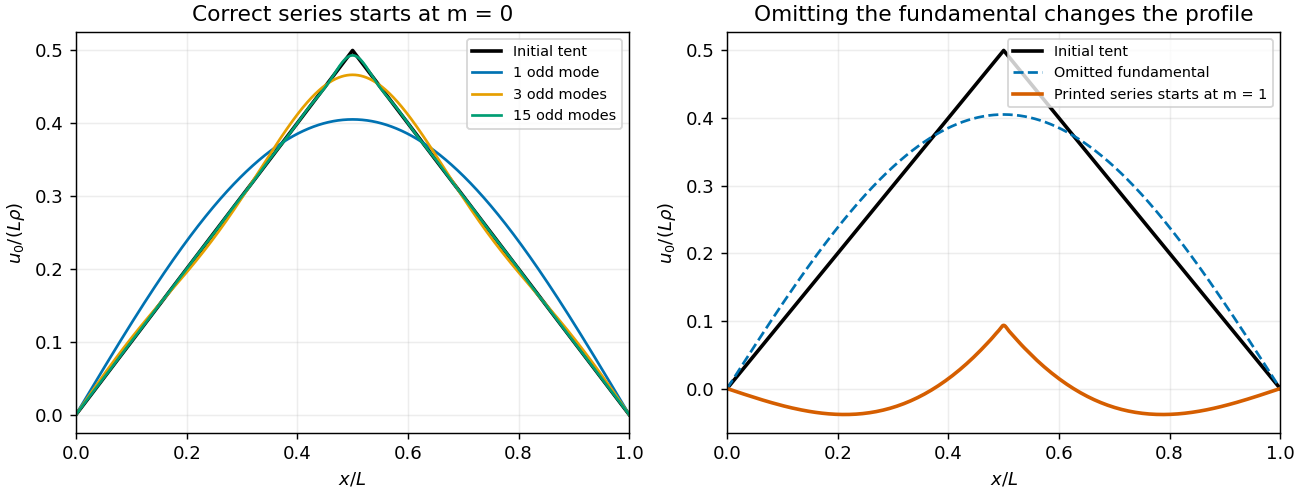
The tent Fourier series requires its fundamental mode
. Details. 
Apply separation of variables to each mode of the damped wave equation , assuming . The spatial ordinary differential equation is . Its general solution is . The boundary condition at gives ; a nonzero mode at requiresOnly odd occur in the initial Fourier sine series. Put and . The temporal equation has roots . DefineFor distinct roots, let the full amplitude be . The initial displacement and zero initial velocity impose and . Solving givesThus the physically consistent superposition isFor there is overdamping, with two real decaying exponentials. For there is underdamping; set ; the equivalent real expression isAt critical damping, the repeated-root case , take the limit, giving . These formulas all satisfy and .
Three source qualifications matter. First, the sum must start at , for the same reason as in (b). Second, the printed cannot hold for a single separated mode: the tent has on each open linear segment but , contradicting for positive , and its peak is not twice differentiable. Separation applies mode by mode, with the initial tent recovered by superposition. Third, no finite “large” makes every mode overdamped, because . The two-exponential expression permits complex conjugate roots, while a repeated root requires its displayed limiting form. The tent initial data are naturally interpreted through the convergent modal solution, rather than as a single smooth separated product.
Articles by others on the same topic
There are currently no matching articles.