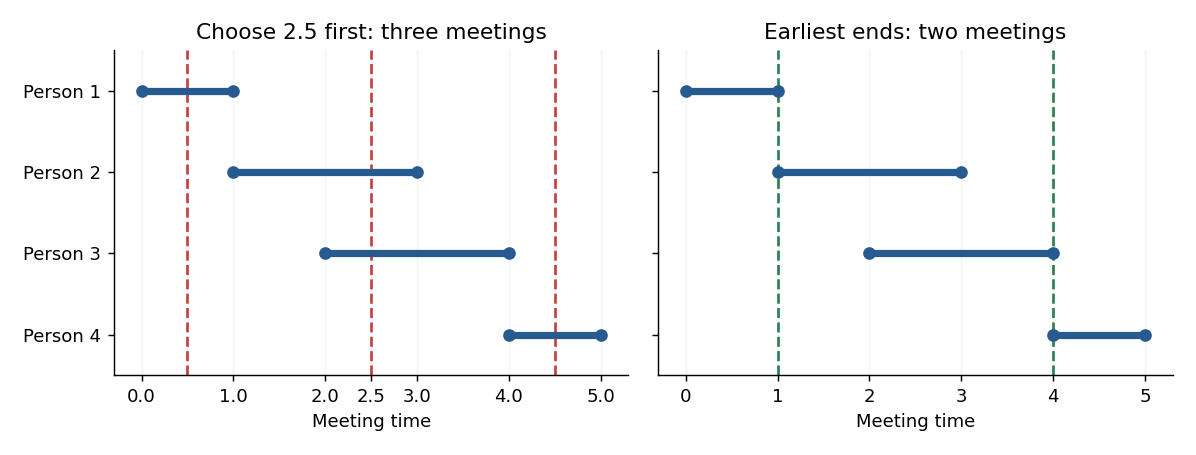
Four closed intervals suffice:No time belongs to three intervals, so the maximum number of attendees at one meeting is two. Strategy 1 is allowed to choose , which meets and . The remaining intervals and are disjoint, requiring two further meetings. This run therefore uses three meetings.
However, times and meet everyone: and . One meeting is impossible because . Thus the optimum is two, while strategy 1 can use three. The counterexample deliberately uses an allowed tie between maximum-attendance choices: the instruction to pick “any” such time would require every tie choice to be safe.

Articles by others on the same topic
There are currently no matching articles.