The gradient equations areThus gives , while gives . The Hessian matrix isAt both critical points the determinant is , so the Hessian is indefinite and the second-derivative test classifies both as saddle points. Direct substitution givesThe factorization also shows the crossing level-set branches through each saddle.
Write , , , , and , . Put . The product rule and chain rule giveHere are derivatives with respect to . In the first derivative, because the expression is scalar. Likewise if desired. This differentiation of a parameter-dependent quadratic form does not assume that is symmetric. The positive linear term contributes the positive chain-rule terms in the derivatives; it is independent of .
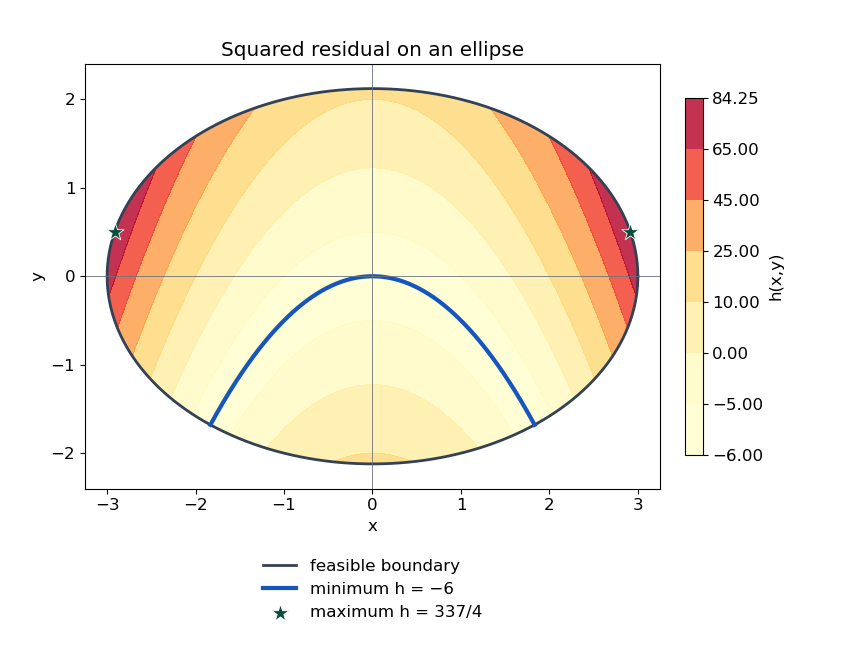
Complete the square:The minimum locus of a squared function occurs where its residual vanishes. Hence the minimum is on , provided these points lie in the ellipse. Setting in the constraint gives , or . ThusFor the maximum, let . The ellipse givesAlso , whose absolute value is less than . Therefore . Equality is attained at , , givingThese attained bounds are global, not merely stationary-point tests. The minimizing locus is a parabola segment.

Articles by others on the same topic
There are currently no matching articles.