A strongly connected component is a maximal set of vertices that are mutually reachable in a directed graph; a vertex reaches itself by a length-zero path. The condensation graph, also called the SCC graph, contracts each such component to one vertex and retains directed edges between different components. It is a Directed acyclic graph, since a cycle of components would make them mutually reachable and therefore one component.
For an original seven-vertex example, take cycles , , , and add , . The three components are , and . Their condensation is the three-vertex directed chain in that order: there is no return edge from a later component to an earlier one.
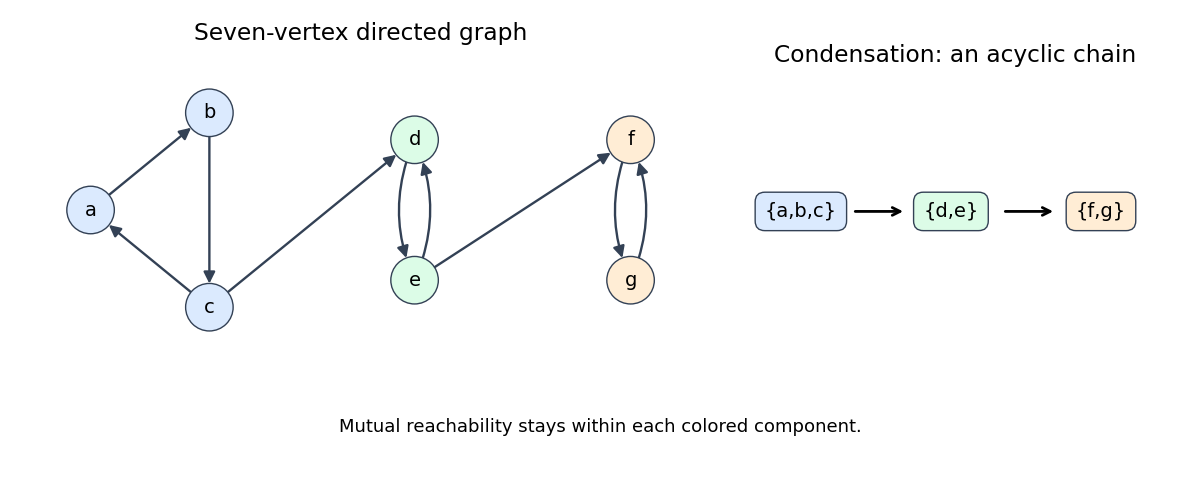

1. Run depth-first search over all vertices of , recording their finish order.
2. Construct the graph transpose by reversing every edge.
3. Mark every vertex unvisited again. In decreasing first-pass finish order, start a transpose search whenever the next vertex is unvisited. The vertices newly reached by each search form one strongly connected component.
2. Construct the graph transpose by reversing every edge.
3. Mark every vertex unvisited again. In decreasing first-pass finish order, start a transpose search whenever the next vertex is unvisited. The vertices newly reached by each search form one strongly connected component.
The finish order prevents a second-pass search from entering a different still-unassigned component, while mutual reachability makes it visit the entire current component. With adjacency lists, each traversal and the transposition scan takes time. Thus the total worst-case time is , including isolated vertices.
Because the vertex set is finite, at least one vertex occurs infinitely often, so is nonempty. Let belong to this set. After any chosen visit to , a later visit to exists; the intervening edges give a directed walk from to . After that visit to , a later visit to also exists, giving a walk in the other direction. Removing repeated portions gives directed paths if desired.
Thus every pair in is mutually reachable and belongs to the same strongly connected component. This proves the claimed inclusion, which need not be equality: an infinite walk can repeatedly follow one cycle while omitting other vertices in its component. This is the recurrence-set part of the infinite walk criterion in a finite directed graph.
An infinite trace exists exactly when a directed cycle is reachable from , by the infinite walk criterion in a finite directed graph. Compute the reachable set with depth-first search, compute its strongly connected components, and return true if any component has at least two vertices or contains a self-loop. A singleton without a self-loop does not qualify.
If the test succeeds, follow a path from to the cycle and traverse the cycle forever. Conversely, an infinite trace in a finite graph repeats a vertex, producing a reachable nonempty closed walk and hence a directed cycle. Reachability, component construction and the self-loop check all scan adjacency lists only a constant number of times. The worst-case time is , with auxiliary space for a straightforward transpose-based implementation.
Articles by others on the same topic
There are currently no matching articles.