Let be the input sampled at clock edge . The desired registered output after that edge is . Only the last two high samples matter: a longer high run still has two high samples immediately before its first low sample.
A direct synchronous 110 detector uses three D flip-flops, holding , with a common clock and initial state zero. Use the following next-state equations, all evaluated from the old state and the input at the active clock edge:After an edge, records the latest sample and records whether the latest two samples were high. The final equation consequently produces the required pulse from the preceding two-high state and the new low sample. A synchronous reset sets all three state bits to zero. The output is the stored
z flip-flop value, so it changes only after clock edges; exposing the unregistered expression would let input transitions between edges alter the output.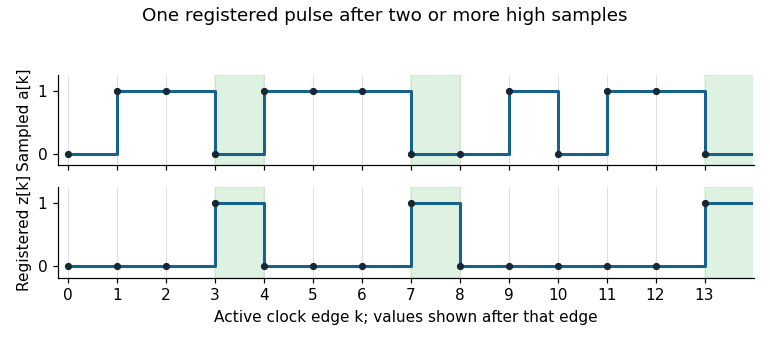
Original sampled-input and registered-output trace for a synchronous 110 detector
. Details. 
An equivalent finite-state machine has states
R (no current high run), H (one high), HH (at least two highs), and P (the pulse state). Its output is one only in P:The pulse cannot last two cycles: after the low input that creates it, is zero, so the next output is zero regardless of the next input. The detector rearms without a global stop and handles repeated patterns indefinitely. The three-flip-flop construction is deliberately direct; minimum storage was not required.
Articles by others on the same topic
There are currently no matching articles.