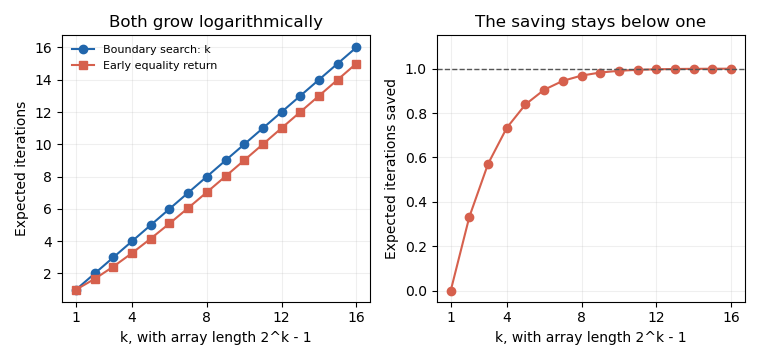
The expected saving on the specified successful searches iswhich tends to one iteration as increases. The fractional saving is , which tends to zero. Both versions have logarithmic expected time, and the improvement is a bounded average saving rather than a change of growth rate. A target at the first middle position benefits greatly, but the uniform distribution does not concentrate on that event. The extra equality branch and machine-level costs also matter when comparing measured execution times.

Articles by others on the same topic
There are currently no matching articles.