Express existence of a minimum using only the given strict-order relation:In the closed interval , the witness is . In the open interval , every possible witness has the smaller member , so the first-order sentence is false. These witnesses are explanations in the ambient real numbers, not additional symbols in the first-order signature.
Express that the order is a dense order:In either real interval, lies strictly between any two distinct ordered elements and remains in the domain. In the integers, have no intervening integer, so this first-order sentence is false. The endpoints of a closed interval do not prevent a dense order.
Combine a minimum with an adjacent pair in a linear order:In , choose . The minimum and the adjacent pair in a linear order both exist. In , the dense order property rules out such an adjacent pair. In , adjacent pairs exist, but no minimum exists: for any , the integer is smaller. Thus this first-order sentence has precisely the required three truth values. Neither the endpoints nor the numerical witnesses occur as constant symbols in the first-order sentence.
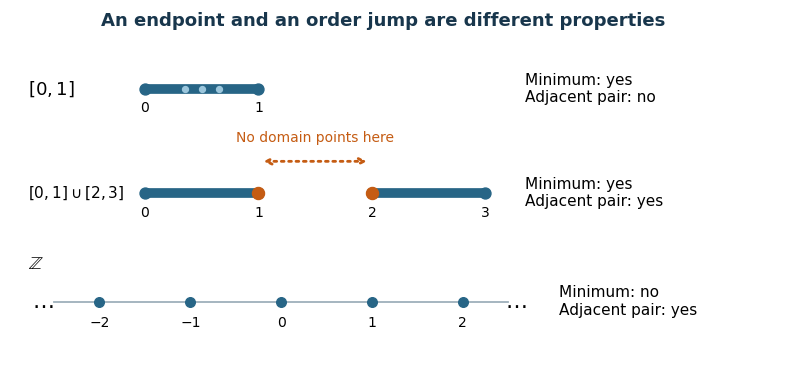
A minimum and an adjacent pair distinguish the two-interval order from a closed interval and the integers
. Orange highlights the consecutive domain members and in the two-interval order. The dotted arrow crosses points absent from that domain. A closed real interval has intervening domain members; the integers have adjacent pairs but no minimum. Details.
Use the intended first-order structure of real arithmetic, with
Int selecting the integers; is the parameter in . A suitable first-order formula isThe first condition requires a real square root of . The second excludes every representation as a rational number with a nonzero integer denominator. This uses only the listed function and constant symbols, the Int predicate and logical equality; in particular, is written and there is no extra division symbol. A square root exists exactly when , and either sign of a root is a rational number exactly when the other sign is a rational number, so the absence of a positivity condition on does not affect the claim about the principal square root. At the formula is false; for there is no real witness. The meanings of and as real arithmetic, not just the meaning of Int, are part of this interpretation.Two unary predicates suffice. Require all four unary predicate types to be inhabited:There are no constants, no logical equality and no nonunary predicates. Any two of these conditions disagree on at least one predicate, so one domain element cannot witness both. Hence every satisfying first-order structure has at least four elements, by distinct witnesses from incompatible unary predicates. Conversely take domain , and : the four elements realize the four displayed unary predicate types, respectively. These element names describe the example; they are not constants in the first-order sentence.
The term is not free for substitution for . The occurrence of in is under , which would capture the inserted . The other occurrence, in the outside disjunct , has no enclosing quantifier. The inner does not bind the occurrence of in its antecedent, so it creates no additional capture at that substitution site.
Rename the bound to a fresh , then carry out capture-avoiding first-order substitution. The result isThe inserted in remains free because it lies outside the scope of . One may additionally rename that bound for readability, but it is not necessary for correctness.
The term is free for substitution for . The only free occurrence of the target is in the outside disjunct , beyond both quantifier scopes. The occurrences under are bound variables and are not replaced. Therefore no renaming is required, andThe new and in the last disjunct are free. First-order substitution replaces the original free occurrences once; it does not recursively substitute into the inserted term.
The printed expression has one unmatched closing parenthesis. Remove that final surplus parenthesis and read the first disjunct as ; the other disjunct has outer universal quantification over the displayed implication. To distinguish the two independent bound uses of , rename the first to .
Push the outer negation through the logical disjunction and through the quantifiers. Negating the implication preserves its existential antecedent and negates its consequent. Applying De Morgan's laws and the quantifier negation rules gives the negation normal formEach negation is now directly before an atomic formula. No bound variable has been captured, and no original existential quantification in the antecedent has accidentally been negated twice.
Articles by others on the same topic
There are currently no matching articles.