A first-order formula is built from atomic formulas using logical connectives and quantifiers over the elements of a structure.
The quantifier rank of a first-order formula is the maximum nesting depth of quantifiers. Atomic formulas have rank zero; negation preserves rank, binary Boolean connectives take the maximum, and either quantifier increases rank by one. It is not the total number of quantifiers.
Two first-order structures are rank-n equivalent if they agree on all sentences of quantifier rank at most . The tuple version compares formulas at fixed tuples. For finite relational vocabulary this is equivalent to a Duplicator winning strategy in the -round Ehrenfeucht-Fraïssé game.
A primitive positive formula is generated from atomic formulas using only logical conjunction and existential quantification. It can be put in the form with each atomic. The exam terminology tame formula refers to this fragment. Its reduced product transfer needs only filter intersection and upward closure, together with coordinatewise choices of witnesses.
Existential quantification forms . In a first-order structure, it is true at an assignment to when some domain element makes the instance true. In natural deduction, elimination uses a fresh variable for the hypothetical witness; that variable may not escape into the conclusion or the remaining undischarged assumptions.
Existence requires at least one witness, not exactly one. Over the natural numbers , is true: works, as do . In intuitionistic first-order logic, a direct proof supplies a witness together with a proof of the corresponding instance; merely rejecting nonexistence is generally weaker.
Placing existential quantification before universal quantification requires a single witness that works throughout:This first-order sentence is false. For any proposed , choose : the required inequality becomes . For example, works for but fails at . No finite list of successful checks establishes universal quantification over the natural numbers.
An existential formula is an existential block followed by a quantifier-free formula, with remaining free variables serving as parameters. Truth is preserved by structure embeddings. Reflection of truth for every such formula defines an existential embedding.
Universal quantification forms . In a first-order structure, it is true at an assignment to when every domain element assigned to makes the instance true. Its introduction rule requires that the generalized variable not occur freely in undischarged assumptions.
Over the natural numbers, reversing the preceding existential quantification and universal quantification gives a true first-order sentence:Choose . The computed witnesses for are . The choice may depend on the previously given . The formula states that every natural number has a larger natural number; the reversed formula demands one larger than all of them.
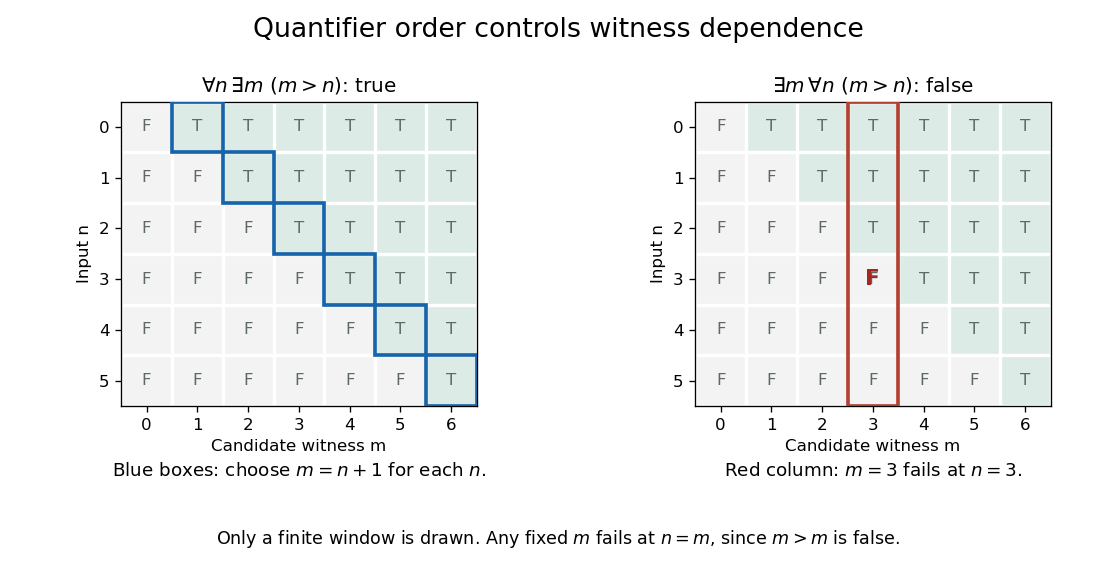
Universal quantification followed by existential quantification permits a different witness for each input
. Details. 
The diagram displays a finite window, while the rules and settle the two statements for every natural number. This dependence is why quantifier order matters in precise specifications. Choosing one that works for every would also provide a witness for each ; the reverse inference fails here.
To introduce universal quantification in natural deduction, reason with an arbitrary input, without assuming a special property of it. The construction does exactly this and also gives a proof in intuitionistic first-order logic. The introduction and elimination rules for both quantifiers are developed in Frank Pfenning, First-Order Logic and Type Theory, section 4.1.
A quantifier-free first-order formula is built from atomic formulas using logical connectives, with no quantifiers. An embedding of first-order structures preserves and reflects its truth, by mathematical induction on the first-order formula. Both positive and negated atomic information are needed for this conclusion in a relational language.
In a first-order language having at least one closed term, validity of a quantifier-free existential sentence forces inconsistency of the set of negations of all its closed-term instances. Otherwise take a model of those negations and its substructure generated by the closed terms. Quantifier-free truth is preserved there, so the valid existential sentence has a closed-term witness, a contradiction. Compactness then gives a finite disjunction of instances. The nonempty closed-term hypothesis is essential: in a language with no constants or nullary functions, the valid sentence has no closed-term instance.
A quantifier-free sentence is a quantifier-free formula with no free variables. In a language whose only closed group terms denote zero, all quantifier-free sentences have the same truth value in every group, even when existential sentences distinguish them.
An atomic first-order formula is a relation applied to terms, or a logical equality of two terms when logical equality is included in the logic. It contains no logical connective or quantifier. Its truth is preserved and reflected by an embedding of first-order structures.
Articles by others on the same topic
There are currently no matching articles.