Section D: Thermodynamics.
Set and , treating the supplied concentration notation as an ideal-dilute activity approximation. For pure solids and unit water activity, the first chemical equilibrium relation gives and the second gives . Thus plotTheir slopes are and respectively. They intersect at . Both the relevant silica activities and the intersection lie at negative , as expected for a dilute aqueous silica species.
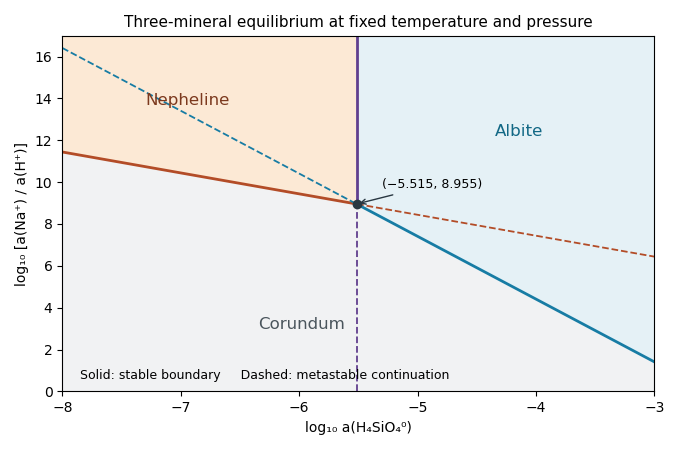
Original activity diagram: solid stable boundaries, dashed metastable continuations, and three mineral stability fields
. Details. 
Subtract reaction (b) from reaction (a) and divide by two. In the direction chosen here, the resulting balanced conversion isThus nepheline plus dissolved silica converts to albite. Additivity of the Gibbs energy of reaction, equivalently Hess's law, givesFor the reverse reaction the answer is ; the reaction direction must accompany the equilibrium constant.
For the reaction direction in part ii, pure solids and unit water activity give . ThereforePlot a vertical line through the common intersection, independent of . Increasing dissolved silica favors albite, consistently with its larger Si/Al ratio. The vertical line’s stable and metastable portions are selected by comparison with corundum, not by its own mass-action equation alone.
Let and . The common-potential test for a three-mineral activity diagram gives relative potentials, in one positive energy unit,The stable phase minimizes these potentials. Consequently the stable nepheline–corundum branch has , the stable albite–corundum branch has , and the stable nepheline–albite branch has , . Draw them solid.
The other halves of each line are metastable: a third mineral has lower potential there. In particular, below the triple point the vertical equality describes two phases both less stable than corundum. Extend those halves as dashed lines. This thermodynamic comparison prevents the incorrect use of all three complete pairwise lines as stable field boundaries.
The stable fields areThus corundum occupies the low- field, nepheline the upper-left field and albite the upper-right field. Pairwise coexistence applies on the indicated stable boundaries, and all three coexist at . These are stability statements within the three-mineral chemical system, not a claim that other possible minerals have been excluded in nature.
Articles by others on the same topic
There are currently no matching articles.