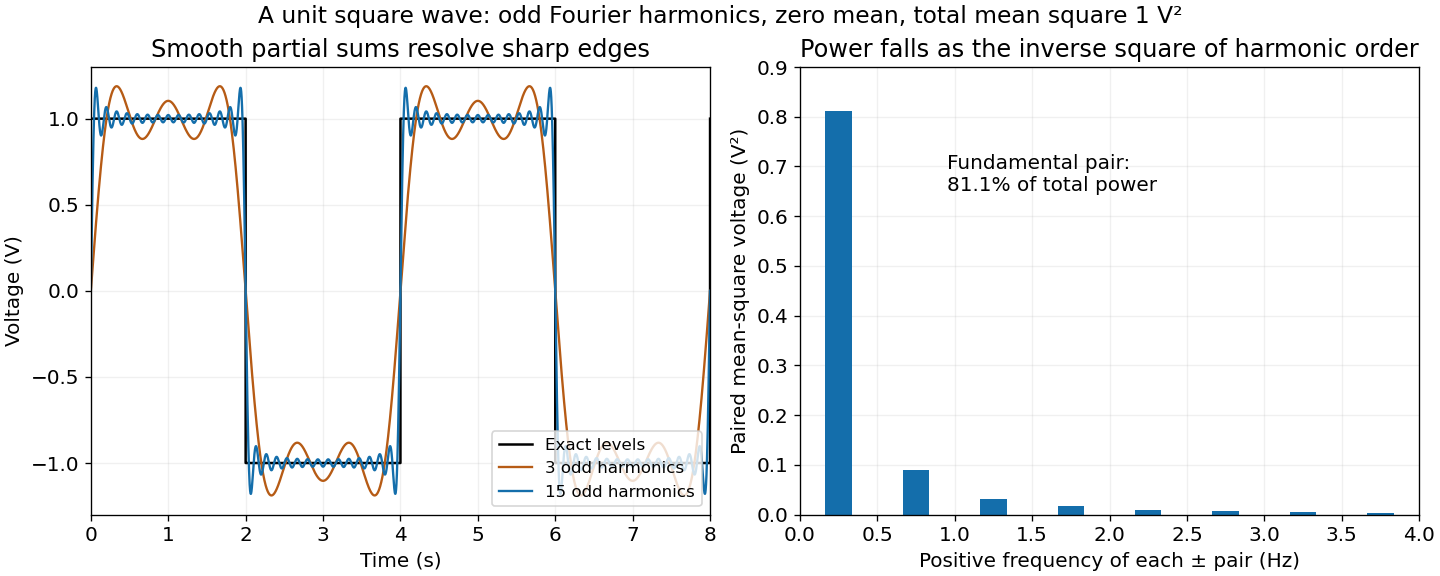
Most of the mean-square signal power lies at low frequencies. Each nonzero coefficient has magnitude , so its power contribution decreases as . The pair at the fundamental frequencies alone containsof the total. The first three positive odd harmonics, together with their negative-frequency partners, contain about . The harmonic power of a square wave still has a nonzero tail: higher harmonics are needed to reproduce sharp edges even though their combined power is small.

Articles by others on the same topic
There are currently no matching articles.