Set and . If , the integrand is one and its integral is . If is a nonzero integer,ThusThis is Fourier orthogonality in its unconjugated form. With a complex conjugate on the second exponential, the nonzero case would instead be .
Multiply the complex Fourier series by and integrate over one period. Fourier orthogonality removes every term except the one with index , givingFor general square-integrable functions, this is an orthogonal projection onto the corresponding Fourier mode. It remains valid when the expansion converges only in L2 space: integrate finite Fourier partial sums first, then pass to the limit using the Cauchy-Schwarz inequality. No unjustified pointwise exchange of an infinite series and an integral is needed.
The displayed signal is a square wave with levels and , each lasting two seconds. On a representative period it is positive for and negative for .
The waveform repeats after one positive and one negative interval, so its fundamental period is . A two-second shift reverses its sign and is not a period.
The zero Fourier coefficient is . For a nonzero integer , integrate the two constant halves:ConsequentlyThe complex Fourier series is . The negative-index coefficients are the complex conjugates of the positive-index ones, as required for a real signal. Combining each pair gives the equivalent real expansionAt a jump, pointwise convergence of a piecewise smooth Fourier series gives zero, the average of the two one-sided limits. The value assigned to at isolated jumps does not affect its Fourier coefficients or mean-square signal power.
The squared signal equals except at irrelevant isolated jump times. Its mean-square signal power is thereforeHere “power” has the signal-processing definition specified in the question. To convert this voltage mean square into electrical power in watts, a load electrical resistance would also be required: .
Use Parseval identity for Fourier series with the coefficient normalization above. Only odd nonzero indices contribute; summing the positive and negative indices givesThusThe factor of two from the negative frequencies is essential. The discontinuities do not obstruct Parseval's identity, which is a statement about L2 space.
Most of the mean-square signal power lies at low frequencies. Each nonzero coefficient has magnitude , so its power contribution decreases as . The pair at the fundamental frequencies alone containsof the total. The first three positive odd harmonics, together with their negative-frequency partners, contain about . The harmonic power of a square wave still has a nonzero tail: higher harmonics are needed to reproduce sharp edges even though their combined power is small.
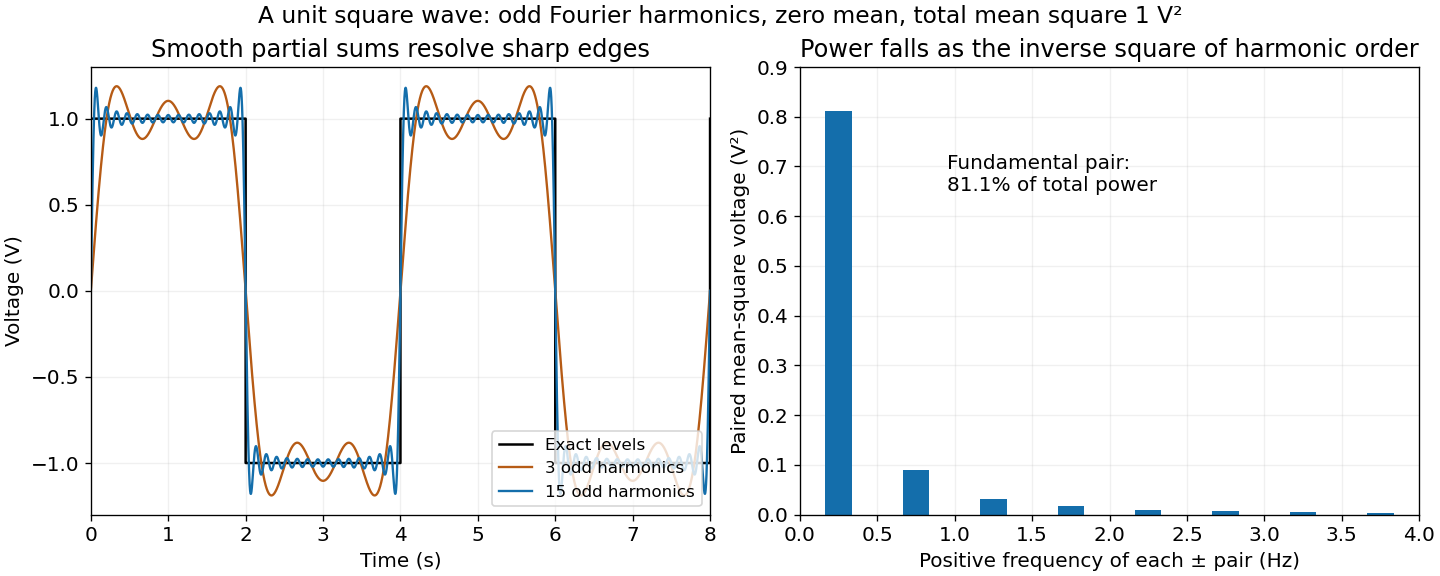

Apply a Fourier transform or discrete Fourier transform, retain the desired low-frequency coefficients and attenuate those in the high-frequency noise band with a low-pass filter, then invert. For a real signal, apply matching gains at positive and negative frequencies to preserve Hermitian symmetry.
Parseval identity for Fourier series shows what an ideal coefficient cutoff does: the output mean-square signal power is the sum of the retained squared coefficients, and cannot exceed that of the unfiltered input. Much of the high-frequency noise can be removed, but a finite cutoff also removes genuine square wave harmonics. Its edges become less sharp, and a sharp spectral cutoff can exhibit the Gibbs phenomenon. There is no claim of exact recovery if the noise overlaps the retained band. Noise already folded into low frequencies by aliasing cannot in general be removed merely by discarding the high-frequency bins afterward.
Articles by others on the same topic
There are currently no matching articles.