Take base-ten logarithms and use dimensionless thermodynamic activities. The supplied concentration notation is interpreted in the ideal dilute-solution approximation, with a consistent reference concentration. PutWith pure solids and unit water activity, the reaction quotients are and . At chemical equilibrium, , so the two lines on the mineral activity diagram areThey have slopes and . Restricting the plotted silica activity to is compatible with their intersection,Their full straight extensions are equilibrium relations for the respective phase pairs; not every extension is a stable boundary when the third mineral is available.
Subtract reaction (I) from reaction (II), cancelling the common aqueous ions and corundum, and divide by two. Choose the albite-to-nepheline direction:This is albite plus water converting to nepheline and dissolved silica. Standard Gibbs energies of reaction add with their stoichiometric coefficients, so logarithms of equilibrium constants do too. For this single-formula normalization,The doubled reaction has , while reversing either reaction changes the sign. Specifying the direction and normalization removes that apparent ambiguity.
For pure albite, pure nepheline and unit water activity, . Consequentlya vertical line through the intersection of (I) and (II). It does not depend on because the net reaction has no hydrogen or sodium ions.
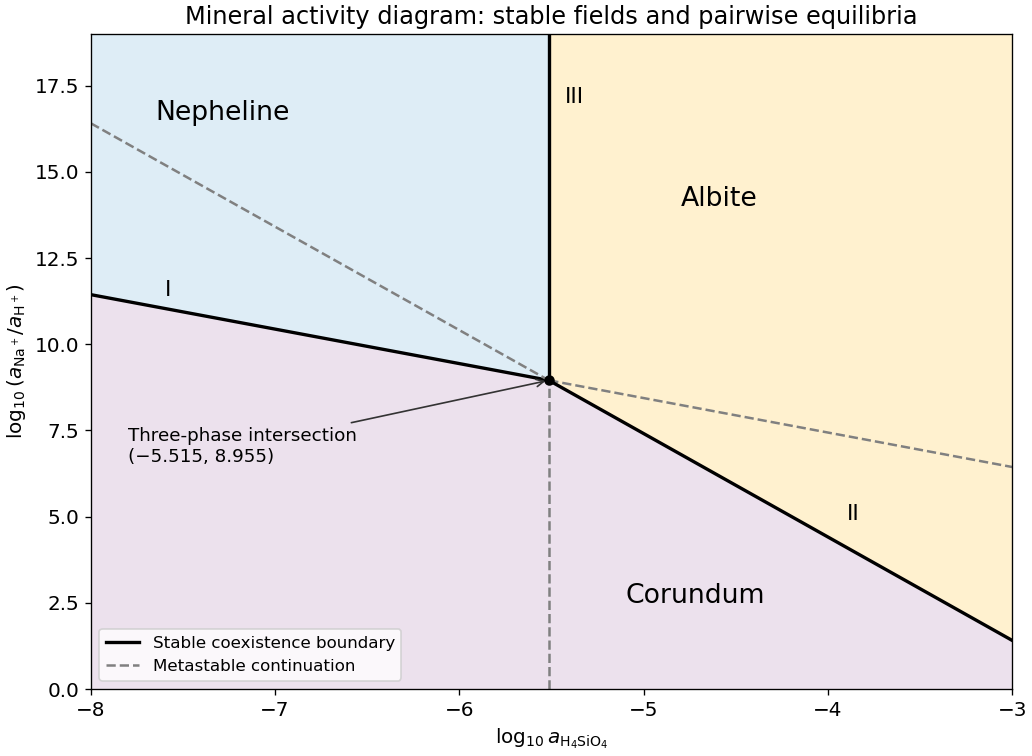

The stability boundary in a mineral activity diagram requires the two coexisting minerals to be stable against the third. For the forward dissolution directions of (I) and (II),A negative value favours corundum over the corresponding silicate mineral. For (III),so low silica activity favours nepheline over albite, and high silica activity favours albite. Combining these comparisons gives the stable portions:
The opposite extension of each line is metastable because the third mineral has lower thermodynamic potential there. All three minerals can coexist at the intersection in this fixed-temperature, fixed-pressure activity model.
The three stable fields are:Equalities give the stable coexistence boundaries described above. In particular, a point between the two descending line extensions is not automatically a fourth field: only the lower line borders the stable corundum region on each side of the intersection. The free-energy comparisons, rather than the appearance of the complete straight-line sketch, select the stable mineral.
Articles by others on the same topic
There are currently no matching articles.