Let be independent random variables, each choosing a label from . Put their probabilities in the matrix , where . Each row sums to one. All choices are distinct precisely when their ordered list is one of the permutations of the labels. These are mutually exclusive events, and independence makes the probability of one list equal to . Adding the list probabilities gives the permanent of a matrix:In particular, this permanent lies between zero and one.
For a two-person example,The distinct outcomes and have probabilities and . ThereforeThe colliding outcomes and have probabilities and , totaling . All four outcomes are shown below; their probabilities sum to one.
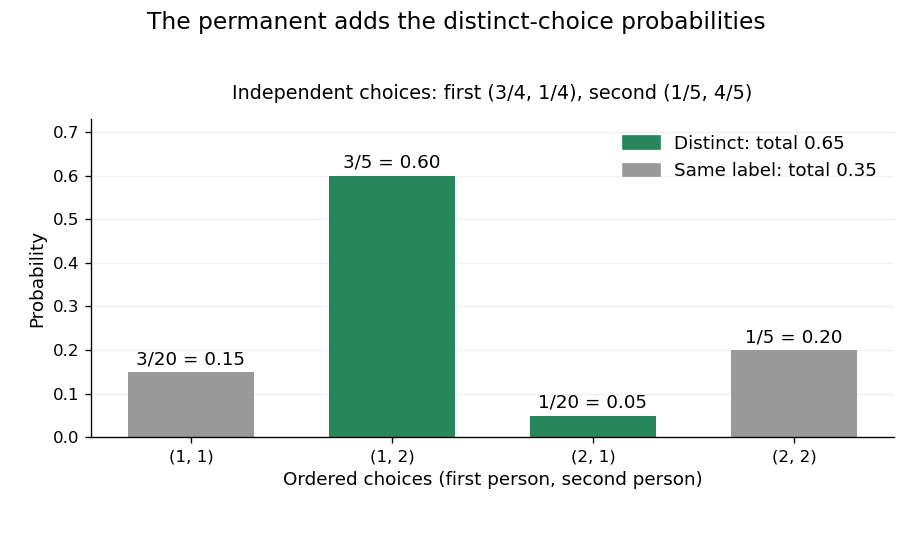
The permanent adds the probabilities of distinct choices: two successful outcomes have total probability 0.65
. Details. 
If every choice has the uniform distribution on a finite set of labels, then and the distinct-choice probability is . For three choices and three labels it is . This counts a subset of all ordered outcomes, not independent pairwise collision events. Independence of the original choices is essential: without it, the individual rows of do not determine the joint probabilities.
Articles by others on the same topic
There are currently no matching articles.