Put . The nonnegative integrand allows Tonelli's theorem to write the square as a double integral:In polar coordinates, , , and the Jacobian determinant supplies the area factor :Since , take the positive square root to get . The computation proves finiteness as well as the value. For an explicit limiting argument, first integrate over disks of radius ; their integrals are , which increase to as . [ref]
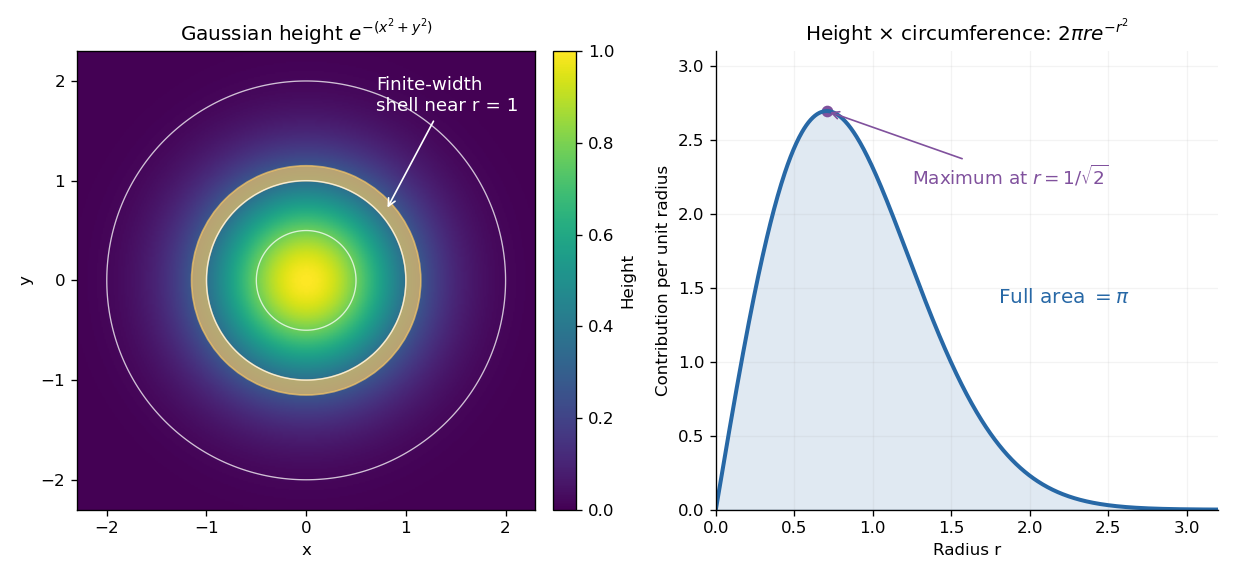

The geometric surprise is that radial shells get longer as increases, even while the Gaussian function gets smaller. Its central height is largest at zero, but the radial contribution vanishes there and peaks at . Differentiating gives , which changes sign at that radius. Keeping the Jacobian determinant is what makes the one-dimensional integral and the plane geometry agree.
Articles by others on the same topic
There are currently no matching articles.