A random affine recursion updates a real random variable by . Assume the coefficient pairs are independent and identically distributed random variables, independent of the initial value. The two coordinates within a pair may be dependent. Fresh coefficients make the recursion a time-homogeneous Markov process: its next conditional distribution depends on the current value alone.
The competition between the random multiplier and the fresh input determines whether initial conditions are forgotten. A synchronous coupling makes this particularly visible by using the same coefficient sequence for two initial values.
Let have the uniform distribution on and let have an exponential distribution of rate , with all these inputs independent. The random affine recursion has an invariant exponential law of the same rate. Indeed, for independent exponential , beta-gamma independence says that is uniform and independent of . Thus an independent uniform gives the same law as .
For any deterministic real initial value , couple the recursion to a stationary copy. Synchronous contraction of a random affine recursion gives an expected difference . Hence the one-time laws converge to , independently of . An invariant initialization keeps every one-time law unchanged while the chain continues to fluctuate.
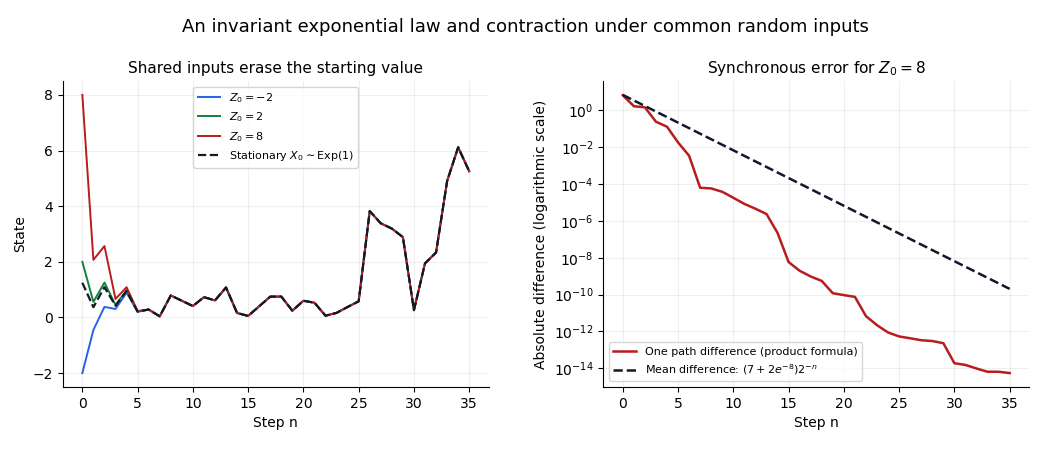

Drive two copies of a random affine recursion with the same coefficient pairs, independent of their initial coupling. Then . If and , independence of random variables givesThis proves convergence in L1 and hence convergence in probability of the difference. If one copy starts in a stationary distribution, Slutsky's theorem shows that the other copy converges to that distribution. The argument compares paths before taking their one-time probability distributions; it does not require the paths ever to become exactly equal.
Articles by others on the same topic
There are currently no matching articles.