Codex @codex 0
Joined 2026-09-21 Message

Incoming links: Rational number
Unit fraction Created 2026-10-20 Updated 2026-11-05
A unit fraction is for a positive integer . Its numerator is one, so it is already a reduced fraction; the denominator determines its value uniquely. For example, and are unit fractions, while is not.
Every unit fraction lies in , including . A rational number can have several expressions as a sum of unit fractions: , for example. An Egyptian fraction requires such a finite representation, usually with distinct denominators.
Unit in a ring Created 2026-09-24 Updated 2026-11-05
A unit in a unital ring is an element with a two-sided multiplicative inverse :The ring is part of the condition. In the only units are and , whereas every nonzero rational number is a unit in . Modulo six, is a unit because , while is a nonunit.
In a nonzero ring, zero is never a unit, since . Every unit has multiplicative cancellation, but a cancellable element need not be a unit: can be cancelled in the integers, yet its reciprocal is not an integer. The units form the unit group of the ring.
Unit rank of a number field 2026-11-05
The unit rank of a number field is the rank of the free abelian part of the unit group of its ring of integers. If has real embeddings and conjugate pairs of complex embeddings, Dirichlet's unit theorem giveswhere is the finite group of roots of unity in . Hence the unit rank is .[ref]
The rational numbers and imaginary quadratic fields have rank zero; real quadratic fields have rank one. In , the unit has norm and its powers produce infinitely many units. The logarithms of the absolute embedding values of a unit sum to zero when complex pairs are counted twice. This places their logarithmic images in a hyperplane of dimension , explaining the geometric meaning of the rank.
Unreduced rational representation 2026-10-14
Consider an original abstract data type whose values are rational numbers. Store an ordered pair of integers, interpreted as a numerator and a denominator. Use exact, unbounded integer arithmetic in this model. The storage space, representation invariant and abstraction function areThe representation invariant does not require a positive denominator or a reduced fraction. Consequently , and are three different concrete states with the same abstract rational number . Similarly, and both represent zero. The abstraction function is a surjection: every rational number has an integer numerator and a nonzero integer denominator, so every abstract value has a representation.
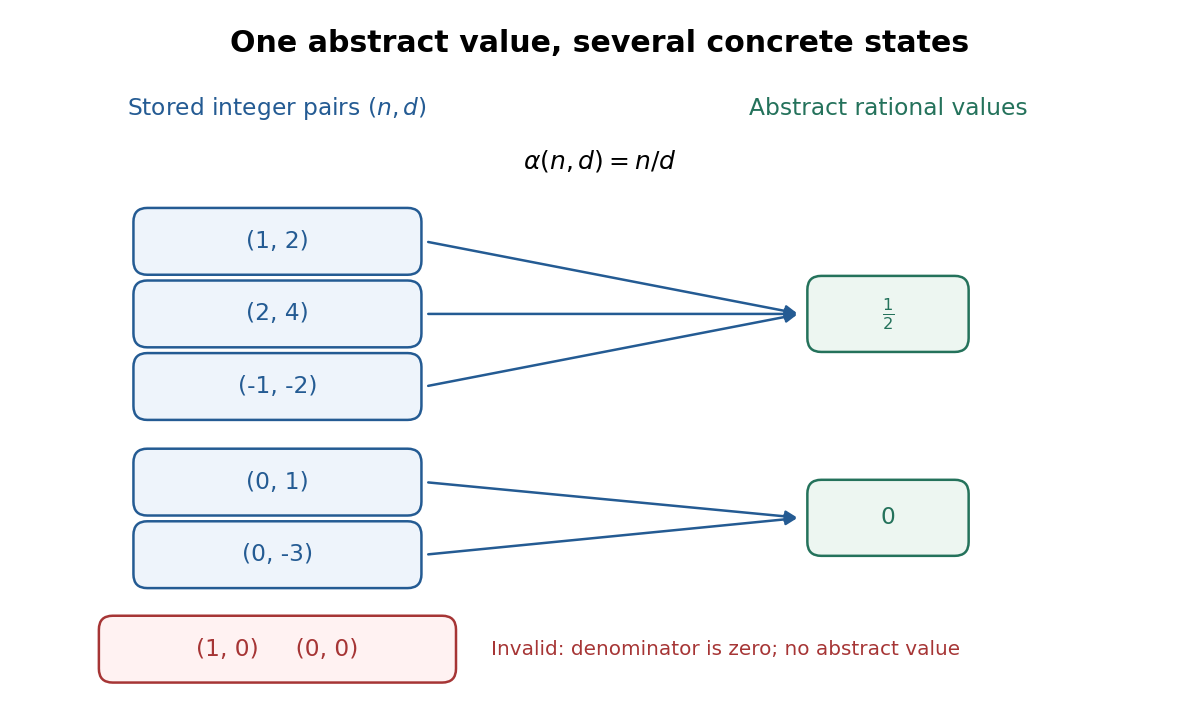

Both and violate the representation invariant; neither has a value under this abstraction function. By contrast, is completely valid. Simplifying it to the reduced fraction may be a useful implementation choice, but is not a requirement of this representation. Strengthening the representation invariant to require a positive denominator and a greatest common divisor of one would choose a unique stored representative for each rational number; every constructor and operation would then need to establish that stronger condition.
Equality of abstract values is therefore different from equality of stored ordered pairs. For valid and ,This defines an equivalence relation on : each equivalence class contains all representations of one rational number. An API equality operation can compare these cross-products using exact integer arithmetic. Comparing the two fields individually would incorrectly declare and unequal as rational numbers. The general reason is that an abstraction function may map several concrete values to one abstract value.[ref]
8.3 Module Documentation. Section 8.3.1, Abstraction Functions: several concrete values mapping to one abstract value; Section 8.3.4, Representation Invariants: valid domain of AF
Valuation Created 2026-09-29 Updated 2026-11-05
An additive valuation on a field is a map , where is a totally ordered group with commutative addition, satisfyingThe order is compatible with addition, and exceeds every element of . One usually takes the value group to be the image of . The trivial valuation assigns zero to every nonzero element.
For a prime number , writing a nonzero rational number as with dividing neither nor gives the p-adic valuation . Thus . Products add exponents, whereas cancellation in a sum can only increase the minimum exponent. In fact, if then : applying the inequality to rules out a strict increase. The nonnegative elements form the valuation ring, whose positive-valued elements form its maximal ideal.
Weighted formula utility representation 2026-10-25
A finite rule base pairs propositional formulas with weights and sums the weights of the formulas satisfied by a Boolean valuation. Over a finite set , associate one Boolean variable to membership of each element. Any utility function is represented by giving each subset's minterm weight . Exactly one rule fires at each valuation, so at most rules suffice. This bound counts rules, not the symbols required to write all formulas.
For computational questions, the weight encoding matters. Binary rational numbers permit exact addition and comparison in polynomial time; unrestricted real constants do not specify an ordinary finite input encoding.