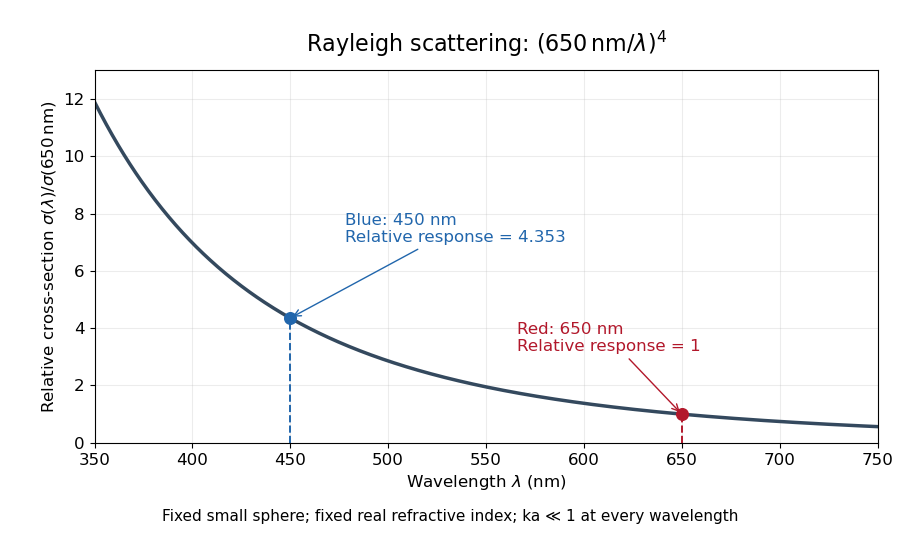
For a fixed sphere and fixed refractive index, both the Rayleigh scattering cross-section and scattering efficiency are proportional to . Halving wavelength multiplies either by , as long as the shorter wavelength still satisfies . If optical dispersion changes , the material factor changes too; the pure fourth-power comparison then needs correction.
For equal incident light intensities at blue wavelength and red wavelength , the same toy sphere givesBlue light therefore produces about times the scattered power. This compares the particle's response at two wavelengths; it does not assert that an actual sky has this ratio of observed blue and red light intensities.

Articles by others on the same topic
There are currently no matching articles.