Electromagnetic radiation is a propagating disturbance of the electric field and magnetic field that carries energy and momentum away from its source. It can be a sustained electromagnetic wave or a finite wave packet: periodic oscillation is not required. In vacuum the disturbance travels at the speed of light. A receiver responds to fields arriving now from an earlier source event, as expressed by retarded time. This is how electrical activity at one place can deliver energy and information elsewhere without a connecting wire.
Stored electromagnetic energy alone does not establish outgoing electromagnetic radiation. A stationary electric charge in electrostatics, or a steady localized electric current in magnetostatics, can store electromagnetic energy with zero Poynting vector. Static combinations can have circulating energy flux without net outward power. Near a changing source, reactive energy can return later. The near and far field distinction separates these contributions from outgoing radiation zone fields.[ref]
Chapter 27: Field Energy and Field Momentum. §27-5, Fig. 27-6: static fields with circulating energy flux
A single traveling vacuum plane electromagnetic wave obeying the Maxwell equations has . Its Poynting vector gives the energy density and flux of a plane electromagnetic wave:Here is wave intensity; and are vacuum permittivity and vacuum permeability. For a monochromatic wave with linear polarization and peak amplitude , squared cosine averages to . Pulses require the instantaneous Poynting vector; arbitrary incident-and-reflected superpositions need not obey this relation.[ref]
Chapter 27: Field Energy and Field Momentum. §27-5, Eqs. (27.16)–(27.18): traveling-wave energy flux
The electromagnetic momentum density is . Completely absorbing a unidirectional vacuum pulse of energy transfers momentum ; see radiation pressure on a perfectly absorbing surface. A calculated pulse transfers . Symmetric emission can lose energy without net recoil because opposite momenta cancel.[ref]
The direction of emission matters as much as its total power. For an oscillating electric dipole moment along , the angular distribution of electric dipole radiation is strongest across the axis and vanishes along it. Its origin is geometric: the electric dipole radiation field is the transverse projection of the second time derivative of the electric dipole moment, so its magnitude contains . Squaring this electric field to obtain wave intensity gives . The electric-dipole approximation for radiation requires a source much smaller than its wavelength and observation in the radiation zone. [ref]
Chapter 28: Electromagnetic Radiation. Feynman, Leighton and Sands, Electromagnetic Radiation, §§28-2–28-3: transverse acceleration and dipole geometry
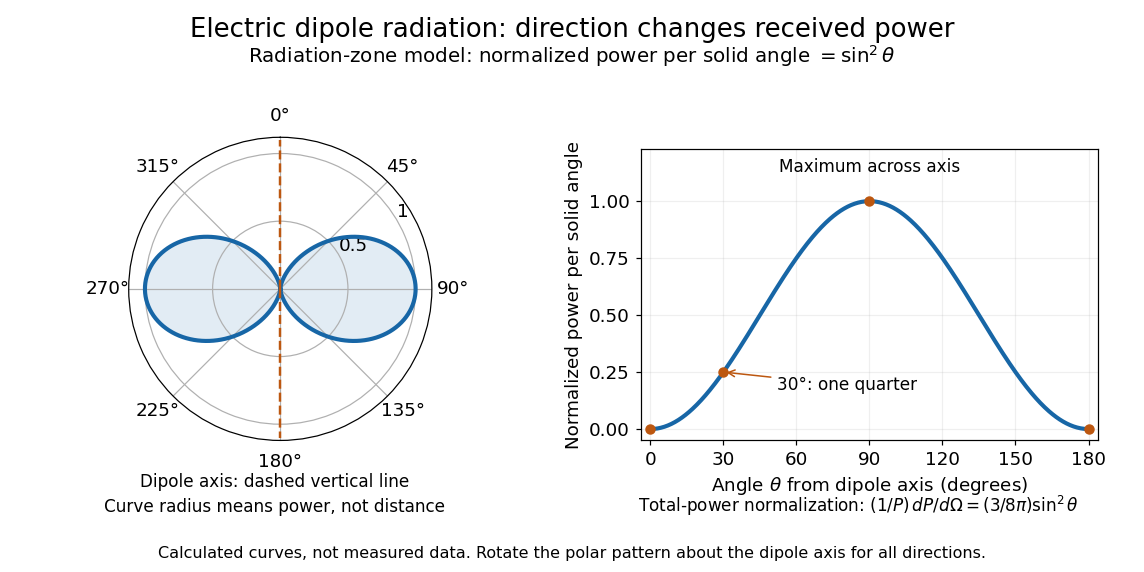
Normalized angular pattern of electric dipole radiation
. Calculated radiation zone model, not measured data. The polar curve's radial coordinate is normalized power per solid angle, , rather than physical distance or a field line. The angle is measured from the dipole axis. Rotating this meridional pattern about that axis gives the three-dimensional angular distribution. Details.For example, the power per solid angle at is one quarter of its equatorial value, while the electric field amplitude is one half. To normalize the angular distribution to total power, use spherical coordinates with :The integral follows by substituting , giving . This is a probability-like normalization over direction, with units of inverse steradian; it does not make the dipole an isotropic radiator. The same angular integral underlies the Larmor formula for nonrelativistic accelerated electric charge.
Detection requires the incident electromagnetic field to do something observable. An antenna develops an electrical response; a thermopile converts absorbed energy into a thermal and then electrical signal; a photodetector can respond through photon absorption. Hertz spark transmission and detection experiment makes this conversion visible as a tiny spark. Detector orientation, sensitivity, and surrounding reflections all matter: failure to see a signal does not prove that no electromagnetic radiation reached the receiver.
A radio wave is electromagnetic radiation in the radio portion of the frequency spectrum. In vacuum its frequency and wavelength obey the vacuum frequency-wavelength relation.
A monochromatic wave in vacuum has frequency and wavelength related by , where is the speed of light. During one oscillation period , a constant-wave phase surface travels one wavelength, so . Equivalently, the plane electromagnetic wave relation with angular frequency and wavenumber gives the same result.
As a calculated example, a vacuum radio wave with has using . Doubling frequency halves wavelength, independently of wave amplitude and wave intensity. The frequency spectrum of a pulse contains multiple frequencies; the relation applies to each vacuum component, rather than assigning one exact wavelength to the whole pulse. In a homogeneous medium replace by the appropriate phase velocity; the vacuum equation does not assert that all media have the same wavelength at a given frequency.
An outgoing radiation pulse carries a finite amount of electromagnetic energy through successively larger enclosing spheres. In vacuum, far from a localized source and without absorption or additional reflections, let be the emitted power. The retarded time at radius is . Define as the angular average of the radial Poynting vector over the sphere, not a cycle average:Here is the angularly averaged energy density in the leading radiation zone approximation. Multiplying by shell area removes geometric dilution: the energy per unit radial thickness translates outward without losing its shape. These angular averages do not assume that an actual electric dipole emits equally in all directions. Nor do they specify an exact spherically symmetric transverse solution of the Maxwell equations.
For an explicitly stipulated model, emitAfter emission ends, , the pulse lies between and , provided this shell is in the radiation zone. Its radial thickness remains . Substituting in the shell integral gives at every such time. The same substitution in the time integral of at any enclosing sphere gives that same total crossing energy. This is conservation of energy in two different views.
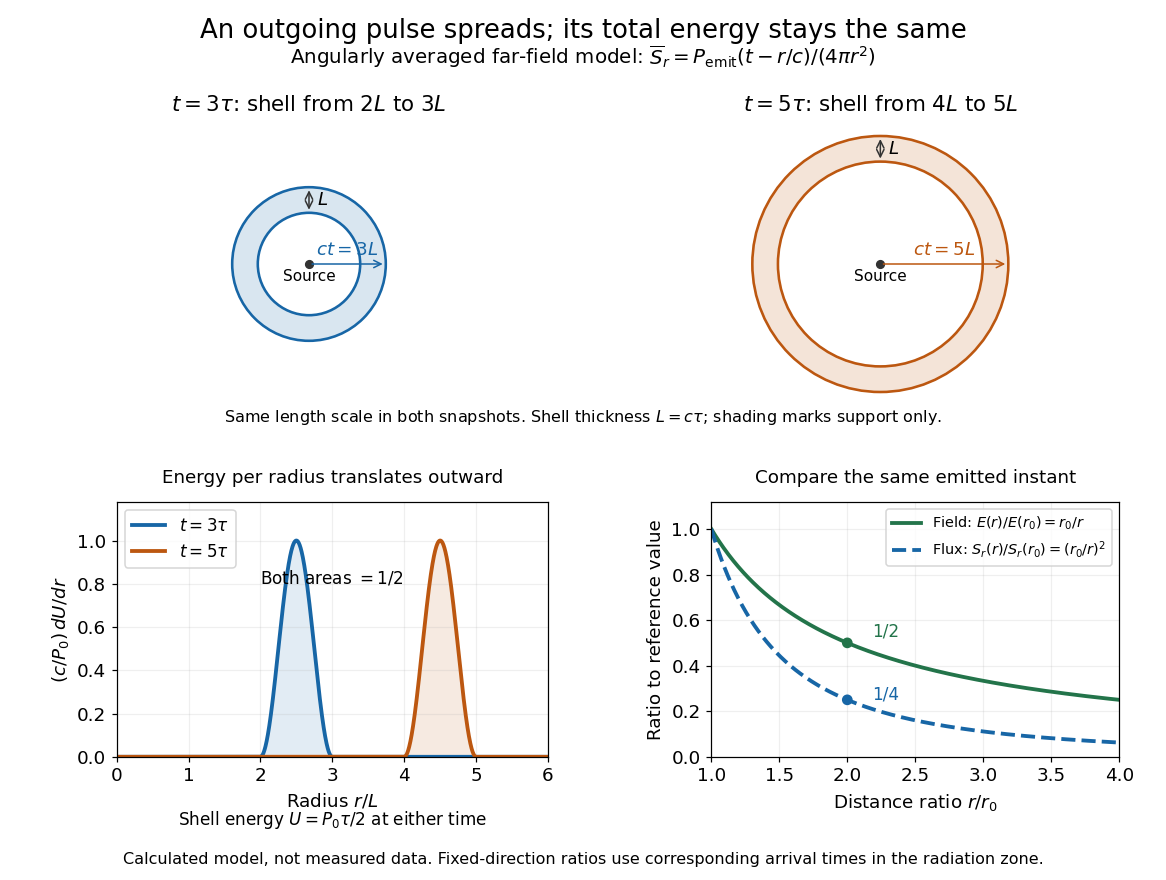
Along any fixed direction with nonzero outgoing power, compare the same part of the pulse at two radii, hence at different arrival times. The leading electric field amplitude falls as , while its squared wave intensity falls as . At the field is one half and the energy flux one quarter; the signal arrives later. A small fixed area receiver therefore intercepts less energy at greater distance even though every enclosing sphere receives the same total pulse energy. The inverse-square law expresses spreading over area, rather than destruction of energy. Close to the source, the neglected near and far field terms prevent extrapolating these formulas down to .
In his 1888 reflection experiments, Heinrich Hertz excited a straight conductor with a central spark gap driven by an induction coil. The receiver was a wire circle of radius with an adjustable small spark gap; tiny sparks were observed in darkness. There was no connecting transmission wire. [ref]
Electric Waves: Being Researches on the Propagation of Electric Action with Finite Velocity through Space by Heinrich Hertz. Hertz, Electric Waves (1893 translation), VII, pp. 108–109; VIII, pp. 125–127
He removed hanging metal fixtures, installed a by zinc reflecting sheet, and moved and rotated the receiver. Spark strength alternated with position and gap orientation, supporting specular reflection and wave interference. He checked observations from farther away because the observer's body perturbed the response. Changing oscillator dimensions changed the spatial pattern. [ref]
Electric Waves: Being Researches on the Propagation of Electric Action with Finite Velocity through Space by Heinrich Hertz. Hertz, Electric Waves, VIII, pp. 125–127 and 135–136: preparations and controls
These tests supported propagating electromagnetic waves, rather than mere detection of nearby induction. They did not establish unlimited reception distance. His wire-versus-air wave interference experiment addressed finite velocity; he later judged its quantitative velocity comparison doubtful because of room effects. [ref]
Electric Waves: Being Researches on the Propagation of Electric Action with Finite Velocity through Space by Heinrich Hertz. Hertz, Electric Waves, VII, pp. 107–108; Introduction, pp. 9–12: retrospective limitations
The physical inference combines transmission with a spatially structured response to a reflected disturbance. In an ideal monochromatic incident-and-reflected model, standing wave nodes are separated by ; combining a reliable wavelength with independently known frequency gives phase velocity . A spark is a threshold event, however: its presence or length is not a calibrated wave intensity or a direct arrival-time measurement. The actual loop also responds to its orientation and finite size, so the simple standing-wave model is an explanation of the test's logic, rather than a reconstruction of Hertz's measured points. Poynting theorem explains how source energy can reach and drive the receiver's discharge.
X-rays are high-frequency electromagnetic radiation, conventionally with wavelengths of roughly to . The precise wavelength convention varies with context. Hot accreting gas and energetic electronic processes can emit X-rays, whose short wavelengths make them useful probes of compact objects and atomic structure.
The nonrelativistic radiated power of an accelerated point charge is in SI units. Integrating its dipole radiation pattern over solid angle gives this result; relativistic motion requires the Lienard generalization.
The relativistic generalization of the Larmor formula uses the invariant proper-acceleration magnitude: in signature . In coordinate time this is the displayed expression. For perpendicular magnetic circular motion, , giving . The statement concerns total instantaneous emitted power; directional radiation flux is not itself invariant.
The electromagnetic scattering solution for a sphere describes the transition between Rayleigh scattering and geometrical optics. Grain-size-dependent efficiencies can produce structure in the radiation-pressure coefficient.
Bremsstrahlung is electromagnetic radiation emitted when a charged particle accelerates during interaction with another charged particle or field. The microscopic process creates a photon, while its inverse absorbs one. Thus it contributes to a photon-number collision source in the photon number current, unlike ordinary Compton scattering. Thermal bremsstrahlung averages this emission over a thermal distribution of charged particles.
Thermal radiation is electromagnetic radiation emitted by matter because of its temperature. Matter in thermal equilibrium emits a spectrum governed by its absorptivity, approaching the Planck law for a blackbody.
For a sphere of radius , the scattering efficiency is its effective scattering area divided by the projected geometric cross-section . It is a dimensionless quantity. For Rayleigh scattering by a small sphere with relative refractive index and incident wavenumber ,At fixed wavelength and fixed refractive index, the Rayleigh scattering cross-section scales as , whereas the scattering efficiency scales as . Doubling radius multiplies the former by and the latter by . An efficiency here is an effective scattering area relative to a reference area, rather than a fraction of all light in an arbitrary beam.
For a worked toy example, take , , and . Then and . Substitution gives Rayleigh scattering cross-section and scattering efficiency . At incident light intensity , the scattered power is approximately . These are leading small-particle estimates, not a measured air-molecule cross-section.
Rayleigh scattering is elastic scattering of electromagnetic radiation by particles much smaller than the incident wavelength. In the stationary particle approximation, the scattered electromagnetic radiation keeps the incident frequency: its direction changes, rather than its color. The incident electric field induces an oscillating electric dipole moment, which produces electric dipole radiation. This is a useful example of how a microscopic response can explain a familiar large-scale sight, why the sky is blue. [ref]
https://farside.ph.utexas.edu/teaching/jk1/lectures/node108.html. Richard Fitzpatrick, Rayleigh Scattering: bound-charge response and wavelength dependence
.The smallness condition for Rayleigh scattering by a small sphere of radius is , where the wavenumber is and is the surrounding medium's wavelength. For ordinary materials with modest refractive index, the incident electric field then varies little across the particle, making the electric-dipole approximation for radiation useful. For very large refractive index, also check the internal size before applying the simple electric dipole model. Once these conditions fail, use Mie scattering for a sphere instead of extrapolating the Rayleigh scattering wavelength dependence.
Historically, the 1871 paper [ref]
https://en.wikisource.org/wiki/Scientific_Papers/Volume_1/On_the_Light_from_the_Sky,_Its_Polarization_and_Colour. Rayleigh, On the Light from the Sky, Its Polarization and Colour: original-paper transcription
connected the color and polarization of an electromagnetic wave of scattered skylight with particles smaller than the wavelength. Its dimensional analysis anticipates scattered light intensity proportional to particle volume squared and to . The original mechanical picture is historical; the modern explanation uses induced electric dipole radiation.Consider a fixed, homogeneous, nonabsorbing, nonmagnetic sphere of radius in vacuum. Let be its relative refractive index, a fixed real number; in vacuum this equals the sphere's refractive index. Treat as independent of wavelength over the range being compared, neglecting optical dispersion. Air can be approximated by vacuum here because its refractive index is close to one. These assumptions describe a toy particle, rather than a literal model of an individual air molecule.
The Rayleigh scattering cross-section is an effective area: the total scattered power is , where is the incident light intensity. For its leading approximation isThe units are area, since has units . This Rayleigh scattering cross-section measures scattering, not conversion of the incident electromagnetic radiation into heat. The definition follows [ref]
https://farside.ph.utexas.edu/teaching/jk1/lectures/node107.html. Fitzpatrick, Thomson Scattering: total and differential scattering cross-sections
.To see the mechanism, the nearly uniform applied electric field produces an electric dipole moment with peak magnitudewhere is the incident electric field peak wave amplitude and is vacuum permittivity. This is the sphere's response in electrostatics, with its permittivity divided by vacuum permittivity equal to under the nonmagnetic assumption. [ref]
https://farside.ph.utexas.edu/teaching/jk1/lectures/node42.html. Fitzpatrick, Boundary Value Problems with Dielectrics, equation 554: induced sphere dipole
. The averaged electric dipole radiation power is , with angular frequency and speed of light . Dividing by gives the displayed Rayleigh scattering cross-section. Thus doubling radius multiplies the electric dipole moment by eight and the scattered power by , provided the larger sphere still satisfies . [ref]https://farside.ph.utexas.edu/teaching/em/lectures/node95.html. Fitzpatrick, Electric dipole radiation: angular power and its integral
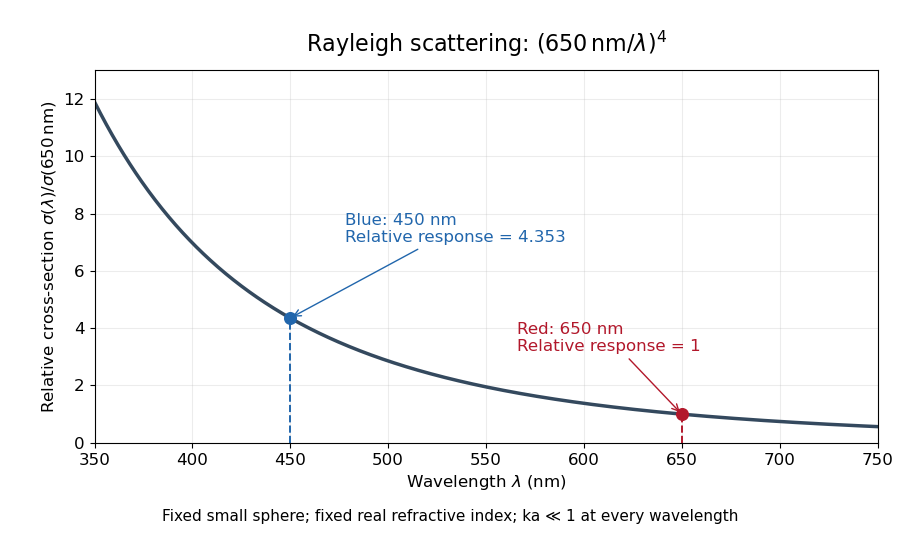
.For a fixed sphere and fixed refractive index, both the Rayleigh scattering cross-section and scattering efficiency are proportional to . Halving wavelength multiplies either by , as long as the shorter wavelength still satisfies . If optical dispersion changes , the material factor changes too; the pure fourth-power comparison then needs correction.
For equal incident light intensities at blue wavelength and red wavelength , the same toy sphere givesBlue light therefore produces about times the scattered power. This compares the particle's response at two wavelengths; it does not assert that an actual sky has this ratio of observed blue and red light intensities.
For incident unpolarized light and the isotropic electric dipole response of Rayleigh scattering by a small sphere, let be the angle between the incident beam's propagation direction and the outgoing direction. The differential scattering cross-section and its relative angular pattern arewhere is an element of solid angle. Averaging over the two transverse directions of incident polarization of an electromagnetic wave gives this pattern. Forward scattering at and backward scattering at are equally strong: . Sideways scattering at is weakest, but nonzero: . [ref]
https://farside.ph.utexas.edu/teaching/jk1/lectures/node107.html. Fitzpatrick, Thomson Scattering, equations 1283–1287: averaging the dipole angular pattern
.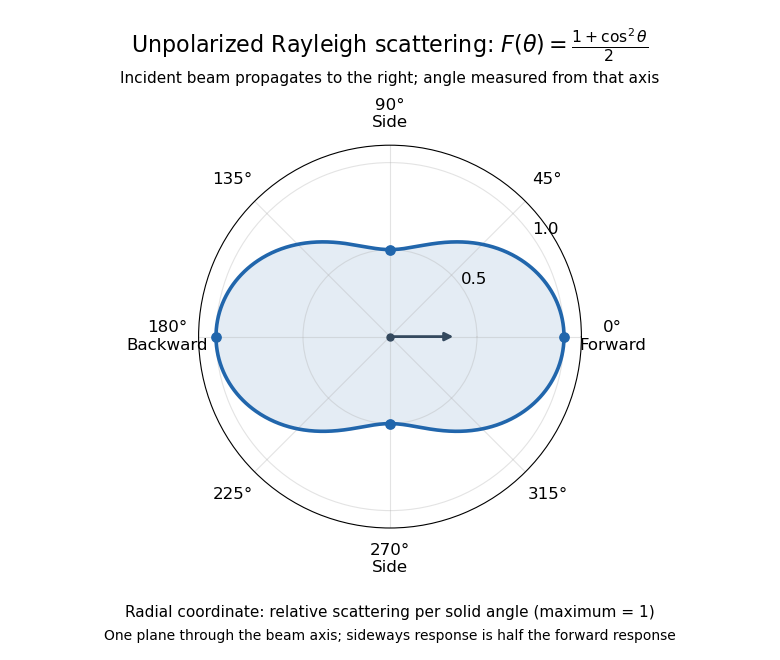
Rayleigh scattering angular pattern for incident unpolarized light, measured from the incident beam
. The plotted radial coordinate is , a relative differential scattering cross-section, rather than the distance travelled by light. The incident propagation axis points right: is forward, backward, and sideways. Rotating this plane about the incident axis gives the three-dimensional pattern. Details.The normalization is consistent becauseThus integrating gives the total Rayleigh scattering cross-section . The plotted has maximum one; it is not itself normalized to unit solid angle integral.
For a single electric dipole driven by incident linear polarization, the angular distribution of electric dipole radiation instead has a factor, where is measured from the electric dipole moment direction, parallel to the incident electric field. That direction is perpendicular to the incident beam. Confusing with the beam angle would incorrectly predict zero forward scattering. Averaging the dipole patterns over incident unpolarized light yields the displayed .
In a clear terrestrial atmosphere, Rayleigh scattering by air molecules redirects some sunlight toward an observer looking away from the Sun. Shorter wavelengths are preferentially scattered, enriching the scattered light in blue compared with the incoming sunlight. Along the longer atmospheric path to the low Sun, more short-wavelength light is removed from the direct beam, helping produce red sunsets. [ref].
Violet light has an even shorter wavelength than blue light, so the Rayleigh scattering wavelength dependence alone cannot predict the perceived sky color. The incoming solar optical spectrum and the eye's differing response to wavelengths both matter; human vision is less sensitive to violet than to blue. [ref]
https://www.weather.gov/fgz/SkyBlue. NOAA National Weather Service, Why Is The Sky Blue?: solar spectrum and visual response
. Multiple scattering and other atmospheric particles also affect the observed sky. Cloud droplets are generally too large for this simple Rayleigh scattering model: Mie scattering describes spherical droplets, with much weaker visible wavelength selectivity, while repeated scattering helps make clouds appear white. [ref]https://www.giss.nasa.gov/edu/icp/research/ppa/1997/reyes/. NASA GISS, Aerosols in the Atmosphere: particle size, Mie scattering and white clouds
. Articles by others on the same topic

Electromagnetic radiation is a form of energy that travels through space in the form of waves. It is produced by the movement of electrically charged particles, which create oscillating electric and magnetic fields. These waves can travel through a vacuum as well as through various media. Electromagnetic radiation is characterized by its wavelength or frequency, which determines its type and energy. The electromagnetic spectrum encompasses a wide range of wavelengths, from very short gamma rays to long radio waves.



