Whether increasing electrical resistance increases Joule heating depends on what the supply holds fixed. Consider separate ideal resistor experiments with and , each maintained at its specified temperature. At fixed electric current , doubling changes the required electric potential difference from to and doubles power from to . At fixed electric potential difference , doubling halves electric current from to and halves power from to . These are stipulated model values, not measured data.
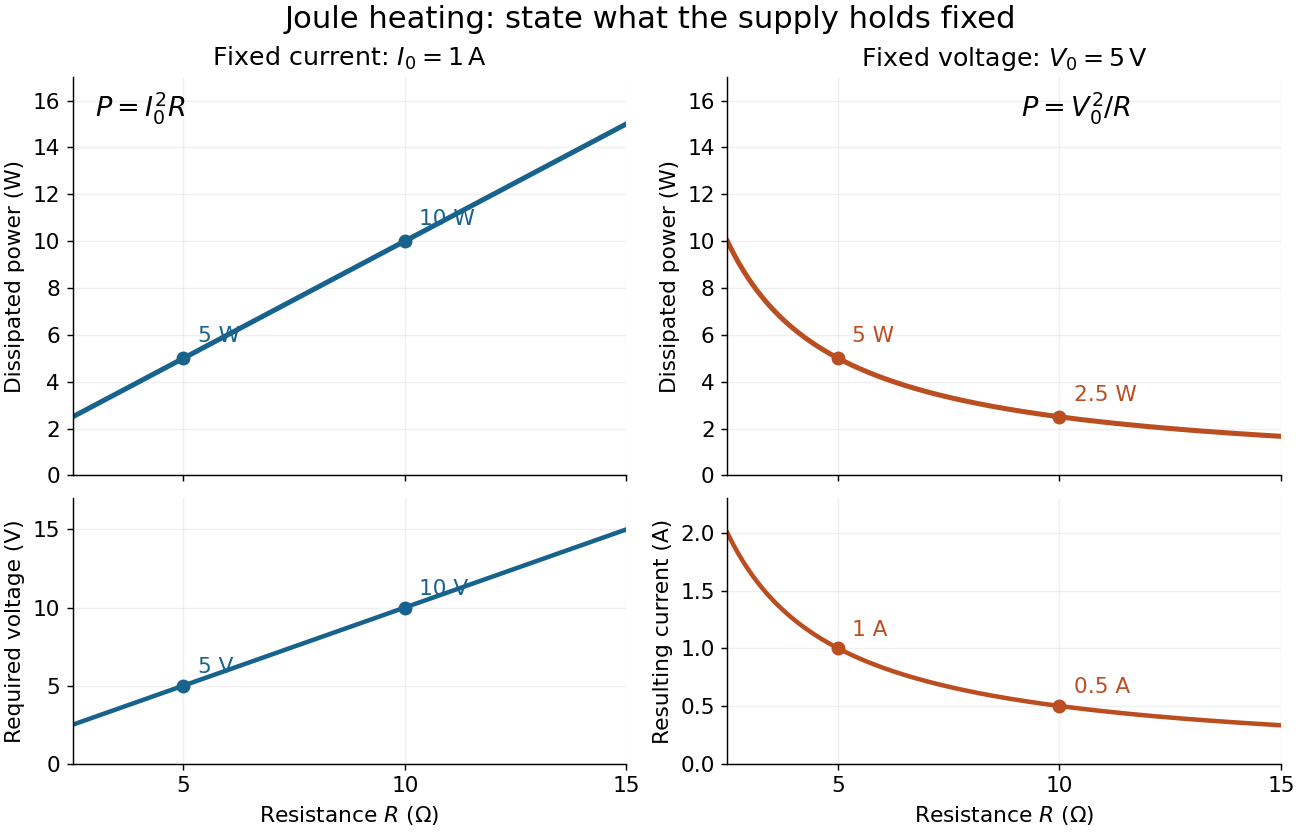
Increasing electrical resistance has opposite effects on Joule heating under fixed electric current and fixed electric potential difference
. Original calculated comparisons, with on the left and on the right. The marked and cases are separate ideal experiments. Each lower panel shows the companion quantity that changes when the supply holds the other quantity fixed. Details.
The comparison also predicts feedback when a particular resistor's electrical resistance rises with temperature: a supply maintaining electric current increases its heating power, whereas one maintaining terminal electric potential difference reduces it. Predicting the actual temperature still needs the material response and its heat transfer to the surroundings; a nominal supply setting does not establish which drive is actually constant at the resistor.
Articles by others on the same topic
There are currently no matching articles.