Ring-methyl counting in tocopherol nomenclature tracks which methyl groups belong to the named parent and which are additional aromatic substitutions. The tocol parent already has a position-2 methyl group. The familiar tocopherol names specify further methyl groups at positions 5, 7 and 8; counting the parent methyl again gives the wrong composition.[ref]
For the specifically named saturated parent, let be the number of additional aromatic methyl groups. Each substitution replaces one hydrogen by , adding net . Starting with therefore givesThe familiar forms follow directly: delta-tocopherol has and formula ; beta-tocopherol and gamma-tocopherol have and ; alpha-tocopherol has and . These counts concern the saturated tocol parent, not every member of a broader ontology category.
The positions distinguish equal-count cases. Beta is 5,8-dimethyltocol, whereas gamma is 7,8-dimethyltocol.[ref]
Nomenclature of Tocopherols and Related Compounds by IUPAC-IUB Joint Commission on Biochemical Nomenclature. Recommendations 3–4
Their molecular formulas agree, but their connectivity differs. They are constitutional isomers; this distinction is separate from the stereochemical configurations of the side chain.An original combinatorial check is instructive. Choosing two occupied positions among 5, 7 and 8 allows three sets: , and . The familiar beta and gamma names identify two particular sets, rather than defining every theoretically possible dimethyl substitution. A substituent count alone cannot recover the attachment pattern.
Aromatic-hydrogen counting in tocopherol identification offers a complementary prediction. Within those three aromatic positions, the expected number of remaining hydrogens is : zero for alpha, one for beta or gamma and two for delta. This is an atom count, not a claim that a particular nuclear magnetic resonance spectrum must contain that many resolved peaks; chemical shifts, coupling and overlap also matter.
An identification experiment should therefore combine the named parent, methyl positions and stereochemical specification with the analytical observations. A mass consistent with the beta/gamma formula does not uniquely identify either form. Nor does correct structural nomenclature establish equal biological activity: chemical identity and relative biological potency answer different questions.
Aromatic-hydrogen counting in tocopherol identification uses unoccupied ring positions to constrain the identity or composition of a tocopherol sample. In the tocol framework, positions 5, 7 and 8 can carry the additional methyl substituents. The familiar alpha-tocopherol, beta-tocopherol, gamma-tocopherol and delta-tocopherol substitution patterns leave respectively zero, one, one and two hydrogens at those positions.[ref]
Let count those aromatic methyl substituents. The count concerns aromatic carbon-bound hydrogens. It excludes the hydroxyl hydrogen and hydrogens on the saturated ring and side chain. A missing aromatic hydrogen is not a missing hydrogen atom from the entire molecular formula: replacing ring H by adds two hydrogens overall.
A proton nuclear magnetic resonance experiment can compare an integrated aromatic region with a calibrated amount standard. For a sufficiently resolved, quantitatively acquired signal, integrated response tracks the number of contributing protons; the count does not predict the number of separately resolved peaks. Chemical shifts, splitting, spectral overlap and acquisition conditions remain part of identification.
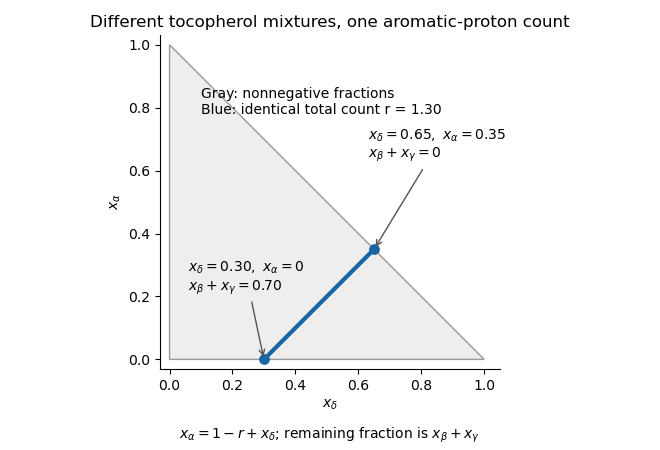
An original mixture example illustrates mixture ambiguity in aromatic-proton counts. Suppose the calibrated aromatic response corresponds to hydrogens per tocopherol molecule. If the sample contains only beta-tocopherol and delta-tocopherol, and is the mole fraction of delta-tocopherol, then , giving . The same count occurs in a gamma-tocopherol/delta-tocopherol mixture. If the allowed components are instead alpha-tocopherol and delta-tocopherol, gives . Counting alone does not identify an unrestricted mixture.
In particular, beta-tocopherol and gamma-tocopherol are constitutional isomers with one remaining aromatic hydrogen each, at different ring positions. Their count agrees while their structural assignment differs. A useful experiment therefore combines the aromatic integral with resolved chemical shifts or other structural evidence and specifies which candidate components were allowed. These are predictions from the named structures, not measured spectra or universal instrumental settings.
Mixture ambiguity in aromatic-proton counts is the inability of a total aromatic proton nuclear magnetic resonance integral to identify all components of a tocopherol mixture. The named substitution patterns leave zero, one, one and two aromatic hydrogens in alpha-tocopherol, beta-tocopherol, gamma-tocopherol and delta-tocopherol, respectively.[ref]
Let their mole fractions be . Under an ideal quantitative response model, an aromatic integral normalized per tocopherol molecule givesThe normalization requires an independently established molecular amount or an equivalent valid calibration. A raw integral alone is not automatically a hydrogen count per molecule. This model also assumes that the selected response includes the relevant aromatic protons with compatible quantitative acquisition conditions.
There are four unknown fractions but only two displayed linear constraints. In particular, exchanging any allowed amount of beta-tocopherol for gamma-tocopherol preserves both constraints: their equal counts cannot distinguish these constitutional isomers.
An original feasible-range calculation makes the remaining ambiguity explicit. Setting givesNonnegative fractions implyFor , any between and can fit. The first endpoint has no alpha-tocopherol and a combined beta/gamma fraction of ; the second has alpha fraction and no beta/gamma component. Intermediate values and beta/gamma exchanges produce further mixtures with the same count.
Resolving additional chemical shifts or using an independently calibrated chromatography measurement can provide new component-sensitive evidence. Repeating the same total integral more precisely only narrows the uncertainty around ; it does not add the missing independent composition constraints. The calculation expresses structural possibilities from the named molecules, not an assignment of measured peak positions.

Articles by others on the same topic
There are currently no matching articles.